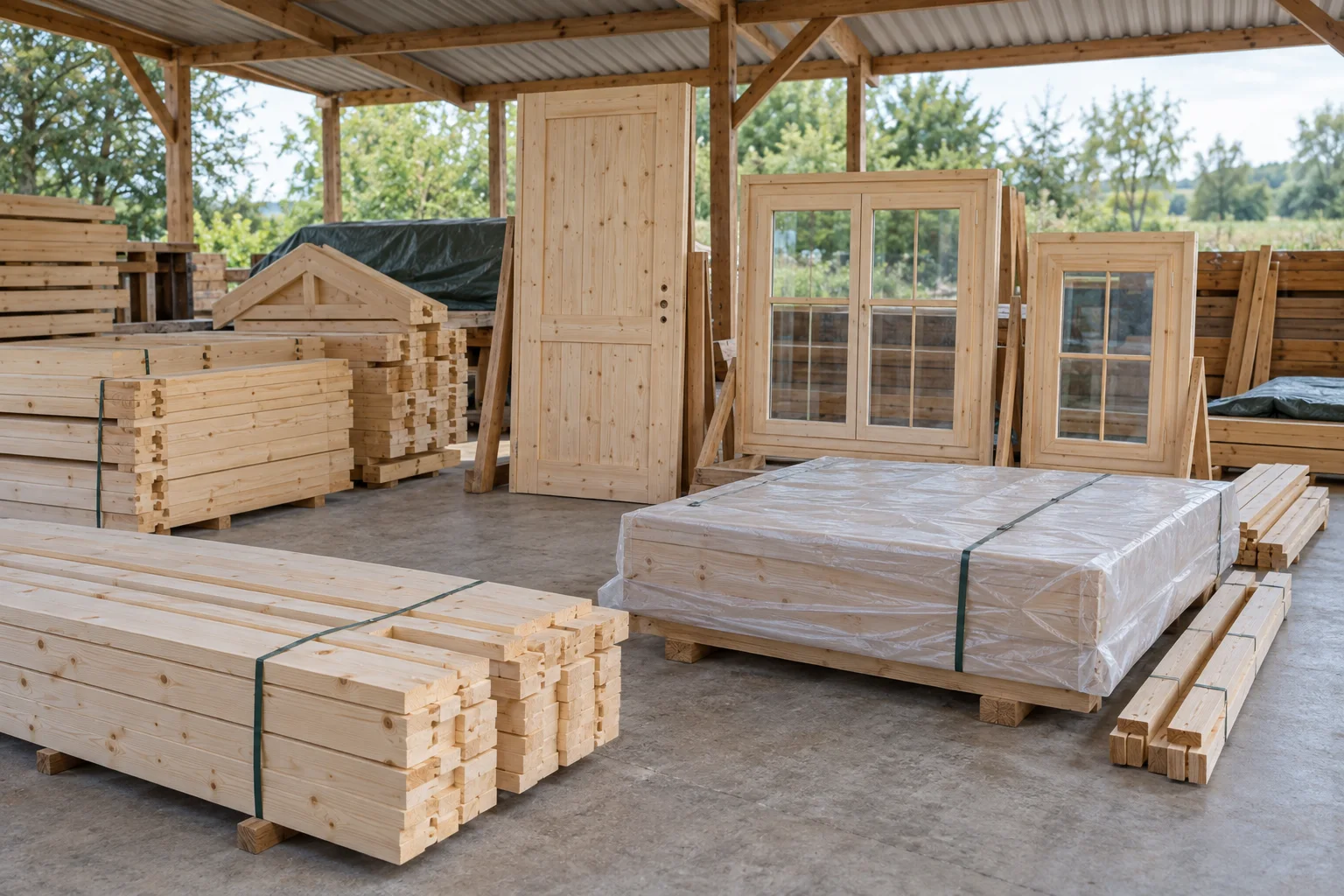
Wooden cabin kits are component packages, not a universal promise of a finished building. Before ordering, reconcile the quoted model with a revision-controlled parts list, drawings and exclusions. Confirm quantities, preparation level, roof covering, doors, windows, fixings and locally supplied work. Treat every upgrade as a change to the whole package, not just one line on the quotation.
Introduction: buy an identifiable package
A cabin photograph shows the intended result. It rarely tells you whether the roof covering, insulated floor, window hardware or external coating is inside the package. For an importer, distributor or resort buyer, these details determine which local trades must be booked and whether quotations can be compared fairly.
The useful question is not whether the supplier calls the offer complete. It is complete for which agreed stage: structural shell, enclosed building, insulated enclosure or fitted accommodation? Buying a cabin kit becomes easier when those stages are separated before commercial terms are negotiated.
This guide provides a component audit, not a CabinWild inventory or an installation manual. No particular model specification, factory testing record or customer delivery has been independently verified here. Use the worksheet to ask precise questions, then have destination-specific design and compliance requirements reviewed by the appropriate local professionals.
Further reading: Start with the broader supplier evaluation checklist.
1. What is a cabin kit, and where does its scope end?
A cabin kit is a coordinated collection of building components supplied for assembly according to defined drawings. Depending on the product, components might be pre-cut logs, framing members, panels, joinery or combinations of these. The label alone does not establish insulation, services, foundations, assembly labour or approval status.
A log cabin assembly kit may rely on identified wall pieces and system-specific junctions. A framed package may separate its structural frame from sheathing, membranes and cladding. Neither description tells you whether the finished enclosure is suitable for your intended occupancy. First establish the construction system; then inspect the component schedule.
As a concrete example of variable scope, Satus Baltic distinguishes roof boards from optional roof covering in its published kit description and lists several buyer-arranged tasks separately. That is evidence of one supplier's offer, not a standard that CabinWild or another manufacturer automatically follows. Ask for the same clarity in your own quotation.
Further reading: Satus Baltic: its stated kit inclusions and exclusions; Understand log and timber-frame systems.
2. Match three documents before comparing prices
Request a quotation, drawing set and bill of materials that refer to the same model and revision. The quotation establishes commercial scope. Drawings show arrangement and interfaces. The bill of materials identifies physical parts. A mismatch between them is an unresolved question, even when each document looks professionally prepared.
For example, a quotation may show a wider entrance while the attached elevations retain the original door. The packing list could still contain the original header and trim. Do not let a revised illustration stand in for a coordinated change. Record the approved opening and require confirmation of all affected components before production release.
Give every decision a traceable identity
Use model code, revision date and document reference consistently. Record which version supersedes the previous one and who accepted the change. A distributor ordering several identical cabins should also distinguish the standard package from destination-specific variations, so a local upgrade does not accidentally become the assumed specification for every unit.
Resolve conflicting descriptions
Ask the supplier to reconcile contradictions rather than choosing whichever document appears most favourable. Agree a written order-of-precedence process in the purchase documentation with suitable commercial advice. Retain the resolved schedule with the order, not only in a salesperson's message thread.
3. Build a component-level inclusion worksheet
Use explicit statuses: included, optional, buyer supplied, installer supplied and unresolved. An empty cell should never mean included. Each line also needs a part reference, unit, quantity, finish or material description, and the party responsible for installation. The worksheet below is a starting point, not a standard CabinWild package.
Keep small interfaces visible. A window may be included while external flashing, sealing materials, trims or installation labour are not. Similarly, a roof board is not a waterproof roof covering. The purpose of this exercise is to locate the boundaries between packages before those boundaries become work-site disputes.
| Package line | Evidence to request | Boundary to resolve |
|---|---|---|
| Base members | Dimensions and part schedule | Building foundation versus supplied timber supports |
| Walls and structure | Identified members and drawings | Factory cutting versus local preparation |
| Floor assembly | Layer-by-layer schedule | Finish, insulation and local moisture control |
| Roof assembly | Deck, covering and accessory list | Weatherproofing versus structural boards |
| Doors and windows | Sizes, handing and hardware | Glazing, trims, seals and fitting labour |
| Connections | Fixing schedule linked to drawings | Supplied connectors versus site-specific anchors |
| Services and finishes | Explicit inclusions and exclusions | Local trades, approvals and commissioning |
4. Check quantities, units and usable coverage
A useful materials list describes what can actually be installed. Pieces, linear metres, square metres and packs are different units. Roof and cladding coverage can differ from the gross dimensions of loose pieces. Ask the supplier to explain the quantity basis and whether cuts, laps or agreed spares are already included.
Consider a hypothetical order containing four identical cabins. If each approved drawing calls for two windows, the planned total is eight window assemblies. That arithmetic does not confirm eight sets of handles, seals or trims; those items need their own scope confirmation. The example illustrates reconciliation, not any CabinWild configuration.
Distinguish spare parts from construction allowance. An extra full-length board may be a replacement spare, whereas an allowance could be consumed during normal cutting. Request a separate spare-parts line and agree whether it must remain unused at handover. Do not use a universal waste percentage without the actual layout and cutting plan.

5. Separate factory preparation from site work
Ask what pre-cut means for each component group. Length cutting, drilling, profiling, treatment, coating and pre-assembly are different operations. A package can contain accurately prepared walls while requiring local adjustment of finishes. Request a list of operations left to the installer and the tools or specialist competence those operations require.
Installation preparation should include the approved foundation interface, storage conditions, access, lifting arrangements and an assembly sequence. Assign responsibility for supplying temporary protection and preventing damage while the enclosure remains incomplete. This is especially important when separate contractors install the structure and roof covering.
For timber condition and dimensional behaviour, the USDA Wood Handbook provides technical background. Its discussion of wood and moisture explains why delivery condition and service environment matter; it does not establish a single acceptable moisture value for every kit. Request the supplier's material-specific acceptance criteria and their measurement basis.
Further reading: USDA: Wood Handbook; Coordinate the cabin base and installation.
Turn these questions into a project brief
Send your destination, intended use, preferred layout and locally supplied items. Ask CabinWild to identify proposed inclusions, options and unresolved responsibilities in writing.
6. Control the dependencies in custom cabin kits
Custom cabin kits should be assessed as coordinated revisions, not a menu of unrelated upgrades. Moving a window can affect the wall layout, structure, trims and cladding quantities. A different roof finish can affect the supporting assembly and accessories. Changes to wet rooms can introduce service penetrations that were absent from the original drawing.
Give each proposed change a simple record: customer requirement, affected drawings, affected components, local review needed, cost implication and approval status. Include the person authorised to release it. This prevents an attractive rendering from becoming the only instruction used by the supplier, installer and buyer.
A useful hypothetical application is a small hospitality operator requesting a wider bathroom door. The objective may involve accessibility, but a wider door alone cannot establish compliance. The layout, circulation, thresholds and local requirements still need review. Ask for a coordinated proposal rather than assuming a single substituted component solves the whole requirement.
Freeze the approved scope before packing and preserve a route for later changes. If a substitution is proposed, compare its function, dimensions, documentation and interfaces; matching colour or appearance is not enough. Record acceptance before dispatch, especially where replacement sourcing at the destination may be difficult.
Further reading: Specify bathroom and kitchen boundaries.
7. Decide which assembly tasks your team can own
A search such as 'cabin kits diy' often means the buyer wants a predictable assembly project, not an unfinished materials bundle. Evaluate that intention realistically. Drawings should explain component identification and sequence, while the supplier should identify work requiring specialist contractors or destination-specific design. Self-assembly language is not a safety or permission exemption.
Before assigning work, identify component weights and sizes, access limitations, working-at-height tasks and equipment needs. Have the installer plan safe handling and assembly with competent local support. Do not infer a crew size or completion time from a promotional video showing a different model on a prepared site.
Ask for a sample manual before committing. Can the intended crew understand its language, numbering and revision system? Are missing-part enquiries linked to clear identifiers? Agree technical support responsibilities and response arrangements commercially without treating an informal promise as a guaranteed service level.
For a distributor, local installation capability may influence package choice more than the lowest ex-factory price. A more prepared package can simplify some tasks while adding transport constraints; a less prepared one can require stronger local skills. Evaluate the whole workflow rather than labelling either approach universally easier.
8. Ask for inspection evidence tied to the actual order
For factory testing or shipment inspection, specify what the evidence should demonstrate. A count check verifies quantities against a list. Dimensional checks address agreed tolerances. A trial fit may assess particular connections. None automatically proves whole-building structural performance, weather resistance or destination approval.
ISO describes testing, inspection and certification as distinct conformity-assessment activities. Use those distinctions when requesting documentation. Ask for the subject, method, date, acceptance criteria and responsible party. An unrelated certificate or an image of a measuring tool is not a substitute for evidence matching your ordered product.
Plan a discrepancy process before delivery: who records shortages, which photographs identify damage, how packaging and part labels are retained, and who decides whether a component can be used. Define claim procedures in the actual contract rather than relying on an assumed deadline. Delivery responsibilities also need an agreed trade term and named place; ICC's Incoterms guidance does not replace the rest of the contract.
Further reading: ISO: testing, inspection and certification; ICC: Incoterms 2020; Plan shipment and receipt of a flat-pack cabin.
9. Use a final package-release checklist
Before release, ask one person to walk through the package from base to roof using the approved drawing. Confirm every component group has a status and every locally supplied item has an owner. Close unresolved substitutions and separate optional items that have not been accepted from the actual order.
Retain the final drawing set, materials schedule, exclusions, approved changes and inspection requirements together. This record is useful not only for the first assembly but also for replacement parts, repeat orders and communication between importers and local installers. Its value comes from consistency, not from the number of documents.
- Same model and revision across quotation, drawings and parts list.
- Quantities and units reconciled per cabin and for the full order.
- Roof, floor, joinery and interface accessories explicitly assigned.
- Factory preparation and locally completed operations distinguished.
- Approved substitutions, spare parts and inspection criteria documented.
- Delivery, storage, installation and discrepancy responsibilities agreed.
10. Test the paperwork with a receipt rehearsal
Before dispatch, rehearse how a person unfamiliar with the sales discussion will identify the package on arrival. Give the receiving team the proposed packing list and one drawing sheet. Can they locate the right bundle, identify its contents and associate those contents with the cabin revision? If not, request clearer references while the supplier can still revise the documentation.
A hypothetical mixed order makes this especially useful. Imagine three standard cabins and one with a different entrance position. Four similar timber bundles could look interchangeable from outside. The receiving documents should distinguish the modified unit and its affected components without requiring staff to recognise the design from memory. This is an organisational example, not a report of a CabinWild shipment.
Check how the package is divided across deliveries. A separate joinery shipment or locally sourced roofing order should have its own reference and responsible recipient. The main cabin can be physically present while the project remains incomplete. Keep a component-status register so arrival, inspection, acceptance and installation are not treated as the same event.
For repeat purchasing, preserve a comparison copy of the approved baseline. When a later quote changes a profile, hardware item or preparation level, ask whether that change affects interchangeability and local work. Reordering the same commercial model name does not remove the need to check its current revision. A short controlled difference list is often more useful than reviewing an entire document set without knowing what changed.
Finally, agree who closes outstanding items after receipt. An installer may identify a shortage while the purchasing team holds the contract and the warehouse controls the packaging. Name a coordinator who can assemble the evidence and communicate one clear request. This reduces fragmented messages without prejudging liability or promising a particular remedy.
FAQ: checking a cabin kit before ordering
Does a cabin kit include everything needed to finish the building?
Not necessarily. The package may stop at a structural shell or include selected enclosure components. Foundations, services, finishes and labour can remain separate. Ask for a component schedule and a written exclusion list linked to the exact model, options and revision being quoted.
Are roofing boards the same as a finished roof?
No. Roof boards or decking form only part of an assembly. The specified covering, underlay where required, flashings, edge details, fixings and drainage responsibilities must be checked separately. The final combination needs review against the product instructions and the destination's conditions.
Can I compare two kits using floor area alone?
Floor area is only one comparison field. Check the measurement basis, construction system, prepared components, joinery, insulation, finishes and installation exclusions. Two similarly sized cabins can represent very different delivery stages, so normalise the scope before comparing quoted totals.
Should I order extra components?
Discuss critical spares and construction allowances separately with the supplier and installer. Identify parts that would be difficult to replace locally and record their references. An arbitrary percentage can miss essential hardware or duplicate items already included in the cutting allowance.
Can a custom kit be approved from a picture?
A picture is useful for design intent but cannot establish component quantities, junctions or local compliance. Require coordinated drawings, a revised parts list and explicit change approval. Structural, service and regulatory implications must be checked by the relevant qualified professionals before release.
Conclusion: make scope visible before commitment
The strongest kit comparison connects a clear intended use with identifiable components and assigned responsibilities. Confirm the package stage, reconcile documents, check units, resolve interfaces and agree how changes are controlled. That process makes omissions visible while decisions can still be changed.
Send your preferred model, destination, quantity and locally supplied items to info@CabinWild.com. Ask for a written scope discussion covering inclusions, options and open questions. A usable enquiry starts with customer requirements and an honest list of what still needs confirmation, not an assumption that every photographed feature is included.
Request a Cabin Kit Scope Review
Send your destination, intended use, preferred layout and locally supplied items. Ask CabinWild to identify proposed inclusions, options and unresolved responsibilities in writing.
Prepared with AI assistance for CabinWild Editorial using the linked public sources. Examples are illustrative, not customer results or verified CabinWild test data. Project-specific design and local requirements need review by the appropriate professionals.