
Shipping flat pack cabins requires an order-specific packing list, a checked loading proposal, clear delivery responsibilities and a prepared receiving site. Cabin floor area alone cannot determine freight requirements. Confirm package sizes and weights, access, unloading, protected storage and inspection before dispatch, then reconcile the delivered packs with the approved documents before assembly begins.
Introduction: plan the handover, not just the journey
A cabin package can reach the correct address and still be difficult to install. The first components may be buried beneath later-stage materials, the unloading area may be unsuitable, or the site team may not know which package belongs to which unit. Delivery planning therefore starts with how the order will be received and used, not simply how it leaves the factory.
This guide is written for importers, resort developers and other buyers coordinating international supply with local work. It provides a planning checklist rather than a freight quotation, a customs ruling or a lifting method. Illustrations and examples are not records of actual CabinWild shipments. Confirm the final arrangements with the supplier, freight provider, receiving contractor and relevant destination advisers.
1. Define the package before requesting freight
Flat pack cabins are supplied as components or panels that require assembly after delivery. The exact level of completion varies. One offer may contain prepared timber and hardware; another may include larger wall sections, installed windows or selected interior components. The package description should identify the actual goods, not rely on the phrase flat pack to explain everything.
Ask the supplier to distinguish transport dimensions from finished-building dimensions. A cabin with a modest footprint can contain long structural members or fragile glazed units that govern handling. Conversely, several smaller packages may share a shipment. The useful starting point is a provisional package schedule, updated when the production and packing design are sufficiently defined.
Compare the trade-offs with your local installer. More factory completion may reduce some site tasks but introduce different handling constraints. Smaller components may be easier to distribute around a site yet need more on-site assembly. Neither format is automatically cheaper overall. Relate the choice to access, available skills, weather protection and the agreed finished scope.
Further reading: Explore CabinWild cabin concepts; Evaluate the proposed supplier and construction system.
2. Request a packing list that supports installation
For flat pack cabin kits, a packing list should do more than total the number of bundles. Ask for package identifiers, contents, quantities, dimensions and gross weights, with references to the relevant cabin or component schedule. If several units share common hardware, the distribution method should be clear enough to avoid consuming another cabin's allocation.
Include handling and storage information agreed by the supplier and transport professionals. Record which packs contain glazing, finishes or other vulnerable components, whether stacking is permitted, and what must remain accessible for receiving checks. Do not infer lifting points or fork access from a photograph. Those details belong in the relevant handling instructions.
Ask how package labels survive the expected journey and remain readable during storage. Keep a digital copy of the packing list available before the truck arrives. The site supervisor should not need to open every package simply to find the assembly instructions, fasteners or weather-protection materials needed for the first stage.
| Packing-list field | Why it matters | Who should review it |
|---|---|---|
| Package ID and cabin allocation | Matches goods to the correct unit | Supplier and receiving supervisor |
| Contents and quantities | Supports shortage checks and assembly sequence | Supplier and installer |
| Packed dimensions and weights | Supports freight and handling planning | Freight and handling providers |
| Protection and storage conditions | Identifies vulnerable components | Supplier and site manager |
| Document revision | Prevents outdated lists being used | Buyer and supplier |
3. Check the load against actual equipment
Cabin shipping is constrained by more than total package volume. A proposed load must pass through the opening, fit the available space and comply with the relevant weight and load-distribution limits. Include packaging and protection in the dimensions. A component that fits on a drawing without its transport frame may not fit in its shipping condition.
Hapag-Lloyd distinguishes internal dimensions, door-opening dimensions and payload in its container specifications, and notes that individual equipment can vary. Treat published figures as planning references, then have the load proposal checked against the equipment actually booked. Do not use a nominal container description as a substitute for an order-specific loading review.
The IMO/ILO/UNECE CTU Code provides a recognized, non-mandatory global reference for cargo-unit packing and handling. Ask the responsible professionals to apply relevant guidance and applicable requirements to the shipment. This article does not prescribe restraint quantities, lifting equipment or a loading sequence; those decisions need competent assessment of the actual cargo and transport arrangements.
Further reading: Hapag-Lloyd: container dimensions and equipment variation; IMO: Cargo Transport Units Code.
4. Separate weather protection from import requirements
Ask how the package protects timber, finishes, hardware and openings during loading, transport and temporary storage. Protection should suit the materials and anticipated conditions. Covering an already wet component is not the same as supplying it in an appropriate condition. Request storage instructions and a process for reporting compromised wrapping or visible water entry.
Wood moisture deserves attention before and after transit. The USDA explains that wood exchanges moisture with its surroundings and that moisture conditions affect its properties. The practical procurement question is what condition the supplier specifies for the relevant components, how it is checked and what the receiving team should do if the delivered condition is uncertain.
Keep phytosanitary questions separate. ISPM 15 addresses relevant raw-wood packaging used in international trade, including dunnage; it is not blanket product approval for a wooden cabin. Ask the supplier and destination specialist to confirm packaging requirements and any separate rules for the cabin materials. Do not assume that a packaging mark establishes structural compliance or permanent resistance to pests.
Further reading: USDA: wood and moisture conditions; IPPC: ISPM 15 scope for wood packaging.
5. Put each delivery responsibility in writing
Define what the cabin delivery service covers: collection, export handling, main carriage, destination handling, inland transport, unloading or some combination. List excluded activities just as clearly. Ask which party books each service, provides the necessary information and handles changes if the intended arrangement becomes unavailable.
Use the agreed Incoterms rule with a named place and edition where appropriate, and have the parties confirm its fit with the transaction. ICC explains that these rules allocate obligations, cost and risk. A freight-inclusive price alone does not tell the receiving contractor whether unloading is arranged or tell the buyer which destination charges remain outside the quotation.
Maintain one responsibility schedule alongside the commercial documents. A broker may need product information from the supplier while the site manager needs a confirmed arrival window from the carrier. Identify these dependencies and the contacts responsible for them. Where contract terms or import obligations are uncertain, obtain advice rather than relying on a generic blog checklist.
Further reading: ICC: Incoterms 2020 responsibilities.
| Milestone | Confirm before it happens | Record to retain |
|---|---|---|
| Dispatch approval | Goods, documents and open inspection items | Release checklist |
| Freight booking | Equipment, route and responsibility boundaries | Booking and written scope |
| Destination arrival | Required documents and onward arrangements | Broker and carrier confirmations |
| Site delivery | Access, receiving personnel and unloading plan | Delivery appointment and site brief |
| Assembly handover | Package inventory and document availability | Receiving report and issue register |
Turn these questions into a project brief
Tell us your destination, cabin style, approximate quantity, site access and preferred supply format. List the packing, freight and installation responsibilities you need clarified.
6. Complete installation preparation before dispatch
Review the route from the public road to the receiving area with the delivery contractor. Provide reliable information about access restrictions, turning space, gradients, ground conditions and overhead obstructions. The contractor must determine suitable equipment and a safe method. Avoid scheduling a loaded vehicle on the assumption that access can be improvised when it arrives.
Confirm whether the cabin's final position and the unloading area are different locations. A resort may need packages moved internally after the main delivery, creating another handling stage. Identify who performs that work and where materials will be stored. Protect public and guest circulation from delivery operations through the site's normal safety planning.
Foundation readiness should be documented by the responsible local professionals. Share the approved foundation and connection information with the supplier and installer, and resolve discrepancies before assembly. A component kit does not establish what foundation is suitable for the site. Ground assessment, drainage, structural design and applicable approvals remain project-specific questions.
Further reading: Prepare the overall wooden cabin purchasing brief.
Give the installer a usable handover pack
Provide the current assembly drawings, component list, supplier contact, approved changes and relevant storage instructions. Record any locally supplied items and the dates they are needed. If an early installation stage depends on a missing sealant, connection fitting or locally fabricated support, identify it before the crew is booked. Small omissions can interrupt a sequence without appearing significant on the main order value.
7. Inspect the shipment and control discrepancies
Shipment inspection before departure and receiving inspection after arrival serve different purposes. The first checks the goods and packing prepared for dispatch; the second records what actually reaches the receiving point. Agree both scopes in advance, including who attends, which records are expected and how issues must be notified under the relevant agreements.
At arrival, the designated receiving team should reconcile package identifiers and quantities with the packing list and record visible condition from safe positions. Note damaged wrapping, obvious impact marks, missing labels or unexpected packages without assuming their cause. Obtain the relevant delivery records and make a prompt factual report to the responsible parties.
Do not allow a photograph to stand alone without context. Link it to the package ID, observation, date and affected cabin. Separate the immediate need to protect materials from the later decision about repair, replacement or responsibility. Follow the supplier's and carrier's procedures, and have competent personnel assess damaged items before their use.
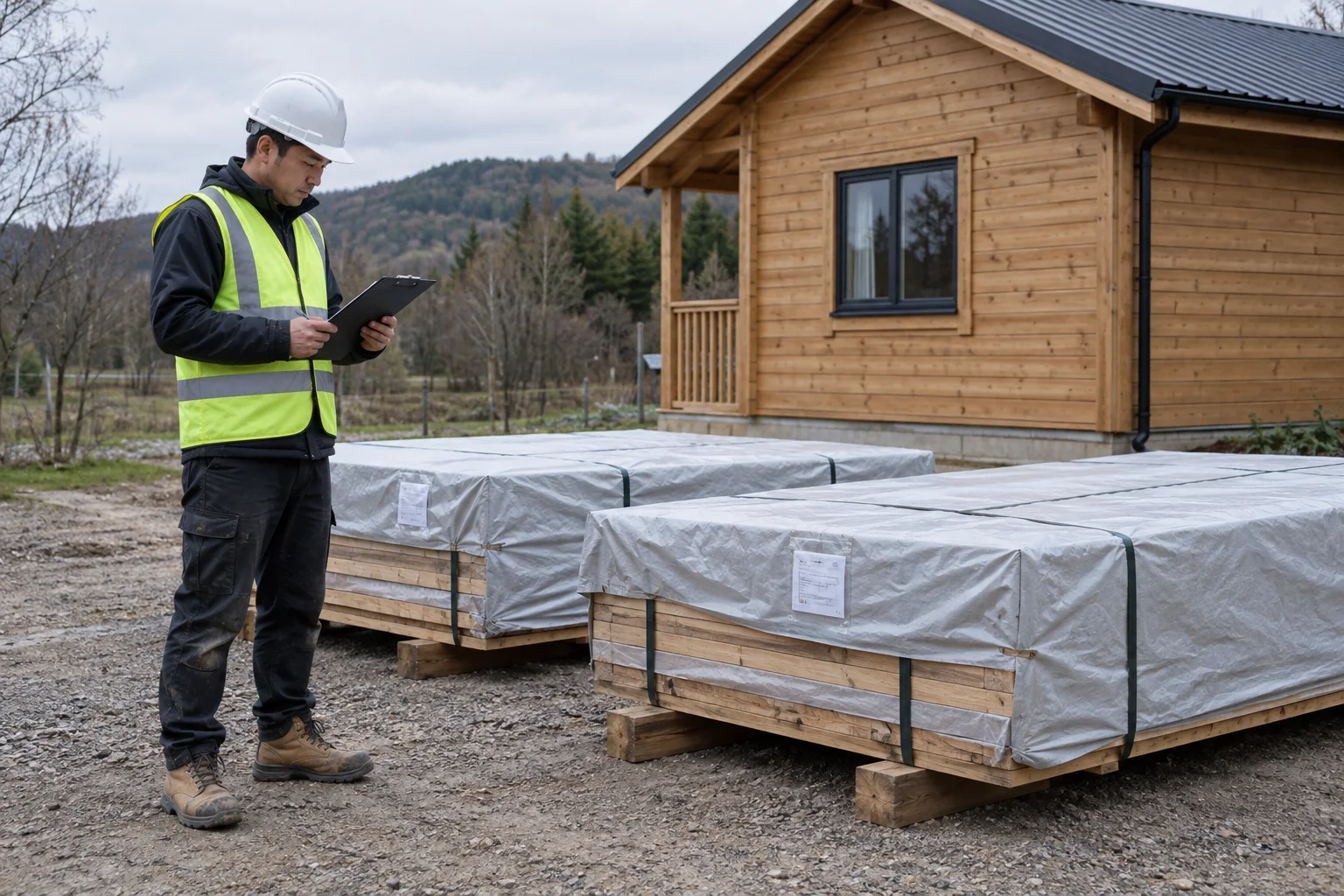
8. Plan storage and phased deliveries together
A hypothetical holiday park orders several identical cabins but has only a limited protected storage area. Sending everything together might simplify one part of the freight arrangement while creating a difficult site-handling problem. A staged approach could support installation sequencing, but it introduces additional booking, packaging and coordination questions. Compare both options against the actual programme rather than assuming one is always better.
For either approach, allocate packages to cabins and installation stages. Keep the inventory current when packs are opened or parts are transferred. If a component from a later cabin is temporarily used to resolve an issue, record the transfer and replacement action. Otherwise the shortage simply moves downstream and becomes harder to explain.
Before authorizing a shipment, review whether storage, foundations, access and local procurement are ready for the expected delivery window. Freight schedules can change, so agree who receives updates and how the site plan will be adjusted. Do not publish a universal delivery time or promise an opening date without confirmed production, transport and local-work assumptions.
9. Clarify what delivered and installed means
Buyers searching for prefab cabins delivered and installed usually want a usable building with few coordination gaps. However, that phrase may describe very different scopes. Ask whether it includes unloading, foundations, assembly, weatherproofing, electrical work, plumbing, finishes, commissioning and local inspections. Identify the responsible business for each part.
Compare cabin installation cost against the same completion standard. One quotation may cover structural assembly only, while another includes additional finishes or services. Record exclusions and obtain destination-specific estimates from the relevant contractors. For a full budget discussion, use a separate cost worksheet rather than hiding installation allowances inside the freight line.
A practical handover closes the remaining inventory and completion issues, transfers the care documents and confirms who handles later questions. Retain the final drawing revision and replacement-part references with the cabin's records. Delivery is complete for purchasing purposes only when the agreed delivery obligations are met; readiness for guest use may require further local work and approvals.
Further reading: Build a complete cabin budget; Plan care after installation.
10. Use a final dispatch-readiness check
Before shipment release, compare the latest packing list with the approved supply schedule and any changes agreed during production. Check that the receiving contact has the same documents as the freight provider. The final review should identify unresolved inspection items, outstanding local purchases and any change to the planned receiving area. A simple shared checklist is more useful than several conflicting email attachments.
Define how changes will be communicated after release. If an arrival estimate moves, the site manager may need to reschedule equipment, protected storage or installation labor. If a package is split from the main consignment, update its identification and expected arrival separately. Keep these changes visible instead of allowing the original shipment plan to appear current when its assumptions no longer apply.
Retain the agreed document set after handover. It supports replacement-part requests, later phases and investigation of discrepancies. For repeat orders, review what the first delivery revealed about labels, access and assembly sequence, then approve any improvements before the next packs are prepared.
FAQ: flat pack cabin delivery
Can the number of cabins per container be estimated from floor area?
Not reliably. Finished floor area does not establish package dimensions, weights, fragile components or allowable stacking. Ask for a packing schedule and a load proposal checked by the responsible transport professionals against the equipment booked. Any early estimate should be labeled provisional and updated before freight is confirmed.
Does a cabin delivery quotation include unloading?
Only when the agreed scope makes that responsibility clear. Confirm the delivery point, applicable trade term, service inclusions and local handling arrangements. The receiving team should know who supplies equipment and personnel before arrival. Do not assume a transport booking includes moving materials to the final cabin position.
Does ISPM 15 certify the cabin itself?
No. The standard addresses relevant wood packaging material in international trade. It is not a building approval or proof of a cabin's structural performance. Ask the supplier and destination specialist about the packaging and the separate requirements, if any, applying to the imported cabin materials.
What should I do if a package arrives damaged?
Record the package identity and visible condition safely, retain the relevant delivery documentation and notify the responsible parties promptly under their procedures. Protect materials using agreed guidance. Have competent personnel assess affected components before installation; do not assume that cosmetic appearance alone establishes whether an item remains suitable.
Can I receive the package before the foundations are ready?
That depends on suitable storage, handling and the agreed delivery arrangement. Review whether materials can remain protected and identifiable without repeated moves. A delayed foundation should trigger a coordinated discussion with the supplier, installer and freight provider, not an assumption that every package can be left outdoors indefinitely.
Conclusion: connect the factory plan to the site plan
A dependable delivery plan connects the component schedule, packing list, transport arrangement and installation sequence. Keep responsibilities visible, verify equipment and access, and retain order-specific inspection records. These steps make flat pack cabins easier to evaluate as a complete supply project rather than as a collection of unassigned tasks.
Send your destination, preferred cabin format, quantity and known site restrictions to CabinWild through the form or info@CabinWild.com. Ask for a written supply boundary and the packing information needed for freight planning. Use that proposal with local contractor input before finalizing the delivery and installation arrangements.
Further reading: Send your delivery requirements.
Request a cabin supply and delivery proposal
Tell us your destination, cabin style, approximate quantity, site access and preferred supply format. List the packing, freight and installation responsibilities you need clarified.
Prepared with AI assistance for CabinWild Editorial using the linked public sources. Examples are illustrative, not customer results or verified CabinWild test data. Project-specific design and local requirements need review by the appropriate professionals.