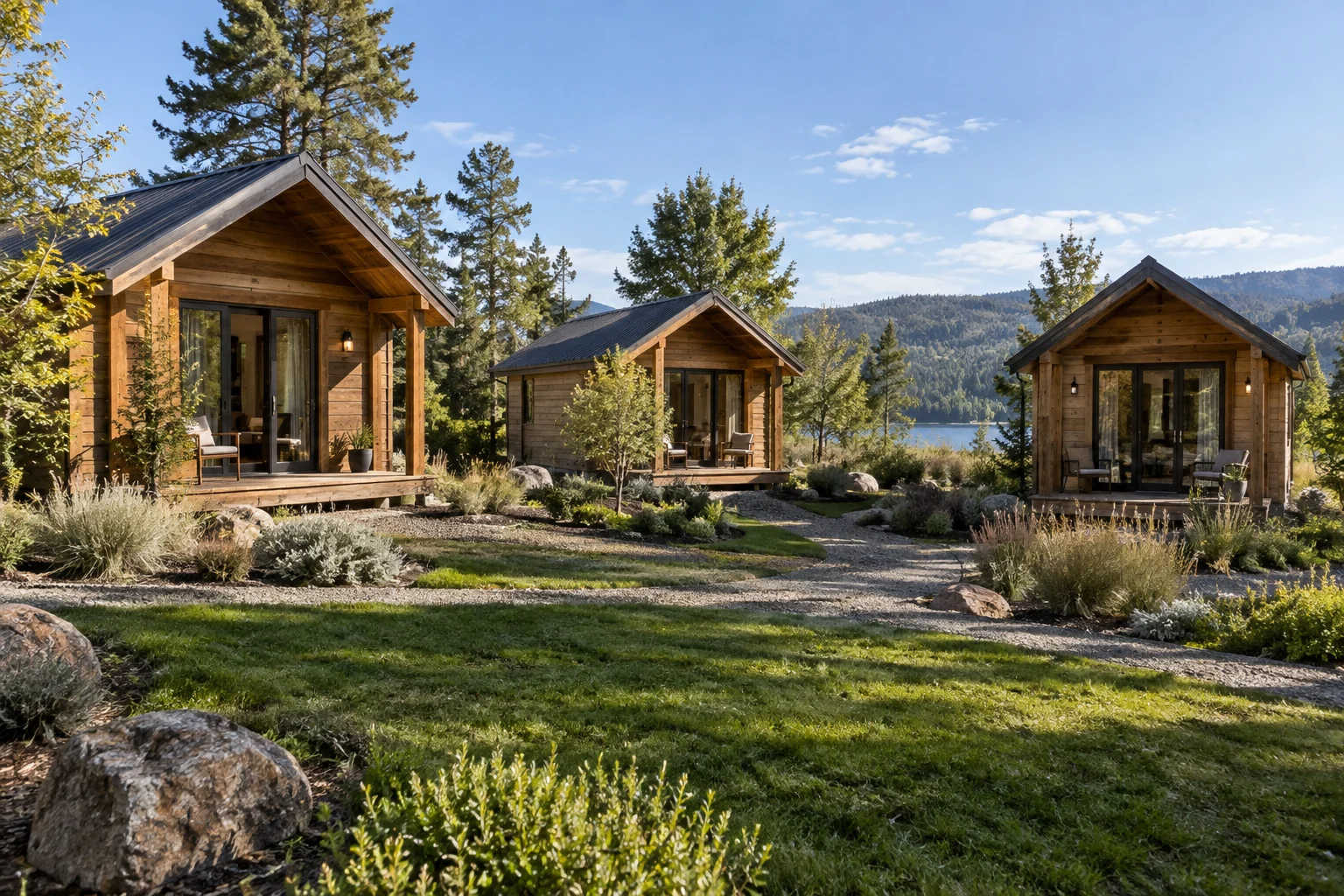
A prefab cabin's factory price is only one part of its completed cost. Budget separately for the agreed cabin package, transport, destination charges, site preparation, installation, services, and handover. Compare quotations against the same drawings and exclusions. Without a destination and supply scope, a universal price per cabin is not a dependable buying benchmark.
Introduction: what are you actually buying?
For resort developers, glamping operators, and importers, the useful question is not simply how much a wooden cabin costs. It is how much a defined cabin project will cost to deliver, install, and prepare for its intended use. Two attractive photographs can represent completely different packages, even when their advertised floor areas look similar.
This guide provides a procurement framework rather than a CabinWild price list. No current project drawings, destination freight quotation, or local contractor estimate have been supplied, so there is no defensible universal price range here. Instead, use the worksheet and comparison method below to turn supplier offers into a budget you can interrogate. The worked example is deliberately hypothetical, not a customer case study.
1. What does a prefab cabin price include?
Start by naming the supply format in writing. A component kit may include prepared timber and selected hardware, while a closed panel package may include more of the wall construction. A largely finished module moves more work into the factory, but its transport and lifting requirements can be different. The word prefab alone does not define any of these boundaries.
Ask for a schedule that identifies what arrives, its condition, and who completes the remaining work. A bathroom described as included might mean sanitary fittings, a finished bathroom, or only a reserved space on a drawing. Likewise, a floor package does not automatically include foundations, subsoil work, or the connection between the cabin and its support system.
Further reading: Explore CabinWild cabin concepts; Prepare a customization brief.
Compare the same area and specification
Record external footprint, internal floor area, deck area, and any loft separately. If one offer includes a covered terrace and another does not, dividing both totals by a single advertised area can hide the difference. List glazing, finishes, roof covering, insulation, doors, services, and assembly materials against a common revision of the drawing.
Treat upgrades as explicit alternatives. Ask the supplier to show the base specification, the requested change, and its price effect. This makes it possible to remove a nonessential finish without accidentally removing a weatherproofing component or a performance requirement. Your comparison should describe a complete intended product application, not a collection of disconnected discounts.
2. Build a complete prefab cabin cost worksheet
Give every budget item an owner, an inclusion status, and a source. Useful statuses are confirmed quotation, provisional allowance, excluded, and awaiting information. Avoid entering zero when you have no information: zero suggests the task is free, whereas an open allowance identifies a question that still needs an answer.
The worksheet below separates the supplier's scope from destination activities. Some suppliers may quote several categories together. That is acceptable if the boundaries remain clear and the same amount is not counted again under another heading. Ask the relevant local professional or service provider to confirm destination-specific costs.
| Budget category | What to verify | Typical evidence to request |
|---|---|---|
| Cabin supply | Components, finishes, openings, fit-out, exclusions | Dated quotation and specification |
| Transport and handling | Packing, freight, port handling, onward delivery | Packing proposal and carrier quotation |
| Destination administration | Applicable import procedures, charges, local approvals | Broker and local adviser confirmation |
| Site preparation | Ground assessment, foundations, drainage, access | Site-specific contractor scope |
| Installation and services | Assembly, lifting, utilities, commissioning | Method, responsibilities, written estimate |
| Handover and uncertainty | Inspection, corrections, spare parts, unresolved items | Acceptance checklist and risk register |
Separate per-cabin costs from shared costs
A reception connection, access road, or shared service trench should not automatically be multiplied by the number of cabins. Conversely, an electrical connection or bathroom commissioning task may need a separate allowance for each unit. Put shared infrastructure on its own line before allocating it across the project for internal reporting.
Budget timing also matters. A lower total can still require more cash earlier in the programme. Record deposit dates, remaining supplier payments, freight payments, and destination work milestones separately from the total. This is a planning worksheet, not financial advice; have your finance team review tax treatment, financing, and currency exposure where relevant.
3. How do you compare two cabin quotations fairly?
Normalize each offer to a common delivery stage before comparing totals. Begin with its stated price, add excluded work needed to reach your agreed scope, and remove duplicated allowances. Keep unresolved items visible. Do not treat an unsupported estimate as equivalent to a firm contractor quotation just because both occupy a spreadsheet cell.
For illustration only, imagine Offer A has a quoted package value of 40,000 budget units, with 12,000 units of identified additional work. Offer B is 47,000 units with 4,000 of additional work. The normalized amounts are 52,000 and 51,000 units respectively. These arbitrary values demonstrate arithmetic, not market prices, currency quotations, or a recommendation to choose either supplier.
The second offer appears lower only under those stated assumptions. If its excluded foundations remain unpriced, the comparison is still incomplete. Label every number as a quotation, calculated value, or provisional allowance. Keep the date, currency, validity period, quantity, and drawing reference alongside it so an expired offer does not look current.
Price the consequences of a change
Moving a window can affect framing, flashing, interior furniture, and packing. Changing the bathroom arrangement can affect service penetrations and local installation work. Ask for a change record that identifies these connected effects rather than accepting a single revised total with no explanation.
When evaluating a multi-unit purchase, ask whether the proposed discount depends on identical specifications, one shipment, or a fixed production sequence. A phased resort may need staged deliveries or different layouts. The apparent saving should be assessed against storage, site readiness, and the ability to inspect the first unit before repeating it.
Turn these questions into a project brief
Share your destination, cabin style, approximate size, quantity, and required supply scope. Tell us which budget items you need clarified.
4. What changes shipping and destination costs?
Packing dimensions, weight, handling constraints, route, and destination access all belong in the freight discussion. A floor plan does not tell a forwarder the dimensions of the packed load. Request the proposed package count, weights, dimensions, stacking limitations, and unloading method before treating a freight estimate as reliable.
Container equipment also has separate internal, door-opening, and payload constraints. Hapag-Lloyd publishes these categories and warns that specifications can vary by manufacturer. The procurement implication is to obtain a load plan checked against the equipment actually booked, rather than assuming that a nominal container size proves your cabin package will fit.
Further reading: Hapag-Lloyd: standard container specification example.
Name the trade term and delivery point
The International Chamber of Commerce explains that Incoterms rules allocate responsibilities, costs, and the point of risk transfer. Ask the quotation to identify the selected rule, named location, and edition, then have the parties confirm how it fits the shipment. A statement that freight is included does not explain all destination handling or unloading responsibilities.
Wood packaging is another separate question. ISPM 15 concerns relevant wood packaging material in international trade; it should not be presented as a blanket certification of the wooden cabin itself. Ask the supplier and destination broker which packaging and product requirements apply. Do not assume that one stamp resolves all timber import questions.
Further reading: ICC: what Incoterms rules cover; IPPC: ISPM 15 wood packaging scope.

5. Which local costs are easy to overlook?
Installation preparation starts with the site, not the delivery date. Confirm the proposed support system with the appropriate local designer, then obtain a contractor scope for the actual conditions. A photograph of another cabin on simple supports does not establish the foundation solution for your soil, slope, exposure, or intended use.
Describe access from the public road to the final cabin location. The delivery planner needs to understand turning space, gradients, overhead obstructions, temporary storage, ground conditions, and the planned unloading area. Have competent contractors assess equipment selection and safe lifting. This article does not provide rigging instructions or substitute for a site-specific method.
Budget for a usable accommodation unit
List the work needed after assembly: utility connections, service testing, bathroom completion, final cleaning, furniture installation, and the agreed inspections. Confirm who supplies small but necessary items such as transition trims, sealants, connection fittings, and replacement touch-up materials. Their absence can interrupt handover even when the major cabin components have arrived.
Operational access deserves the same attention as guest arrival. Think about housekeeping carts, waste collection, laundry handling, maintenance equipment, and emergency access with the relevant local advisers. The US Access Board's guidance illustrates why an accessible route is a connected site issue, not simply a wider entrance door. Use the requirements applicable to your own location.
Further reading: US Access Board: accessible route guidance.

6. What should factory testing and shipment inspection prove?
Agree the inspection scope before the purchase becomes difficult to change. A useful record identifies the order, drawing revision, component or cabin, check performed, acceptance criterion, result, and outstanding action. Ask which inspections are included in the price and which require an independent inspector or a separately agreed test.
Factory testing is not a single universal certificate. Depending on the supplied scope, a plan might include dimensional checks, fit-up checks, material identification, finish review, and checks of installed services by qualified personnel. Do not describe any test as completed unless there is a relevant record. A workshop photograph cannot establish the performance of a concealed wall assembly.
At shipment inspection, reconcile labels and package contents against the approved packing list. Record visible condition and unresolved discrepancies before dispatch. Timber condition also deserves attention: the USDA Forest Products Laboratory explains that moisture exchange influences wood properties. Ask for the appropriate material requirements and records rather than applying one moisture threshold to every species and component.
Further reading: USDA: moisture relations and wood properties; CabinWild factory review topics.
- Confirm the current drawing and specification revision.
- Identify included inspections, acceptance criteria, and responsibilities.
- Resolve substitutions and record any approved changes.
- Reconcile package labels, quantities, protection, and handling information.
- Agree how shortages, damage, or incomplete work will be documented.
7. What should you send in a request for quotation?
Send one consistent brief to each shortlisted supplier. Include destination, intended use, operating season, preferred cabin style, approximate size, quantity, target delivery timing, and required supply format. Add available drawings and clearly label unconfirmed customer requirements. Separate firm constraints from preferences so the supplier can propose alternatives without misunderstanding the essentials.
Ask for a written inclusions-and-exclusions schedule, proposed inspection plan, package information, and installation responsibilities. Then list the questions that remain open for local advisers. The resulting document is more useful than an attractive price with no specification behind it. For the broader supplier-selection process, use the existing sourcing guide alongside this cost worksheet.
Further reading: Wooden cabin sourcing guide; Compare A-frame and traditional cabin layouts.
Use a clarification register before choosing a supplier
Create a short register with one row for each unanswered question. Record the question, the party responsible for answering it, the document affected, and the date needed for a decision. For example, an uncertain unloading arrangement may affect the forwarder's price, the installer booking, and the delivery date. Keeping that dependency visible is more effective than placing an unexplained allowance in the total and assuming someone else will resolve it.
Ask suppliers to return answers in the same format as the original inquiry. If a proposed alternative changes the wall assembly or supplied bathroom scope, request a revised specification as well as a revised price. Keep the previous version for comparison, but identify one current version for approval. This gives the purchasing team a clear record of what was accepted instead of relying on separate emails containing partial changes.
Test the budget against a few plausible changes without presenting them as forecasts. What happens if the destination contractor cannot accept the planned delivery week, if protected storage is needed, or if the first phase contains fewer cabins? Ask the responsible provider to price the relevant alternative. A sensitivity check is useful because it reveals which assumptions matter; it does not require invented probabilities or a claim that delays are inevitable.
Finally, compare the clarity of the offers as well as their normalized amounts. A supplier who identifies an exclusion has given you something actionable. An ambiguous inclusion is not necessarily a saving. Record the remaining decisions, obtain the necessary local advice, and use the agreed documents as the basis for the purchase. Before approving the order, confirm that the budget owner and the person managing installation are working from that same specification and responsibility schedule.
Frequently asked questions
How much does a prefab cabin cost installed?
A dependable installed price requires a defined cabin package, destination, site conditions, foundation scope, services, and installation responsibilities. Request an itemized project quotation and local work estimates. A supplier's starting price is not enough to establish the completed cost of a resort accommodation unit.
Is a cabin kit cheaper than a finished module?
A kit may move more work to the destination, while a finished module may involve different transport and handling. Compare the completed scope, not just the factory package. Local labour, equipment, weather protection, access, and the amount of finishing work can change the result.
Does a turnkey price include foundations and utilities?
Not necessarily. Turnkey is a commercial description whose scope should be written down. Ask for specific confirmation of foundations, utility connections, transport, lifting, installation, approvals, and handover. Anything not expressly included should remain an open item rather than an assumed inclusion.
Should I use a standard contingency percentage?
Identify your unresolved risks before choosing an allowance. Unconfirmed ground conditions, design changes, access constraints, and freight validity create different uncertainties. Record the reason and owner for each allowance, then ask the project team to set an appropriate contingency rather than borrowing an unexplained percentage.
Can CabinWild provide a fixed worldwide cabin price?
A meaningful offer needs your requirements and destination. Use the inquiry form to discuss the selected concept, quantity, supply scope, and timing. Published design images are references, not binding specifications, verified availability, or a universal delivered-price commitment.
Conclusion: compare complete scopes, not isolated prices
The most useful prefab cabin cost comparison has three qualities: a shared specification, a clearly defined delivery stage, and visible unresolved items. Keep factory supply, freight, local work, and handover connected without merging them into an unexplained number. That discipline helps you ask better questions before placing an order.
Send CabinWild your location, intended use, preferred cabin, approximate dimensions, quantity, and the work you expect the supplier to include. Ask for a project-specific quotation and clarification of exclusions. Begin with a scope that can be reviewed, then refine the budget as drawings, logistics, and local installation requirements become better defined.
Request a project-specific cabin quotation
Share your destination, cabin style, approximate size, quantity, and required supply scope. Tell us which budget items you need clarified.
Prepared with AI assistance for CabinWild Editorial using the linked public sources. Examples are illustrative, not customer results or verified CabinWild test data. Project-specific design and local requirements need review by the appropriate professionals.