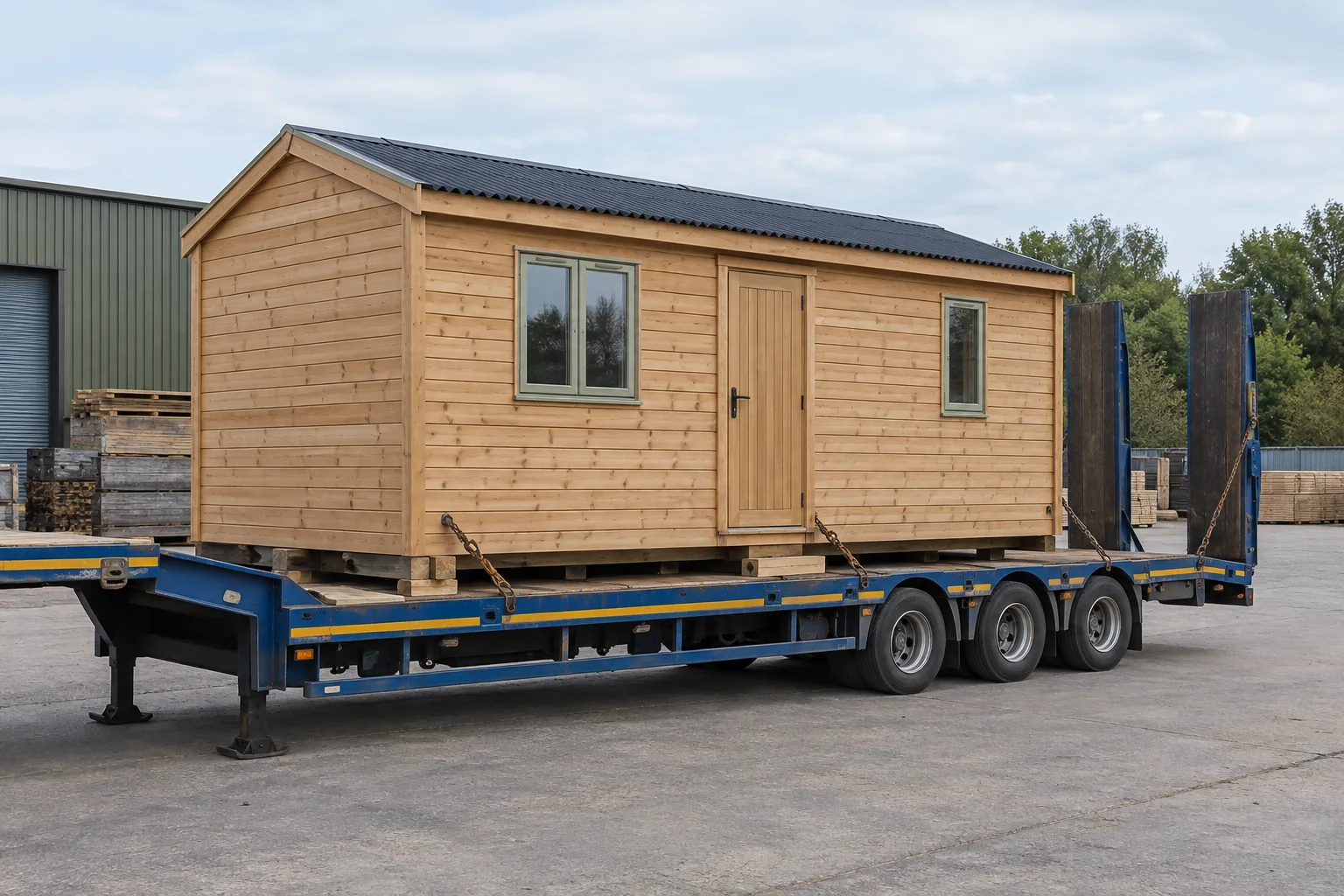
Pre built cabins delivered to a site still require a verified transport route, a suitable unloading and positioning method, prepared supports and a clear completion scope. Obtain the actual transport dimensions and mass, not only the cabin floor plan. Confirm who controls each stage before dispatch. Delivered, placed and ready to occupy are different milestones unless the contract explicitly combines them.
Introduction: the final approach can decide the project
A finished cabin photographed on a truck can make delivery appear straightforward. For an overseas buyer, however, the route from the factory to the intended foundation contains several separate decisions. The last turn into a garden, campground or resort may matter as much as the main freight journey.
This guide focuses on complete buildings and three-dimensional modules rather than bundles of components. It helps buyers organize feasibility questions and quotation boundaries; it is not a transport permit, crane plan or site-engineering instruction. The actual carrier, lifting contractor, designer and relevant authorities must assess the specific load and location. No CabinWild delivery capability or local service is assumed.
1. Define what arrives when you buy pre built cabins delivered
Ask whether the proposal is one complete building, several volumetric sections or an enclosure requiring substantial site assembly. Prefabricated describes work completed before arrival but does not establish the transport format. A reference image may show the completed result rather than the condition in which the cabin will leave the factory.
For modular cabins delivered in multiple sections, identify the section boundaries and the work needed to join them. Ask which roof, wall and floor interfaces remain unfinished, which service connections are made locally and who protects open interfaces during the sequence. These decisions belong in the quotation, not in an improvised conversation on arrival day.
Buyers comparing pre built log cabins delivered should also verify the actual wall system. Log appearance does not tell the carrier how the building may be supported or lifted. Obtain system-specific transport information from the responsible supplier and designer. Do not transfer handling assumptions from a framed module to an interlocking or solid-timber system.
If your proposal consists of numbered panels or loose components, use the separate flat-pack guide. Both formats need careful receiving plans, but they have different installation and equipment dependencies. Comparing them fairly means showing how each reaches the same completed, approved condition at the destination.
Further reading: Plan flat-pack component shipping instead.
2. Request a transport data sheet for the exact configuration
The carrier needs the load as transported, including packaging, temporary supports and any protrusions that remain fitted. Record length, width, height and mass with units, document revision and the person responsible for the values. Ask whether each figure is calculated, measured or provisional, and what must happen before it becomes a booking input.
The building's floor dimensions are not the dimensions of the loaded vehicle. Trailer height, transport frames and projection beyond the base can change the envelope. Ask the carrier to establish the full transport arrangement. Avoid subtracting a guessed deck height from an internet clearance figure and treating the result as route approval.
Require review when the configuration changes. A porch, roof extension, fitted equipment or transport cover may affect the data already sent to the logistics team. Keep one current data sheet and make superseded versions clearly obsolete. A drawing revision should trigger a decision about whether the transport and handling assessment remains valid.
The UK's Driver and Vehicle Standards Agency advises a separate plan for each abnormal-load movement and coordinated loading and securing instructions. This is a jurisdiction-specific reference, not a universal classification of cabins. Have the carrier confirm applicable requirements for every leg rather than prescribing a securing method from a blog or illustrative image.
Further reading: UK DVSA: abnormal-load planning and securing responsibilities.
3. Review the public route and the last site approach
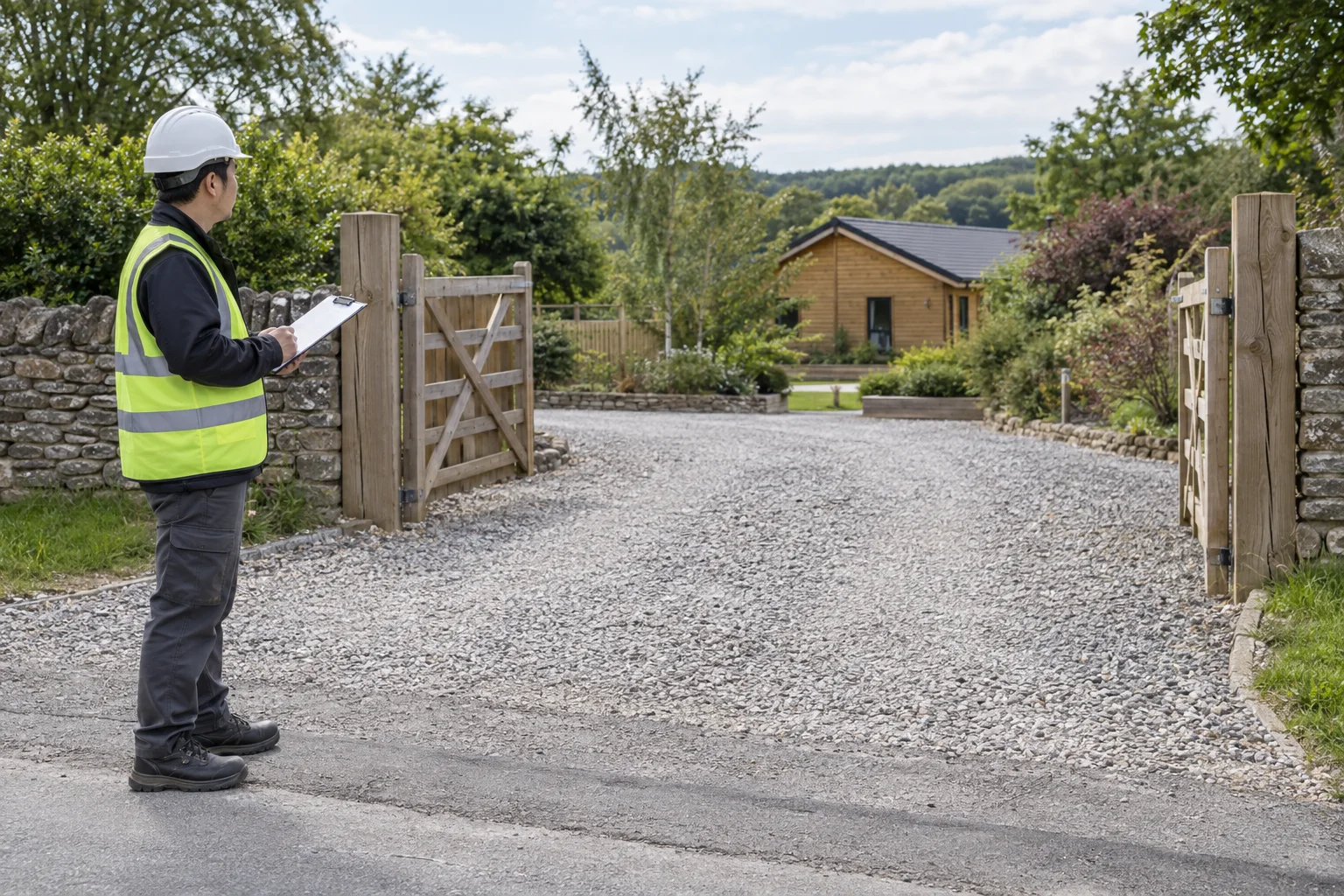
Ask the transport provider what route survey, permissions or movement arrangements are needed for the load and destination. The buyer's useful contribution is accurate information about the actual site entrance, operating hours and known constraints. A postcode identifies a destination; it does not prove that the final access can accommodate the proposed vehicle.
Share current photographs and a marked site plan showing gates, bends, gradients, narrow sections and the intended delivery area. Identify where temporary access changes might be possible and who controls the land. The responsible contractor must check the real conditions and vehicle movements; aerial imagery alone cannot establish load-bearing capacity or reliable clearances.
Overhead electrical lines need specialist attention. Britain's Health and Safety Executive warns that dangerous proximity can exist without direct contact and calls for consultation with line owners when planning affected work. Do not estimate a safe distance visually, assume a line is inactive or ask staff to guide a high load beneath it informally.
Separate a feasible arrival route from a feasible departure route. The carrier may need different space after unloading, while crane positions or stored materials may change the available circulation. Include that sequence in the site discussion before contractors commit to equipment and appointments.
If the preferred route is unsuitable, compare genuine alternatives with the design and logistics team: another lawful site entrance, a different module split or a component-based supply format. Each alternative needs its own scope and feasibility review. Do not assume that removing a gate solves a turning constraint, or that splitting a building leaves the structural and weathering details unchanged.
Keep a decision record that links the selected format to the verified route constraints. That record helps prevent a later design change from recreating the original problem. It also makes supplier discussions concrete: the customer requirement is not merely deliver anywhere, but deliver an identified configuration through an assessed route under an agreed responsibility plan.
Further reading: HSE: planning work near overhead power lines.
4. Check the working area independently of the foundation
A foundation designed for the finished cabin does not automatically establish suitable support for a loaded vehicle or temporary lifting equipment. Ask the responsible professionals to assess the working positions and ground conditions separately. Existing paving, underground services and recently disturbed ground should be identified for their review, not judged by surface appearance.
Keep visitors, guests and unrelated workers out of delivery activities using the site's approved management arrangements. HSE construction guidance emphasizes separating pedestrians and vehicles, limiting unnecessary movements and briefing visiting drivers. For a resort that remains open, agree the operating restrictions before accepting bookings that conflict with the delivery window.
Record who checks the working area shortly before arrival and who has authority to stop or postpone the operation. Weather, other trades or a parked vehicle can alter a previously reviewed arrangement. A schedule entry should not override a changed safety assessment. Maintain a clear communication route to the carrier and the supplier.
Treat access preparation as project work with an owner and completion evidence. A note saying site ready is too broad. Identify the entrance, route, working area, foundation interface and exclusion arrangements separately, with outstanding actions and responsible contacts.
Further reading: HSE: construction-site traffic management; Coordinate cabin foundations and installation interfaces.
5. Allocate unloading and positioning responsibilities
Ask whether the price includes transport only, unloading beside the vehicle or placement on the prepared supports. The same word delivery can describe different services. Obtain the equipment and contractor scope in writing, including coordination with the supplier's approved lifting and temporary-support information.
For work under its jurisdiction, HSE says lifting operations must be planned by a competent person, appropriately supervised and safely carried out. Its guidance also distinguishes crane hire from a contract lift with expressly assumed responsibilities. A buyer should confirm the actual arrangement, not assume that booking a crane transfers every planning duty.
Do not specify crane capacity, lifting points, sling arrangements or ground support from a cabin's advertised size. Those are professional decisions based on the actual load, equipment and operating conditions. Missing transport or lifting information is a reason to resolve the design, not an invitation to improvise on site.
Further reading: HSE: construction lifting operations and responsibilities.
| Milestone | Question to close | Evidence to request |
|---|---|---|
| Transport booking | Which load and route have been reviewed? | Current transport data and carrier confirmation |
| Arrival at site | Where does the vehicle stop and manoeuvre? | Approved site coordination information |
| Unloading | Who plans and controls the operation? | Named contractor and agreed scope |
| Final placement | Which supports and interfaces are ready? | Accepted setting-out and interface records |
| Completion | Which work follows placement? | Trade schedule and remaining-work list |
| Occupation | Who authorizes use after completion? | Applicable inspections and handover records |
Turn these questions into a project brief
Send your destination, intended cabin configuration, site approach and required completion stage. Ask which transport and local-contractor information is needed for a realistic proposal.
6. Compare delivered prices using named boundaries
A useful quotation identifies the destination and what happens there. Separate the cabin supply price from transport, destination handling, final positioning, local connections and completion work. Do not treat a missing amount as included or zero. Request confirmation of provisional allowances and the events that would change them.
The International Chamber of Commerce explains that Incoterms rules allocate obligations, costs and risks between buyers and sellers. Use the agreed rule, named place and edition with appropriate commercial advice. It does not replace a project-specific description of the building, local installation services or the acceptance evidence required by the buyer.
For international proposals, have the responsible logistics and customs specialists establish the import scope and required information. Do not copy a tariff classification or tax allowance from a different product. The finished module, its materials, fitted equipment and destination may raise questions that a generic cabin label cannot answer.
Ask about changed dates before an interruption occurs: storage, waiting, return journeys and rebooking may fall outside the original transport scope. Record the agreed notification procedure and decision owner. This is a contract-comparison question, not a prediction of what any provider will charge.
Further reading: ICC: Incoterms 2020 obligations, cost and risk; Build a complete cabin project budget.
7. Create a dispatch release that joins factory and site readiness
Factory completion and site readiness should meet at a documented release point. The supplier may be ready to load while the local contractor is still waiting for an interface detail. Agree who collects the confirmations and who authorizes dispatch. Avoid making an irreversible logistics commitment on the basis of one party's progress report.
Before release, reconcile the approved model revision, transport data, delivery appointment and outstanding work. Factory testing records, where specified and available, should identify the relevant component or system and any limits of the test. A factory check does not prove that services will function after transport, connection and commissioning at the destination.
Use shipment inspection to record visible condition, loose items, fitted equipment and protected interfaces. Agree the safe inspection method with the supplier. The purpose is an identifiable baseline for receiving, not a collection of uncaptioned photographs that cannot be connected to a particular module or component.
- Confirm the exact module identity, configuration and drawing revision.
- Confirm current carrier, site and positioning arrangements with named contacts.
- Resolve open safety or interface issues before dispatch authorization.
- Record what remains to be completed, by whom and at which stage.
- Keep the receiving documents and issue-reporting procedure available on site.
8. Inspect after transport without confusing receipt with acceptance
Agree safe viewing opportunities with the delivery team and keep clear of active handling. Record the module identity and visible condition at the relevant milestones. If access is restricted, note the limitation rather than implying a complete inspection. Follow the agreed reporting procedure promptly when damage or a discrepancy is found.
A signature acknowledging arrival need not mean that every installed system has been accepted; the contractual effect depends on the actual documents. Have the parties clarify those documents beforehand. Keep condition observations, quantity receipt, installation acceptance and operational handover distinguishable in the project file.
For log cabin delivery, ask the supplier which system-specific checks follow transport and placement. For multi-section modules, pay attention to the planned joint-completion and weather-protection sequence. Suspected damage or movement needs assessment by the relevant professional; do not conceal it behind trim to keep the handover date.
9. Plan the work between placement and occupation
Prefabricated cabins delivered with fittings may still need utility connections, interface closure, external access work and local inspections. Ask for an itemized completion schedule even when most work happens off site. A furnished interior photograph does not establish that the destination connections or operating approvals are included.
In a hypothetical two-section project, both modules arrive as scheduled, but the contractor responsible for closing their joint is unavailable. The delivery milestone is complete while the accommodation is not. This example illustrates why the plan should link arrival, positioning, joint work and acceptance instead of assigning one undifferentiated finish date.
Recheck affected services and operating functions through the responsible trades after connection. Retain the resulting records, updated drawings and instructions for the owner. Product application, destination requirements and actual supplied scope determine what the handover needs; this article does not certify a universal ready-to-occupy checklist.
FAQ: complete and modular cabin delivery
Does delivered mean the cabin is placed on its foundation?
Only if the agreed scope includes that stage. Transport to a site, unloading and final positioning can be separate services with different contractors. Identify the delivery point, equipment responsibilities and prepared-support requirements in writing. Also clarify the work and acceptance steps that remain after the module reaches its position.
Can a supplier confirm access from photographs alone?
Photographs help identify questions but may not establish dimensions, ground capacity, overhead hazards or vehicle movements. Ask the responsible carrier and site professionals what survey and review they require. Provide current site information, then retain their confirmation for the actual load and transport arrangement rather than a similar previous delivery.
What changes when a cabin arrives in multiple modules?
The project must coordinate delivery order, temporary protection, joining details and the trades that complete interfaces and services. Ask which elements remain unfinished during each stage. Compare the complete installed scope with a one-piece alternative; the transport format alone does not establish total cost, duration or final performance.
Should I book the crane before choosing the cabin?
Discuss feasibility early, but equipment selection and lifting plans need the actual load and site information. Have competent professionals assess the proposed arrangement and clarify responsibilities. Do not choose a crane from floor area or assume that a preliminary price confirms a workable lift for the final configuration.
What if the site is not ready near the dispatch date?
Notify the supplier, carrier and positioning contractor through the agreed procedure. Reassess storage, access and scheduling with the responsible parties before authorizing movement. Record the changed plan and any commercial consequences. Do not let a booking deadline substitute for confirmation that the operation can be carried out safely.
Conclusion: make the whole delivery chain visible
Buying pre built cabins delivered can reduce some site assembly, but it does not remove route, handling or completion decisions. A sound purchase brief connects the exact module to the loaded vehicle, site working area, prepared supports and final acceptance. Resolve responsibility gaps while changes are still practical.
Send your destination, customer requirements, proposed cabin format and available access information to info@CabinWild.com. Ask for a scope discussion and the information needed by your local transport and installation team. A realistic delivery proposal follows those facts; it should not be inferred from a catalogue image or an unsupported service promise.
Prepare a delivery brief before comparing quotations
Send your destination, intended cabin configuration, site approach and required completion stage. Ask which transport and local-contractor information is needed for a realistic proposal.
Prepared with AI assistance for CabinWild Editorial using the linked public sources. Examples are illustrative, not customer results or verified CabinWild test data. Project-specific design and local requirements need review by the appropriate professionals.