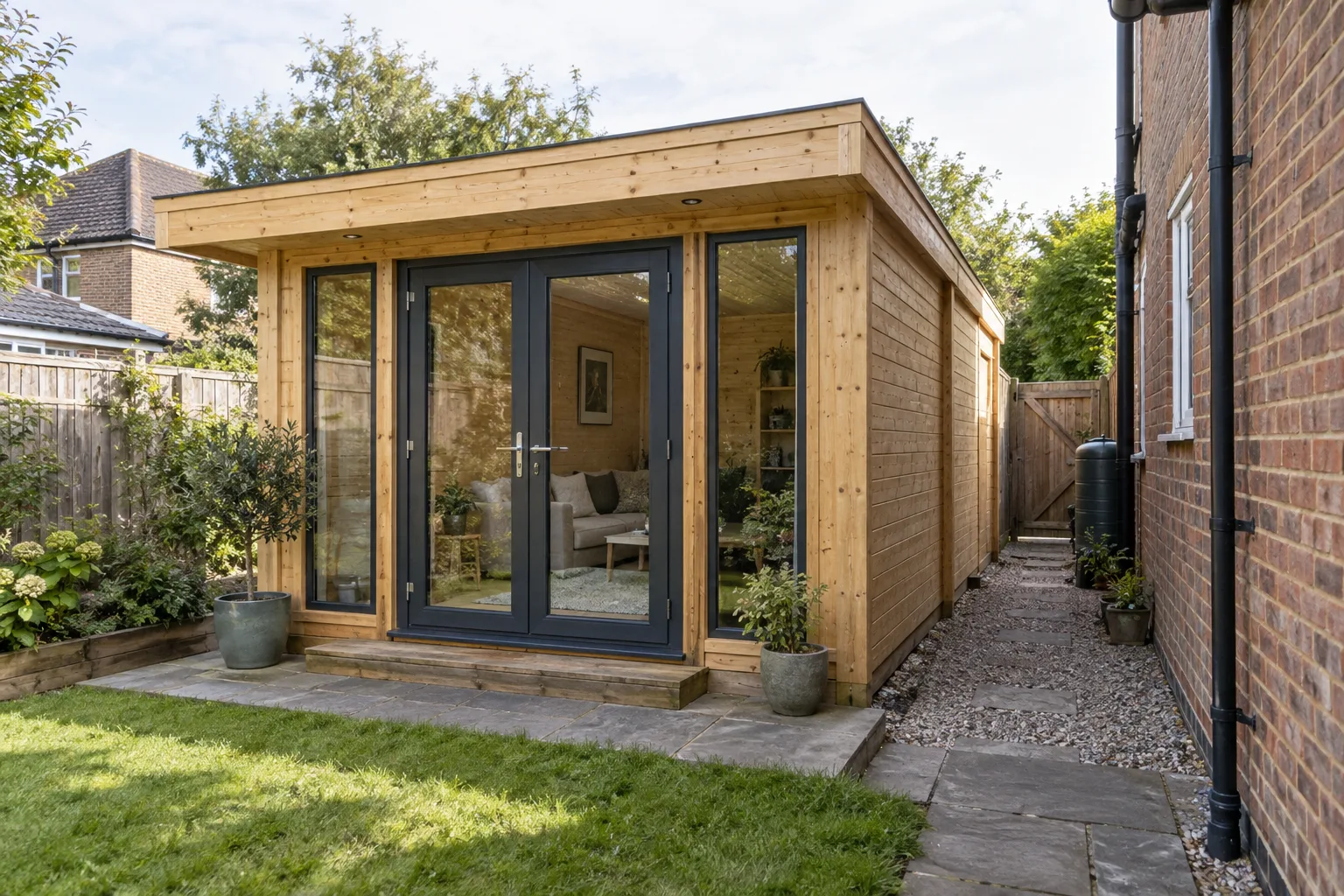
Compare flat pack cabin kits for the UK by identifying the destination nation, intended use, kit contents and local completion team. For imports, check the actual timber and packaging requirements and the named delivery boundary. A UK-facing catalogue, included freight or a small garden footprint does not establish local manufacturing, site approval or a complete installation service.
Introduction: a UK listing may describe several different supply models
Flat pack cabins UK results can include locally stocked kits, made-to-order imports, overseas direct sales and packages coordinated by a local installer. The same product photograph may appear beside different services. Before comparing the number on the page, ask who sells the goods, where the package is dispatched from and who is responsible for completing the cabin at the property.
This guide helps buyers and dealers compare those arrangements. It does not claim that CabinWild has a UK factory, warehouse or installer network, and it is not legal or tax advice. Availability and services must be confirmed directly. Planning, building, import and construction responsibilities need review for the actual destination and transaction.
1. Name the UK destination precisely
Identify England, Scotland, Wales or Northern Ireland in the initial brief. Do not use UK as though every planning, building and import process is identical. Include the intended use, site and whether the building will contain sleeping accommodation, cooking or sanitary facilities. These facts are more useful than a request for a generic no-permission-needed cabin.
The UK government's householder permitted-development technical guidance explicitly applies to England. That scope matters: a seller should not use it as a universal answer for another nation or for a different use. Ask the relevant local authority and advisers to identify the current route. Keep any conclusion tied to the actual drawings and site conditions.
For Northern Ireland, arrange a specific review of the import and local building questions rather than treating a Great Britain delivery example as equivalent. This article points out the distinction but does not provide a complete Northern Ireland procedure. Record the named professional or authority responsible for resolving those requirements before the order is released.
Further reading: England-only householder permitted-development guidance.
2. Understand who coordinates the local work
Ask whether the seller supplies only goods, offers a separate assembly service or contracts for a broader completed package. Identify the actual contracting parties and the tasks each accepts. An installer recommendation is not the same as an included installation contract. Have the commercial documents reviewed where necessary so the buyer understands the arrangement before paying a deposit.
Compare the practical support offered with the kit. Who answers drawing questions, supplies missing-part references and authorizes a substitute? Is the contact available while the local team is working? Do not infer those services from a UK telephone number or a localized website. Request the support process and named scope in writing.
For a dealer purchasing repeated units, consider whether the supply model remains workable when several installations overlap. A single helpful salesperson may not represent a documented process for technical changes and after-sales records. Ask how model revisions are communicated and how the installer knows which instructions apply to each package.
3. Request an exact schedule for flat pack log cabin kits UK offers
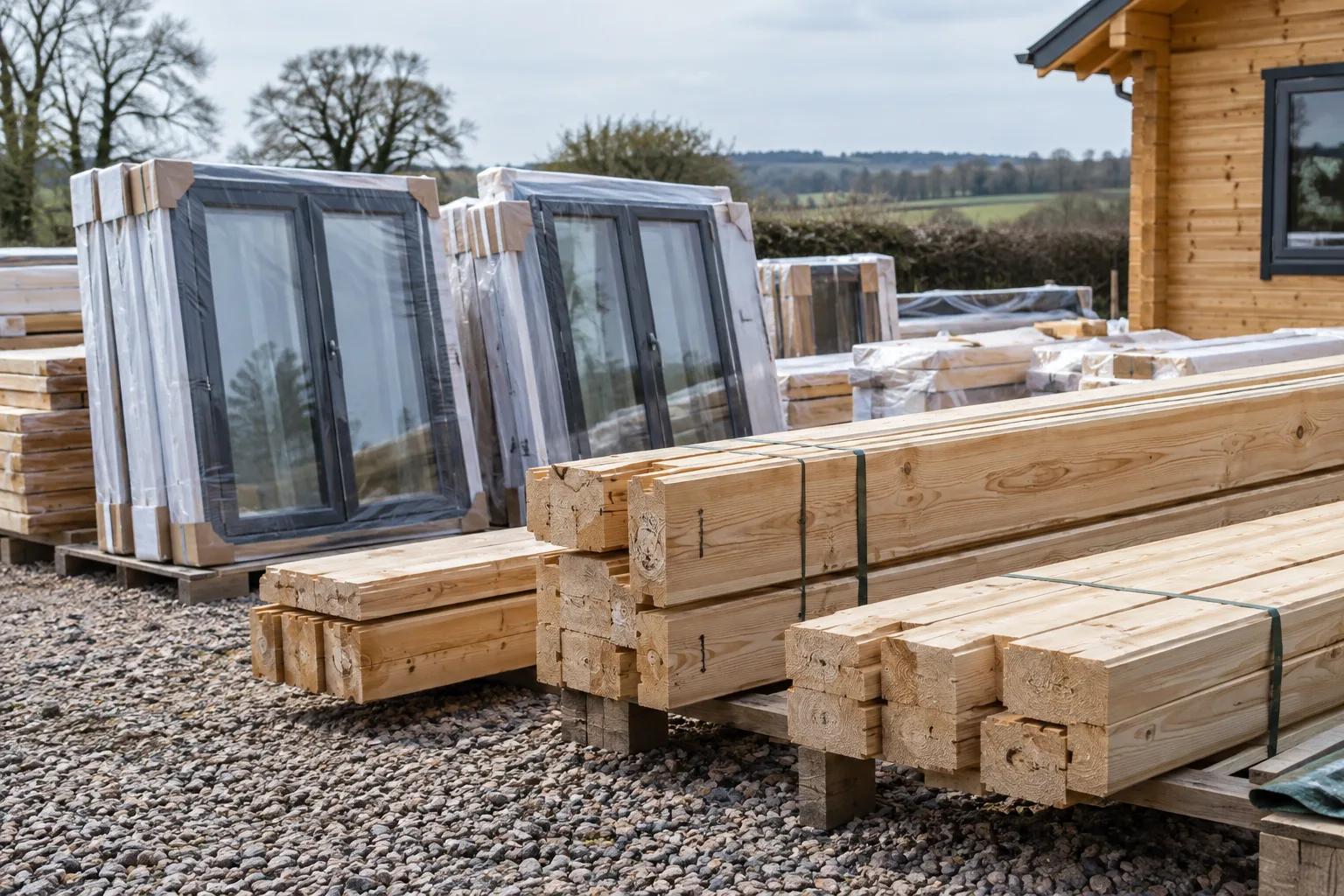
Identify the wall system, floor construction, roof covering, doors, windows, insulation, fixings and finishes. State which items are standard, optional or excluded. A kit may include structural roof boards but not the final weathering system, or floor bearers but not a designed foundation. The product name does not answer those questions reliably.
Check dimensions and drawing revisions. Ask whether advertised area includes the porch, roof overhang or loft. Mark the fixtures and furniture shown for illustration only. When comparing wooden cabin kits UK offers, use the same measurement and completion basis rather than dividing unlike package prices by unlike areas.
Ask the installer to identify any local materials required by the supplied instructions. Compatible sealants, coatings, protection and service components may need to be sourced before work starts. Do not allow a missing accessory schedule to become a series of improvised substitutions during assembly. The installer should know which decisions require supplier or designer approval.
Further reading: Review a complete cabin kit inclusion schedule.
| Kit item | Clarification | Common comparison mistake |
|---|---|---|
| Floor | Bearers, structure, insulation and finish | Assuming a floor kit includes foundations |
| Roof | Structure, covering and junction components | Treating roof boards as a weatherproof roof |
| Openings | Actual units and relevant specifications | Assuming every pictured window is standard |
| Interior | Lining, fixtures and services | Counting illustrated furniture as supplied |
| Assembly | Labor, equipment and acceptance | Treating a recommended installer as included |
4. Test garden access with the real package dimensions
A narrow side passage can make the handling plan important even when the finished cabin fits comfortably in the garden. Ask for the dimensions and weights of the largest packages and components. Have the contractor assess turns, gates, overhead restrictions, ground conditions and the available work area. Do not assume flat pack means every item can be moved by hand through a standard doorway.
Agree the delivery endpoint. Kerbside, driveway and prepared site placement are different services. Ask what vehicle is expected and what unloading equipment is included. A photograph of an accessible property elsewhere does not demonstrate that the carrier can reach your location. Resolve restrictions with the transport and installation teams before confirming the delivery date.
For a hypothetical garden project, the buyer might choose an earlier delivery into protected storage while the foundation is completed. That choice introduces storage, handling and inspection responsibilities. Compare it with delivery directly into a ready work area rather than assuming early arrival always reduces risk. Keep the agreed sequence in the project plan.
Turn these questions into a project brief
Send the destination nation, postcode area, intended use and access information. Ask for a current kit schedule and separate delivery and assembly responsibilities.
5. Check regulated timber imports into Great Britain
Forestry Commission guidance for timber, wood products and bark applies to England, Scotland and Wales and identifies separate Northern Ireland considerations. For regulated material, it describes plant-health and documentary requirements. Ask the importer or broker to determine whether the actual components are regulated and which current conditions apply to their species, processing and origin.
Request the material facts and documents needed for that determination before dispatch. A general statement that the kit is manufactured, dry or treated is not a complete answer. Keep the component list consistent across the supplier's offer, packing information and import records. If the timber specification changes, reopen the relevant review rather than assuming the earlier answer still applies.
Review wood packaging and dunnage separately from the cabin components. The Forestry Commission's import and export collection links to the current packaging and related guidance. Have the logistics team confirm the requirements for the actual route. A marking on a pallet does not certify the building's timber, structural performance or local acceptability.
Further reading: Forestry Commission: importing timber into Great Britain; Forestry Commission: timber and packaging guidance collection.
6. Compare delivered scope, not just the advertised kit price
Ask for a current quotation with currency, validity and explicit inclusions. List goods, freight, destination handling, import support, taxes, inland transport, unloading, assembly, foundations and services separately. Some items may already be included; others may belong to the buyer. Record the boundary rather than adding every line twice or assuming every missing line is free.
UK VAT guidance distinguishes imports into Great Britain from relevant movements into Northern Ireland. Ask a qualified adviser to establish the treatment of the actual transaction. Do not copy a tax rate or customs assumption from another order, and do not present a supplier's goods price as the buyer's final project budget without checking those matters.
Compare a locally stocked kit with a direct import on the same evidence basis. Stock availability, document support and replacement logistics can affect the practical choice, but they should be verified. An imported package is not automatically cheaper after local work, and a local listing is not automatically a complete service. The useful decision is based on the actual written offer.
Further reading: UK government: VAT on imports; Compare cabin prices and floor plans.
7. Agree a realistic assembly and site-preparation scope
Ask the installer to define what must be ready before work begins, including foundations, safe access, storage and necessary services. Compare the supplier's interface drawings with the contractor's proposal. A level-looking base is not proof that dimensions, support locations and other requirements match the kit. The responsible professionals must establish and verify the actual design.
For construction work in Great Britain, Health and Safety Executive guidance describes planning and coordination responsibilities. Use the relevant local framework and competent contractors for the project. This article does not provide lifting, temporary support or work-at-height instructions. A short advertised assembly duration should not exclude the planning needed to carry out the work safely.
Record weather protection and interruption arrangements. If work stops before the enclosure is complete, who protects the components and checks their condition before restarting? Agree how missing or damaged parts are reported. Clear handling of exceptions is more useful than an optimistic schedule that assumes every package is perfect and every day is suitable for work.
Further reading: HSE: planning construction work in Great Britain; Compare cabin assembly service quotations.
8. Define the evidence needed at each stage
Factory testing should identify the relevant product or process question and its record. Shipment inspection should reconcile the supplied goods and accessible condition with the approved order. Local acceptance should address the completed installation and services. These are different stages; a general quality certificate should not be used as evidence that all of them have been completed.
Ask for photographs and package references that make discrepancies traceable. Keep the original condition record before components are spread across the site. If an item is concealed or inaccessible during inspection, record the limitation and agree when it will be checked. Avoid signing an unqualified acceptance statement simply because the delivery vehicle needs to leave.
Retain the final instructions and model revision. If a dealer has several similar kits, do not mix hardware or drawings between them without confirmation. A small change in wall profile or opening arrangement can make a familiar-looking part wrong for the current unit. Good identification reduces confusion without pretending it replaces technical review.
9. Plan support after the garden is handed back
Ask who supplies operating and maintenance information for coatings, seals, windows and installed equipment. Confirm how a future replacement is identified and whether local labor is included in any written warranty. Do not confuse a supplier's product warranty with a promise to repair every site-related issue. Have important commercial terms reviewed before the purchase rather than after a problem appears.
For a hypothetical office cabin, keep the original use brief with the handover documents. If the owner later wants sleeping accommodation, obtain a fresh local review rather than assuming the completed office can be relabelled. The physical shell may be only one part of what needs consideration. A change in furniture does not resolve a change in use.
A buyer assessing flat pack log cabins for sale UK offers should leave the process with a usable record: final plan, component schedule, delivery evidence, installation records and a clear support contact. That record is part of a professional purchase, even for a modest building. It makes future maintenance and alterations less dependent on memory.
Practical buyer workshop
Use a scope schedule that survives the handover to installers
The installer should receive the same component schedule and drawing revision used for the accepted quotation. Include the supplier's exclusions and any locally procured materials. A buyer can lose the benefit of a careful comparison if the construction team later works from a generic catalogue download rather than the agreed package information.
For a hypothetical narrow-access garden site, ask the contractor to review package sizes and the intended handling route before confirming dispatch. If a different packing arrangement is proposed, have the supplier explain how component protection and identification will be maintained. This is a coordination question, not an instruction to carry or lift packages in a particular way.
Keep the destination distinction visible in the file. Requirements applying to Great Britain should not be silently extended to Northern Ireland, and planning guidance for England should not be presented as a UK-wide answer. Record the relevant authority and adviser for the actual address.
At delivery, use the agreed schedule to identify discrepancies and assign the response. Avoid allowing an undocumented local substitution to become the new specification by default. The objective is a clear connection between what was quoted, what arrived and what the competent local team is expected to complete before the building reaches its intended use.
FAQ: UK flat-pack cabin purchasing
Does a UK website mean the cabin is manufactured locally?
No. Ask where the goods are manufactured, stored and dispatched, and which company provides each service. A localized listing does not establish a factory or installer network. Compare the actual support and documentation offered, and confirm availability directly rather than inferring it from the website's geographic wording.
Are planning rules the same across the UK?
Do not assume that. Identify the destination nation and obtain advice for the actual site and use. England-specific guidance should not be presented as a universal UK answer. Keep planning and building questions separate, and review any later changes to occupancy, layout or services against the applicable requirements.
Can every flat-pack kit fit through a garden passage?
No. Obtain the real package and component dimensions and have the contractor assess the access route and handling method. Turns, gates, overhead restrictions and working space can matter. A flat-pack label describes a supply format, not a guarantee that every part can be carried through an ordinary residential entrance.
Is delivery the same as unloading at the foundation?
Not necessarily. Confirm the exact endpoint, vehicle, unloading equipment and responsibilities in the written offer. Kerbside delivery, placement on a driveway and delivery into the work area are different services. Coordinate the carrier and installer before the delivery date so the buyer is not left to improvise handling arrangements.
What makes imported and local offers comparable?
Use the same drawing, area basis and completion scope, then separate freight, import costs, local work and support. Verify inclusions and exclusions in current written quotations. Neither supplier location nor a headline price settles the decision; compare the responsibilities and evidence attached to the actual package.
Conclusion: make the local completion boundary visible
Flat pack cabin kits UK comparisons work best when jurisdiction, kit contents, delivery and assembly are defined together. Check the actual import requirements where relevant and have local professionals review the site and use. A clear scope prevents a modest garden project from depending on several unspoken assumptions.
Send CabinWild your destination nation, site access information and customer requirements through the inquiry form. Request a current kit schedule and a transparent delivery boundary. Confirm local installation preparation and supporting documents before accepting the final offer.
Compare a cabin kit for your UK site
Send the destination nation, postcode area, intended use and access information. Ask for a current kit schedule and separate delivery and assembly responsibilities.
Prepared with AI assistance for CabinWild Editorial using the linked public sources. Examples are illustrative, not customer results or verified CabinWild test data. Project-specific design and local requirements need review by the appropriate professionals.