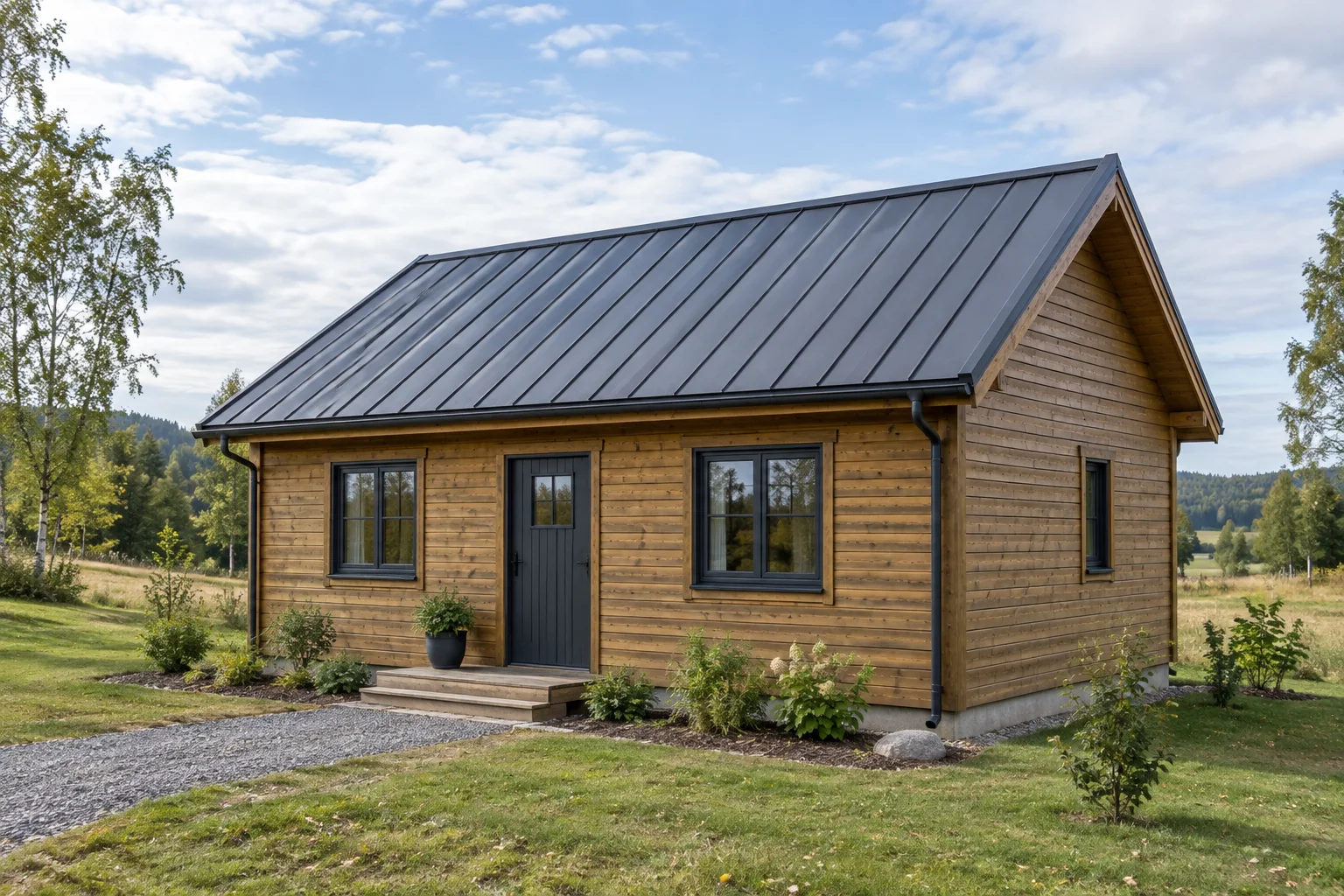
Choose cabin roofing materials as part of a complete roof system. Metal sheets, asphalt shingles and low-slope membranes have different supporting layers, geometry limits and installation requirements. Shortlist options against the actual roof drawing, climate and intended use, then compare the covering, accessories, labour and maintenance together. A material name or warranty headline is not proof of project suitability.
Introduction: compare the roof, not only its surface
Roof coverings are easy to compare in photographs and difficult to compare from incomplete quotations. One price may include shaped edge trims and compatible fixings; another may cover only the visible material. For a timber cabin buyer, the missing items can be as important as the difference between metal and shingles.
Start with the building's use. An unheated storage cabin, regularly occupied office and guest accommodation can require different enclosure strategies. The same attractive covering may be used over different assemblies, but that does not make those assemblies interchangeable. Insulation, moisture control, ventilation and services need coordinated decisions.
This guide is a procurement framework rather than a roof design or installation instruction. It does not verify any CabinWild roof rating, factory test or completed project. Local structural, fire, moisture and regulatory requirements must be reviewed by competent professionals using the selected product's current technical documentation.
Further reading: Coordinate the roof with year-round cabin performance.
1. Define the roof brief before shortlisting products
Collect the destination, intended occupancy, roof shape and pitch, supporting structure, penetrations and drainage arrangement. Include whether the site is exposed, coastal, shaded or difficult to access. These are inputs for assessment, not a shortcut to selecting fasteners or assigning a structural capacity from an online article.
For garden cabin roofing, also identify nearby boundaries, trees and access for maintenance. A small footprint does not eliminate wind, snow, fire or planning considerations. If the cabin will be heated later, discuss that future use before choosing an assembly that is difficult to modify after internal finishes are complete.
Describe appearance separately from performance. A buyer may want a dark standing-seam look, for example, while the destination requires a particular approved roof assembly. Establish which visual preferences are flexible and which functional requirements are mandatory. This helps the supplier propose alternatives without silently changing the customer's priorities.
Ask the local designer which information is still missing before issuing a final enquiry. A preliminary roof sketch is useful for discussion, but an unconfirmed pitch or unresolved support detail should remain visibly provisional. Pricing against assumptions is acceptable only when those assumptions are written down.
2. Compare the main cabin roofing options
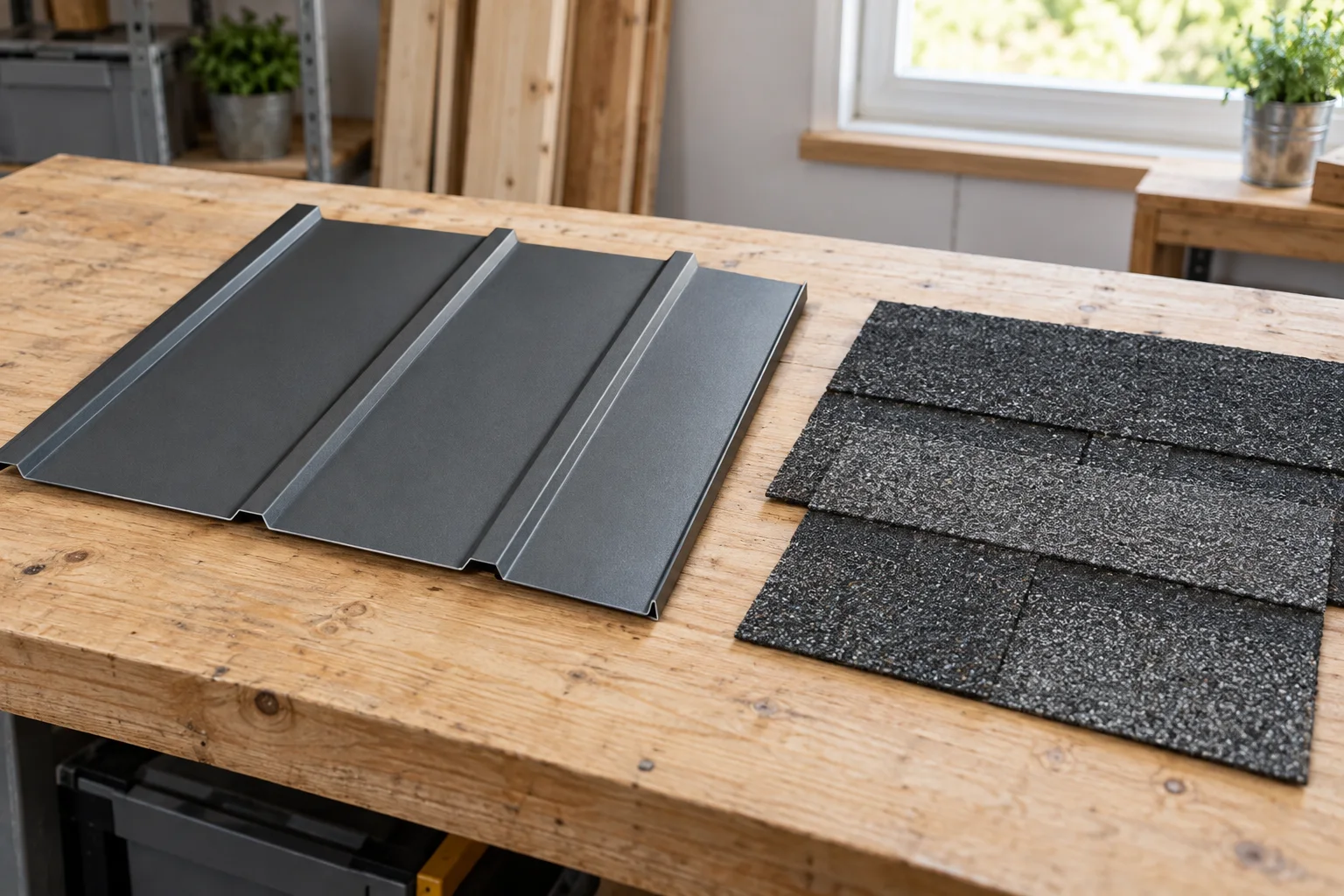
The following comparison organises questions rather than ranking every product. Metal sheets vary by profile and connection method. Asphalt shingles belong to specified systems. Membranes for suitable low-slope roofs require their own substrates, junctions and installer competence. Product application must be checked at the system level.
Do not extend a claim from one tested product to a whole material family. A brochure describing one roof's resistance, finish or warranty is not evidence for another profile or supporting assembly. Ask which exact product is offered and which documents apply to that configuration.
| Option | Useful comparison point | Question before ordering |
|---|---|---|
| Profiled metal sheets | Panel lengths, connection method and finish | Which profile, support arrangement and complete fixing system are specified? |
| Asphalt shingles | Texture, pattern and compatible deck system | Which slope, deck and underlay conditions apply to this product? |
| Low-slope membrane system | Suitability for the actual roof geometry | Who designs and completes outlets, edges, seams and penetrations? |
| Other coverings | Appearance and local availability | Has the complete supporting structure and destination suitability been assessed? |
3. Evaluate log cabin roofing sheets as a package
When considering log cabin roofing sheets, ask for the metal type, profile, stated thickness basis, coating designation and panel schedule. Confirm whether the offer uses exposed fasteners or a concealed connection system. These distinctions affect the accessories and installation approach; a general description such as metal roof leaves too much undecided.
McElroy Metal publishes separate installation documents for different roof products, while the Metal Construction Association's installation manual explains that fasteners and clips depend on the panel and design requirements. The purchasing lesson is simple: request documents matching the proposed system, not a generic sheet of screw locations.
Discuss panel handling and storage as well as installed appearance. Long panels can affect access, packaging and safe lifting arrangements. Ask the supplier and installer how materials will be protected before use and how surface damage will be assessed. These are logistics questions, not reasons to assume a universal maximum transport length.
For a coastal or otherwise demanding environment, request explicit confirmation of the coating, fastener and accessory compatibility with that exposure. Ask what exclusions apply. Avoid translating a finish guarantee into a promise that the entire roof will remain watertight for the same period.
Further reading: McElroy Metal: product-specific installation resources; Metal Construction Association: installation manual.
4. Check what log cabin roofing shingles require underneath
For log cabin roofing shingles, first distinguish asphalt shingles from wood shingles and other products with a similar shape. This article's comparison refers to asphalt products. Ask for the named range, colour, coverage basis and all required supporting components rather than accepting shingles as a complete specification.
GAF's published Timberline instructions identify roof-slope, deck and underlayment conditions, including circumstances affecting a stated fire classification. Those instructions demonstrate why a surface product cannot be evaluated independently of its assembly. They are product-specific examples, not universal dimensions or requirements for every cabin roof.
Have the installer confirm the substrate and preparation needed for the selected product. If the cabin kit supplies roof boards, do not assume those boards automatically satisfy every shingle system. Ask whether additional decking, compatible underlay, starter products, ridge components or flashings are required and who supplies them.
Compare supplied coverage with the roof geometry, including edges and transitions. Package area is not the same as a completed roof quantity after the approved layout is considered. Request a take-off explaining allowances, accessories and spare material rather than adding an arbitrary percentage to the cabin's floor area.
Further reading: GAF: Timberline product installation instructions.
5. Resolve geometry, edges and penetrations early
Roof pitch is a suitability check, not just a visual preference. Different products and assemblies have different limits. Ask the designer and installer to confirm the actual drawing against current product instructions and local requirements. Do not choose a covering first and assume a lower pitch can be accepted later.
Create a junction schedule for eaves, ridges, verges, valleys, wall abutments and every planned penetration. Identify the responsible supplier and installer for each detail. A missing flashing or incompatible outlet can leave a gap between otherwise well-defined packages. Confirm whether gutters and downpipes are included or locally arranged.
Solar equipment, rooflights and exhaust routes should be discussed before fabrication. Added penetrations and attachments can affect the roof system, structure and warranty conditions. Obtain coordinated details and approvals where required instead of treating these features as minor site adjustments. Avoid drilling or substituting components based on a generic online example.
Send your roof sketch and a list of proposed penetrations with the first detailed enquiry. Mark unknown items clearly. A supplier can respond more usefully to a drawing showing unresolved interfaces than to a request for the best roof with no location or intended use.
Further reading: Check all components in a cabin kit.
Turn these questions into a project brief
Share your destination, roof drawing, intended use and preferred finish. Ask for the proposed roof package, supporting documents and locally supplied work to be identified.
6. Separate weather protection from indoor comfort
A roof covering sheds weather as part of its intended system; it does not by itself establish comfortable indoor conditions. Ask how the proposed roof coordinates insulation, air control, moisture management and any designed ventilation path. Have the assembly reviewed for the actual climate and occupancy rather than copying a detail from a different region.
The U.S. Department of Energy's Guide to Cool Roofs explains that solar reflectance and thermal emittance affect roof surface behaviour. It also discusses climate-dependent trade-offs. A lighter or reflective finish may be worth assessing, but no universal indoor-temperature reduction or energy saving can be promised for an unspecified cabin.
If rain noise matters for a bedroom or work space, include it in customer requirements. Request relevant evidence for the complete assembly or discuss a representative mock-up with the project team. A small loose material sample cannot establish indoor sound performance. Avoid choosing solely from unsupported claims that one material is always quiet.
Consider future inspection access when planning ceilings and services. Where the design includes concealed layers, record how installation quality will be checked before closure. Good procurement identifies these checkpoints early without pretending that a photograph can verify every hidden part of the roof.
Further reading: U.S. Department of Energy: Guide to Cool Roofs.
7. Compare complete installed scope and replacement access
Compare cabin roofing quotations using the same drawing and responsibility schedule. Include the covering, supporting layers where applicable, connection system, flashings, drainage, transport protection, local labour and access equipment. Keep unresolved items visible rather than treating them as zero cost.
A hypothetical distributor comparing two offers may find that one includes roof sheets and edge trims while another includes only sheets. The cheaper material line does not establish the cheaper completed roof. Normalise those boundaries before requesting a revised quotation; no generic price range can resolve that mismatch.
Maintenance planning should address access, inspection guidance and replaceable components. Ask whether matching parts can be identified later and what records the owner should retain. Do not equate low maintenance with no inspections, and do not assume every surface repair can be carried out safely by the cabin owner.
Compare warranty scope separately from expected service life. Identify the named issuer, covered product, exclusions, installation conditions and claim process. A coating warranty, material warranty and watertightness commitment may cover different things. Obtain the actual terms rather than relying on the largest number in a brochure.
Further reading: Compare overall cabin project costs; Plan ongoing timber cabin maintenance.
8. Turn inspection requirements into an acceptance plan
For factory testing and shipment inspection, identify what can reasonably be checked before dispatch. Product identity, quantities, visible condition, accessory completeness and packaging may be inspectable. Whole-roof performance depends on the specified assembly and installation; a dispatch photograph does not establish it.
Request any claimed test report with the tested product, assembly, method and issuing organisation. Ask the local reviewer whether it is relevant to the proposed roof and destination. Keep material identification separate from regulatory acceptance. If the evidence is missing, record the claim as unverified rather than repeating it in a purchase specification.
Installation preparation should include a competent roofer's review of the delivered materials and current instructions. Agree checkpoints for supporting layers and junctions before they become concealed, and retain the final records with the owner. Working at height and roof access need appropriate professional planning; this checklist is not permission for untrained roof work.
- Confirm the exact covering and roof drawing revision.
- Assign every edge, penetration and drainage component.
- Review product-specific instructions and relevant evidence.
- Reconcile quantities, accessory lists and local labour.
- Agree safe handling, storage and installation checkpoints.
- Retain warranty terms, final records and maintenance guidance.
9. Record why the preferred option fits the project
A short decision record is more useful than a universal material ranking. Separate mandatory conditions from preferences. Mandatory conditions might include compatibility with the approved geometry and acceptance by the local reviewer. Preferences might include appearance, availability of replacement components or a particular maintenance approach. An option that fails a mandatory condition should not win because it has an attractive colour.
Imagine a hypothetical buyer comparing a sheet-metal package with an asphalt-shingle package for several guest cabins. Both suppliers have received the same drawings. The buyer records which roof layers each offer includes, whether the proposed local installer is familiar with that exact system, and whether unresolved items could affect the programme. This does not establish that either material is better; it makes the comparison reproducible.
Keep the evidence next to the decision. Record the technical document revision, the written response to each open question and the approved accessory schedule. If a supplier later proposes a different product, reopen the affected checks. Similar appearance or nominal material thickness should not be treated as proof that the substitution preserves every earlier conclusion.
Make the sample review specific
Use physical samples to compare colour, gloss, texture and profile under suitable light. Label them with product identity and the agreed finish reference. A sample can settle visual expectations, but it cannot confirm wind resistance, fire classification or watertightness. Keep those claims tied to relevant documentation and professional review.
Allow a decision to remain conditional
A preferred option can remain provisional while a critical detail is unresolved. State the outstanding information, the party responsible and the release condition. That is more dependable than approving an incomplete roof package and hoping the installer will resolve every interface later.
FAQ: choosing a cabin roof package
Is a metal roof always better than shingles for a cabin?
No. Suitability depends on the specific product, roof geometry, supporting assembly, environment and available installation skills. Compare complete packages and relevant evidence. A material family cannot establish a universal winner for every cabin, climate or owner priority.
Can shingles be installed on any timber roof boards?
Do not assume so. Check the selected shingle manufacturer's substrate and preparation requirements against the cabin's supplied deck. Additional layers or changes may be needed. The installer and designer should resolve compatibility before materials are ordered, not after the roof structure is assembled.
Does a metal roof make a cabin too hot?
Indoor conditions depend on the whole enclosure, climate, solar exposure and operation. Surface properties are only part of the assessment. Review the roof assembly and finish together; neither the word metal nor a colour sample can predict a specific room temperature or cooling bill.
Are gutters normally included in the cabin roof price?
Scope varies. Ask whether gutters, outlets, downpipes, brackets and the connection to site drainage are included, optional or locally supplied. A roof-covering quotation does not necessarily include rainwater disposal. Record the responsible parties and confirm the arrangement with the local project team.
What information should I send for a roof quotation?
Provide the destination, intended use, roof drawing and pitch, preferred covering, planned penetrations and known exposure conditions. State what is supplied locally and which details remain provisional. Ask for a coordinated component schedule and the current technical documents applying to the offered product.
Conclusion: select a documented roof system
A good roofing decision joins appearance with geometry, interfaces, supporting layers and local competence. Compare metal sheets, shingles and other suitable systems against the same brief. Resolve missing components and unsupported claims before committing to the package.
Contact info@CabinWild.com with your destination, intended use and roof requirements. Request a proposal that distinguishes the covering, accessories, supporting scope and locally completed work. Clear questions make the next discussion more useful than choosing a roof from a photograph alone.
Discuss Your Cabin Roof Requirements
Share your destination, roof drawing, intended use and preferred finish. Ask for the proposed roof package, supporting documents and locally supplied work to be identified.
Prepared with AI assistance for CabinWild Editorial using the linked public sources. Examples are illustrative, not customer results or verified CabinWild test data. Project-specific design and local requirements need review by the appropriate professionals.