
Container capacity is only one constraint for a prefab cabin shipment. Confirm package dimensions, concentrated mass, door clearance, loading equipment, restraint, unloading sequence and destination access before promising a container count or delivery date.
Introduction: the decision behind this buyer question
Container capacity is only one constraint for a prefab cabin shipment. Confirm package dimensions, concentrated mass, door clearance, loading equipment, restraint, unloading sequence and destination access before promising a container count or delivery date.
The practical answer depends on the actual cabin system, project location, intended use and contracted supply boundary. This guide frames questions that a buyer can put to a manufacturer, local designer, installer, carrier or regulator as appropriate. It does not certify a CabinWild product or replace an order-specific technical review.
Start with a written project brief and keep evidence attached to the decision. The direct answer is: Start with the actual package list and a load plan, then verify equipment and constraints at both ends of the route with the forwarder and site receiver. Then compare options against the drawings, documents and site conditions that apply to your purchase rather than a generic product photograph.
Further reading: IMO/ILO/UNECE: Code of Practice for Packing of Cargo Transport Units.
1. Choose between flat-pack and assembled formats
A wooden cabin supplied as panels, logs, modules or a complete unit imposes different transport constraints. Calling everything ‘prefab’ does not tell a forwarder the longest rigid member or whether a finished room must stay upright. The product format has to be settled before container selection.
Request a packing breakdown by unit and assembly stage. Identify roof elements, walls, glazing crates, service modules and fixings separately. If the design can be divided into smaller transport pieces, check whether extra site labour, joints or weathering details would follow from that change.
Ask for a drawing or measured schedule of each package in its shipping state, including protective frame and pallet. A model's assembled floor area does not predict shipping cube accurately. Note the design revision and any unfinished dimensions pending final manufacture.
Compare freight and installation together. A smaller package may reduce route constraints but increase site assembly work; an assembled module may save some site work but demand special lifting and access. Capture both sides of the trade-off in the quote.
- Actual shipping format is defined
- Largest package includes protective frame
- Installation impact of format is priced
2. Check dimensions at every narrow point
The inside length of a container is not the only fit limit. Door opening, internal protrusions, forklifts, protective skids and the angle of entry can make a technically shorter package impossible to load. Road and site restrictions can be tighter than the port terminal.
Use a route sketch from factory floor to container, port handling, destination vehicle and final laydown area. Record width, height, length and any required tilt or rotation. If a package is close to a limit, ask a competent logistics party for a measured feasibility check rather than allowing a marketing drawing to stand as proof.
Keep a clearance margin that reflects real tolerances and packaging movement, as determined by the logistics team. Do not publish a universal clearance number; container types, carriers and handling equipment vary. Photograph a trial fit if the package is unusual and the order value warrants it.
Decide early whether a different container type or out-of-gauge service is needed. That change affects freight, loading, permits and unloading, so it is not a minor purchasing detail. Requote before the package is fabricated to a size that the chosen route cannot accept.
- Door opening and interior are both checked
- Forklift or crane geometry is included
- Final road and site gates are measured

3. Match mass distribution to handling equipment
A total container payload figure does not describe whether a single heavy wall pack can be safely lifted. Concentrated mass, centre of gravity and asymmetrical components matter to forklifts, cranes and securing systems. Manufacturer and forwarder need a shared list of package gross masses.
Show lift points or fork approach on the package drawings. Confirm that packaging strength and contents support the specified handling method. Avoid placing delicate glazing and long finishes where heavy pieces or tie-down forces could crush them. Loading sequence should support both secure transport and later unloading.
Retain the measured or declared gross masses, equipment capacities and load-plan sign-off. A photograph of workers standing beside a crate cannot demonstrate an adequate lift plan. Shipment inspection should check labels, restraints and any visible package damage before the doors close.
If a package mass changes due to material substitution, recheck the equipment and load plan. A small design change can move the centre of gravity or alter stackability. Treat such changes as a controlled revision, not merely a warehouse note.
- Heaviest package matches equipment capacity
- Centre-of-gravity concern is recorded
- Substitution triggers load-plan review
Turn these questions into a project brief
Send CabinWild your destination, intended use, quantity and technical questions for a clearly bounded quotation.
4. Design restraint for the journey, not only loading
A container leaves the factory and experiences road, terminal and sea movements. A package that was stable while stationary can shift, rub or transmit load to fragile components. Safe packing depends on suitable blocking, bracing and securing for the actual goods and route.
Have a qualified logistics or packing party specify the restraint and load distribution. The IMO's container guidance is a useful starting point, but the project must still determine its own loading configuration. Keep wet wood packaging rules and destination requirements in view when selecting dunnage.
Record the final layout, securing points, package IDs, container number and seal. Take photographs that can be associated with the shipment; avoid using generic factory images as evidence. Do not treat these pictures as proof that concealed restraint or every part is acceptable.
Ask who may open or adjust the container during transit and how any resealing is documented. If a package arrives moved or damaged, the receiver needs to preserve the condition and contact the appropriate parties under the contract and carrier rules.
- Restraint plan has competent review
- Fragile items are not load-bearing
- Final container and seal record are kept
5. Reverse the sequence at destination
Unloading order is often forgotten during container stuffing. A package needed first for the foundation or frame might be behind roof finishes, while a fragile crate might be removed before the site has shelter. The destination crew needs a practical reverse plan.
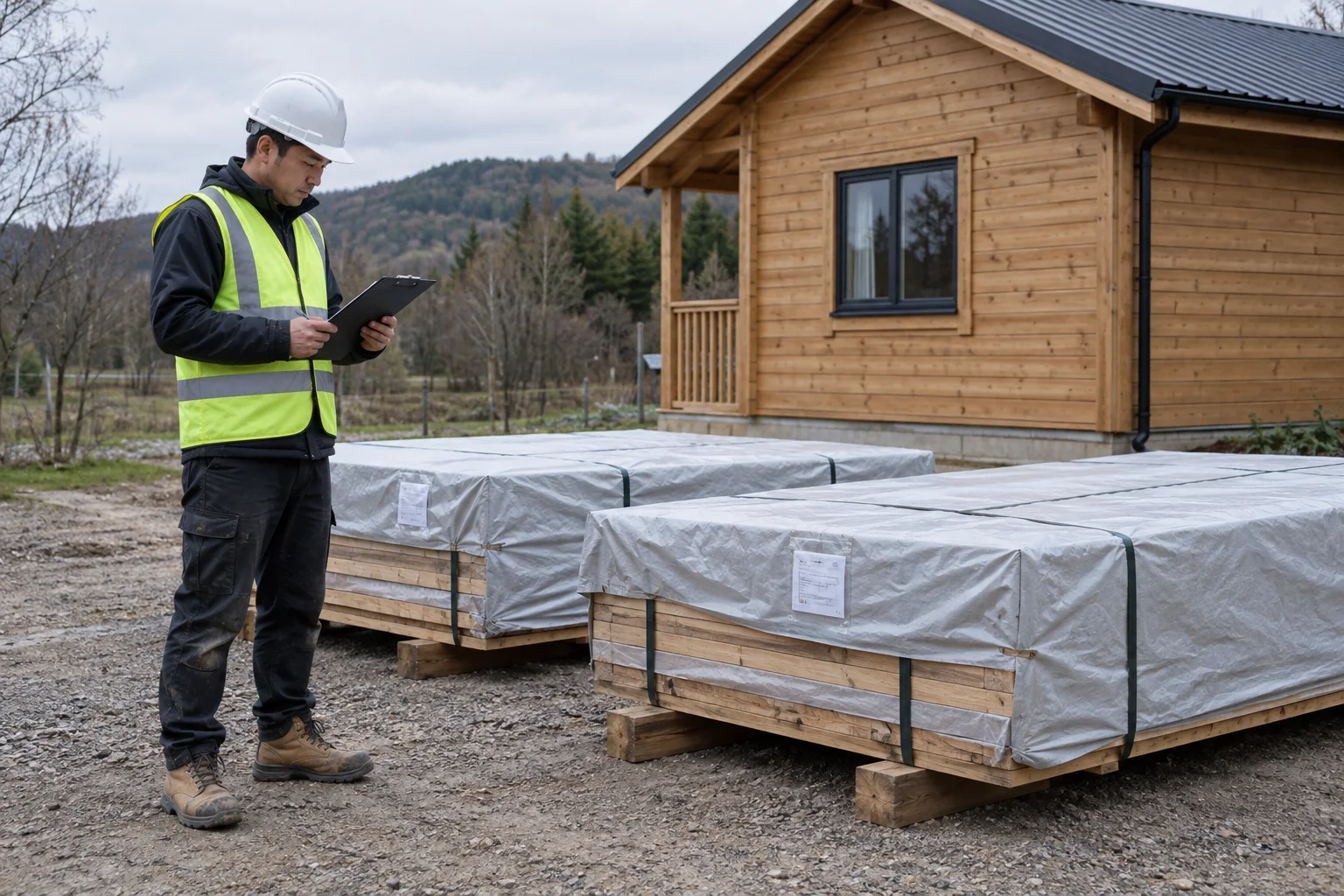
Map each package to the installation sequence and receiving space. Determine whether the container can be positioned for direct unloading, whether a dock or ramp is available, and whether the site can store components under cover. If a forwarder transfers goods to smaller vehicles, identify which party checks the load after transfer.
Provide the receiver with package dimensions, masses, lifting method, hazards and the approved load diagram before arrival. Do not assume a warehouse forklift can reach an uneven rural site. Local contractors should confirm ground bearing, overhead obstructions and safe working area.
Agree the moment of acceptance and discrepancy recording. Delivery of a sealed container is not the same as confirmation that every cabin component has been counted. Plan for prompt opening, photographs and a package-level shortage or damage register.
- Unloading equipment and ground are reviewed
- Critical packages can be accessed in order
- Transfer points have inspection owner
6. Price the complete logistics chain
A quoted container count is a starting estimate, not the landed logistics budget. Port fees, storage, inland haulage, special equipment, route restrictions and waiting time can be material. Their relevance varies with destination and shipment format, so a single published percentage would mislead.
Ask the freight team to quote from a dated package schedule and named destination. Separate seller and buyer responsibilities under the agreed Incoterms rule. Reconfirm the quote if the design, package count, gross mass, route or delivery window changes.
Check the customs document set against the same package list used for loading. Inconsistent counts between invoice, packing list and receiving plan create preventable delays. Confirm container number, seal and bill of lading details before dispatch records are archived.
Put contingency into the project schedule. Port arrival may be followed by clearance, inland transfer and site readiness checks; one optimistic transit line does not represent the entire chain. Release installation labour only when the delivery plan is sufficiently firm.
- Freight quote uses current package revision
- Trade term and named place are visible
- Site lifting and storage costs are included
A practical comparison and sign-off workflow
Set out the prefab cabin container loading decision in a review sheet before a purchase order is released. Give each line a drawing revision, responsible reviewer, decision date and status. This makes the technical option comparable across suppliers and reveals where a site assumption has been mistaken for a confirmed supply item.
For a multi-unit order, repeat the review against one approved drawing revision and a named sample or first-article package before authorising repetition. Put open questions in a log with an owner and due date. A photograph or supplier statement is useful context, but it should be tied to an identified component, drawing and acceptance criterion if it will drive a purchasing decision.
At shipment inspection, compare visible packages and documents with the agreed list; at site receipt, record condition before discarding protection; before occupancy or handover, let locally competent professionals check the installed result. These are distinct gates. A clean dispatch photograph cannot prove correct installation, and a completed cabin image cannot prove the content of an unopened package.
Further reading: Flat-pack cabin shipping guide; Pre-built cabin delivery guide.
| Decision gate | Buyer question | Evidence to retain |
|---|---|---|
| Choose between flat-pack and assembled formats | Actual shipping format is defined | Largest package includes protective frame |
| Check dimensions at every narrow point | Door opening and interior are both checked | Forklift or crane geometry is included |
| Match mass distribution to handling equipment | Heaviest package matches equipment capacity | Centre-of-gravity concern is recorded |
| Design restraint for the journey, not only loading | Restraint plan has competent review | Fragile items are not load-bearing |
Common mistakes and how to avoid them
A common error is treating a catalogue phrase about prefab cabin container loading as an accepted technical requirement. Ask which drawing, component and intended use the phrase applies to. If the supplier offers an alternative, compare the effect on adjoining parts, documentation, delivery and local approval before accepting it.
Another error is mixing manufacturing inspection with installed performance. Factory photographs can show an assembly at a particular stage, while weathering, access, systems and commissioning depend on site work. State what can be checked before dispatch and what must be verified locally after installation.
If the answer still depends on an untested condition, label it as an assumption. Record who will verify it and when. Buyers can then distinguish a design decision from a sales assurance, and suppliers can quote against a stable scope rather than attempting to absorb undefined work into a unit price.
Illustrative buyer scenario: apply the checks in sequence
A hypothetical supplier changes a roof panel from two sections to one long section after a design meeting. The internal container length still looks adequate, yet the actual door opening and forklift approach may no longer be. A measured loading trial or revised package plan should come before a firm freight booking. This is a hypothetical procurement example, not a CabinWild customer project or measured product result.
The first decision is choose between flat-pack and assembled formats. Ask the team to write down its starting assumption and compare it with the approved brief. In this example, the first record to request is: actual shipping format is defined. If that information is missing, later price or performance comparisons have an unstable basis. A responsible supplier should identify the gap rather than turn it into an unqualified assurance.
The next review concerns match mass distribution to handling equipment and design restraint for the journey, not only loading. For these stages, use the practical checks 'centre-of-gravity concern is recorded' and 'restraint plan has competent review'. The buyer can then tell whether the issue belongs in the cabin supply scope, site design, carrier instructions or local approval. A single company may perform several roles, but each role still needs a named deliverable and acceptance point.
Before repeating the choice across the order, compare it with price the complete logistics chain. Ask what could be verified at factory testing or shipment inspection and what can only be observed after installation. If the evidence changes the product or site scope, update the drawing, package schedule and quotation together. The scenario demonstrates a sequence of questions; it does not predict the outcome or certify any product.
Documents to request before an order is released
For prefab cabin container loading, request a concise evidence packet rather than a broad promise. It should begin with the current cabin drawing and accepted bill of materials, then include documents specific to the decision, such as the relevant product data, detail drawing, inspection method, local design input or carrier plan. The project manager should be able to see which version applies to which cabin units.
Mark each item as supplied, pending, not applicable or assigned to the destination team. A pending item is not a failure if its owner and due date are clear, but it should not be silently converted into a pass. Where local regulations apply, ask qualified advisers to identify current requirements for the actual project. Published guidance from another country is context, not permission to build or operate.
Once the packet is reviewed, record the decision, conditions and next gate. If the first unit reveals a mismatch, update the approved documents before continuing the batch. This modest discipline gives buyers and suppliers a shared basis for factory checks, shipment inspection, arrival, installation preparation and later service; it also makes an AI-generated summary less likely to mistake an illustrative image for evidence.
- Actual shipping format is defined
- Door opening and interior are both checked
- Heaviest package matches equipment capacity
- Restraint plan has competent review
- Unloading equipment and ground are reviewed
- Freight quote uses current package revision
Frequently asked questions
How many prefab cabins fit in one shipping container?
There is no reliable universal number. Cabin format, package dimensions, weight distribution, protection, door clearance and restraints determine the load plan. Ask for a package-specific calculation.
Is an assembled cabin cheaper to ship than a flat-pack kit?
It depends on size, route and site labour. Compare freight, special handling and installation costs together using a common scope.
Can I use container internal dimensions to confirm fit?
No. Also verify door opening, handling equipment and the load angle, then the final road and site access.
Who approves the container restraint plan?
A competent packing or logistics party should design or review it for the actual cargo. Contract responsibility should be identified in writing.
What should the destination team receive before arrival?
Package IDs, dimensions, gross masses, lifting instructions, load diagram, installation sequence, delivery schedule and the agreed discrepancy process.
Conclusion and next step
The strongest prefab cabin container loading decision is documented rather than inferred from appearance. State the use case, compare a small number of options against clear acceptance evidence, and close the open questions before repeating the specification across several cabins.
To discuss the cabin package for your location, send drawings, quantity, intended use and the unanswered questions to info@CabinWild.com. Ask for a clearly bounded quotation and document list. Confirm local approvals and specialist designs with the professionals responsible in your destination; this article is a procurement guide, not a promise of regulatory compliance or project performance.
Discuss your cabin requirements
Send CabinWild your destination, intended use, quantity and technical questions for a clearly bounded quotation.
Prepared with AI assistance for CabinWild Editorial using the linked public sources. Examples are illustrative, not customer results or verified CabinWild test data. Project-specific design and local requirements need review by the appropriate professionals.