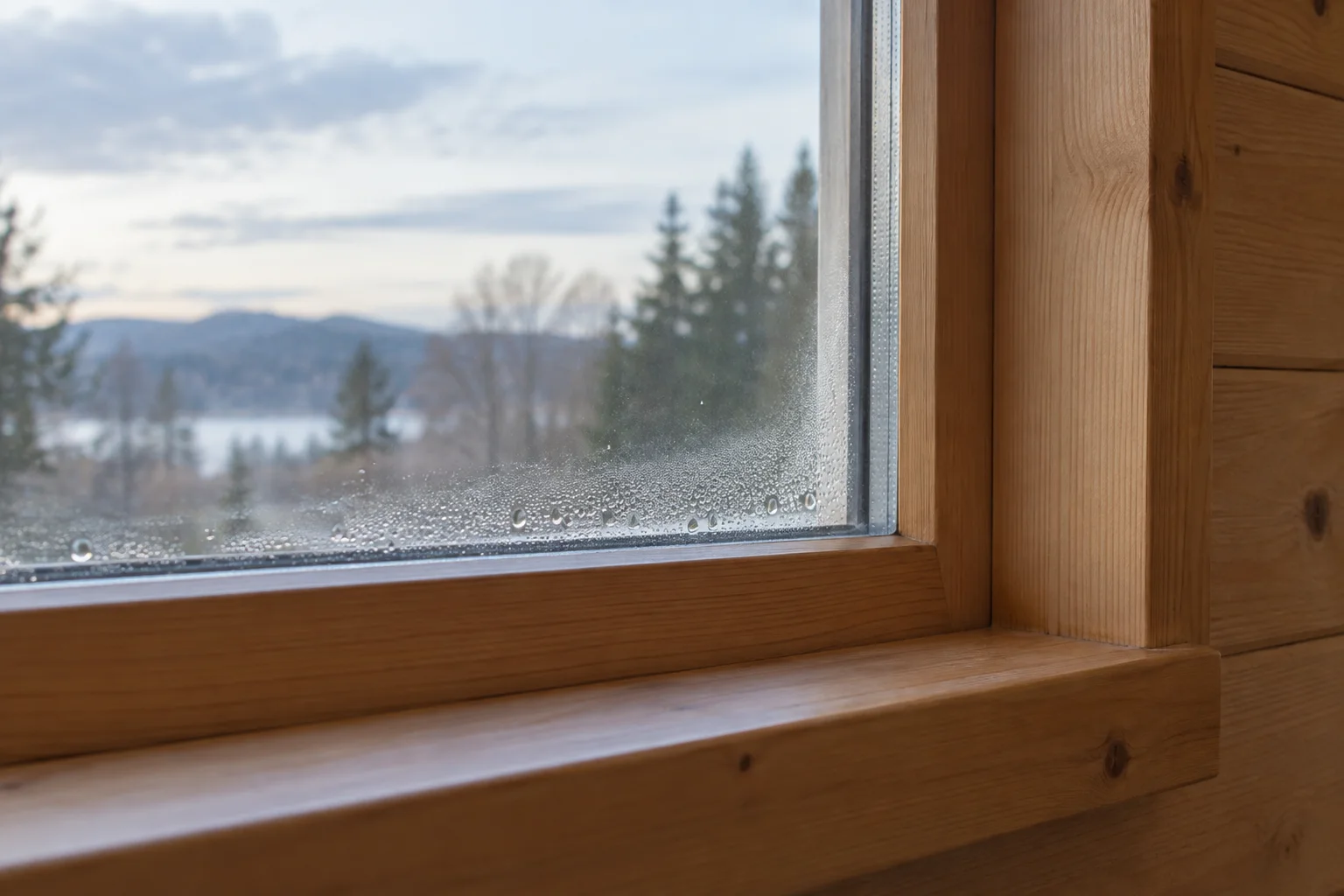
Log cabin condensation occurs when moisture in air condenses on a sufficiently cold surface, but a wet cabin can also have rain penetration, plumbing leaks or ground-related moisture. Identify the likely source before specifying repairs. Record weather, occupancy, surface location and repeated observations; have persistent or concealed problems assessed professionally. Ventilation, insulation, weathering and compatible log-joint seals have different roles and should not be substituted for one another.
Introduction: investigate the water before choosing a product
A damp window, dark patch or musty cupboard can lead to a quick purchase of sealant, extra insulation or a fan. That response may miss the actual cause. For a distributor or accommodation operator, repeating an unsuitable repair across several cabins can also obscure the evidence needed to solve the original problem.
Start with the building and its use, not a favourite treatment. This guide provides an observation and procurement framework, not a remote diagnosis or a construction method. Hidden decay, persistent mould, electrical exposure and uncertain structural condition need qualified local assessment. Do not open unsafe assemblies or work at height to collect photographs.
The examples below are hypothetical. They do not describe verified CabinWild incidents, laboratory results or completed repairs. Their purpose is to help buyers communicate customer requirements clearly and ask the right party for evidence.
1. Separate condensation from other moisture paths
Condensation is a moisture-and-temperature interaction, not simply evidence that timber is defective. Water appearing after occupied cold nights can justify investigating indoor moisture and cold surfaces. It does not prove that every nearby wet mark has the same cause. Several moisture paths can operate in one cabin.
A patch that follows wind-driven rain needs a weathering investigation even if indoor humidity is also elevated. A mark beside plumbing may need a services check. Persistent dampness near the base can involve exterior drainage, splash or other site conditions. Use these patterns as investigation leads, not automatic diagnoses.
The US EPA's moisture-control guidance treats moisture management across site, enclosure, plumbing and ventilation systems. That broad approach matters here: the log wall is only one part of the water-control arrangement. A supplier cannot resolve every site issue by changing the timber specification.
Further reading: US EPA: building moisture-control guidance.
| Observation | Possible investigation route | Useful record | Avoid assuming |
|---|---|---|---|
| Morning droplets on glass | Indoor moisture and surface temperature | Occupancy, heating and time | All water is a roof leak |
| Wet patch after storms | Rain entry or drainage detail | Weather direction and location | More ventilation repairs flashing |
| Dampness near a service | Plumbing or condensate route | Equipment use and timing | A stain identifies the exact source |
| Persistent wet base zone | Ground, splash and enclosure interface | Safe exterior photographs | A coating fixes drainage |
| Musty concealed corner | Restricted drying or hidden moisture | Repeated observations and access limits | Dry visible paint means dry structure |
2. Build an observation log before changing conditions
Give each affected location a reference that remains consistent between visits. Record when the problem was first noticed, recent rain, room use, heating pattern and whether doors or windows were open. Photograph a wider view as well as the detail, from a safe accessible position, so the location is understandable later.
Record operating events rather than blaming occupants. Showers, cooking, drying clothes and groups arriving at an intermittently heated cabin can change the conditions. New materials or recently completed work may also require a drying assessment. Ask what changed just before the symptoms appeared.
A simple temperature and relative-humidity logger can help show patterns, but its location and limitations matter. Record the device, position, interval and relevant operating events. One reading beside a heater or open window does not describe the whole cabin. Compare like locations over time rather than selecting the most reassuring number.
Keep original observations after a change. If someone adjusts heating, improves extraction or repairs a suspected leak, date that action in the same log. Without this record, later improvement may be attributed to whichever intervention is easiest to remember rather than the one that actually changed conditions.
For several cabins, use the same observation headings but maintain individual records. Orientation, occupancy, shading and local drainage can differ even where the supplied model is identical. Record unaffected comparison locations as well as complaints. Avoid concluding that every cabin has a production fault, or that none does, from a single photograph.
When handing the issue to an assessor, provide the construction information you actually have and identify missing documents. A layered roof section, window detail or joint profile can be more useful than an exterior brochure. Do not redraw an unknown assembly from memory and present it as the installed construction.
3. Understand what moisture measurements can and cannot show
Air readings are not timber readings
Relative humidity describes air under the measured conditions. A wood moisture reading addresses a different material question. Neither should be converted into a universal pass or fail for every cabin. Ask the assessor which instrument, material settings and measurement locations suit the actual investigation.
Surface temperature may help explain condensation risk, but a visible cold spot does not independently identify a construction defect. Thermal images and handheld readings need interpretation alongside weather, occupancy and construction details. This guide does not set a universal dew-point margin or acceptable timber moisture threshold.
Use trends with a defined inspection question
Ask what the measurement is intended to establish: recurring overnight conditions, drying after a repair, a difference between locations or possible concealed wetting. A professional can then choose a suitable method and explain uncertainty. Repeated comparable observations are more useful than an unexplained photograph of a meter display.
Do not puncture hidden service zones, remove structural material or open a damp electrical enclosure to get a reading. Where access is unsafe or the condition is uncertain, record the limit and engage the appropriate specialist. Missing information should remain missing until it can be obtained safely.

4. Decide how to vent a cabin from its use and climate
Separate removal of moisture at its source from the overall fresh-air strategy. The US Department of Energy describes local extraction and whole-house ventilation as different approaches, and states that kitchen and bathroom exhaust should discharge outdoors rather than into an attic. Its general guidance is not a cabin-specific system design.
Ask a qualified ventilation designer or installer to review the actual occupancy, wet rooms, enclosure and destination climate. Opening windows occasionally is not evidence that the intended occupied conditions are consistently served. Equally, adding an arbitrary fan without an air-supply and control strategy does not demonstrate a complete solution.
Keep combustion appliances outside informal trial-and-error changes. Ventilation alterations can interact with appliance operation and safety. Follow local requirements and competent specialist advice; do not block required openings or modify flues. A moisture problem does not justify disabling safety arrangements.
For intermittently used accommodation, agree both occupied and unoccupied operation. Ask who checks filters, controls and condensate arrangements where applicable. Customer instructions should reflect the commissioned system rather than a generic recommendation to leave everything open. No single fan size or ventilation rate is suitable for every cabin.
Further reading: US Department of Energy: general home ventilation guide (PDF); Coordinate year-round cabin comfort requirements.
Turn these questions into a project brief
Send CabinWild your location, intended use, cabin system and available drawings. Ask about supplied enclosure details and compatible joint information for review by your local professionals.
5. Treat log cabin waterproofing as coordinated water control
The phrase log cabin waterproofing can suggest a single coating that solves every moisture problem. Instead, identify how the roof, openings, wall joints and base manage water and how the construction can dry. The appropriate details depend on the actual system and climate. A decorative finish is not a substitute for a missing weathering detail.
Ask the supplier or responsible designer to distinguish exposed timber protection, drainage paths and air or vapour-control layers. These have different functions. Do not add a universal vapour barrier, impermeable coating or interior lining based on a photograph; changing one layer can alter the behaviour of the whole assembly.
Inspect maintenance-accessible drainage and weathering features safely, with professional support where required. Record blocked or damaged items for correction by the responsible party. A successful repair should address the identified entry path and its surrounding interfaces, not simply conceal a stain with a new finish.
Where a finish is proposed, confirm compatibility with timber condition, previous coatings, joint products and application circumstances. Obtain the product manufacturer's current guidance and the cabin system requirements. A treatment advertised for timber generally may not be appropriate for every surface or movement condition.
Further reading: Select cabin wood finishes with compatibility in mind.
6. Distinguish log cabin insulation between logs from wall insulation
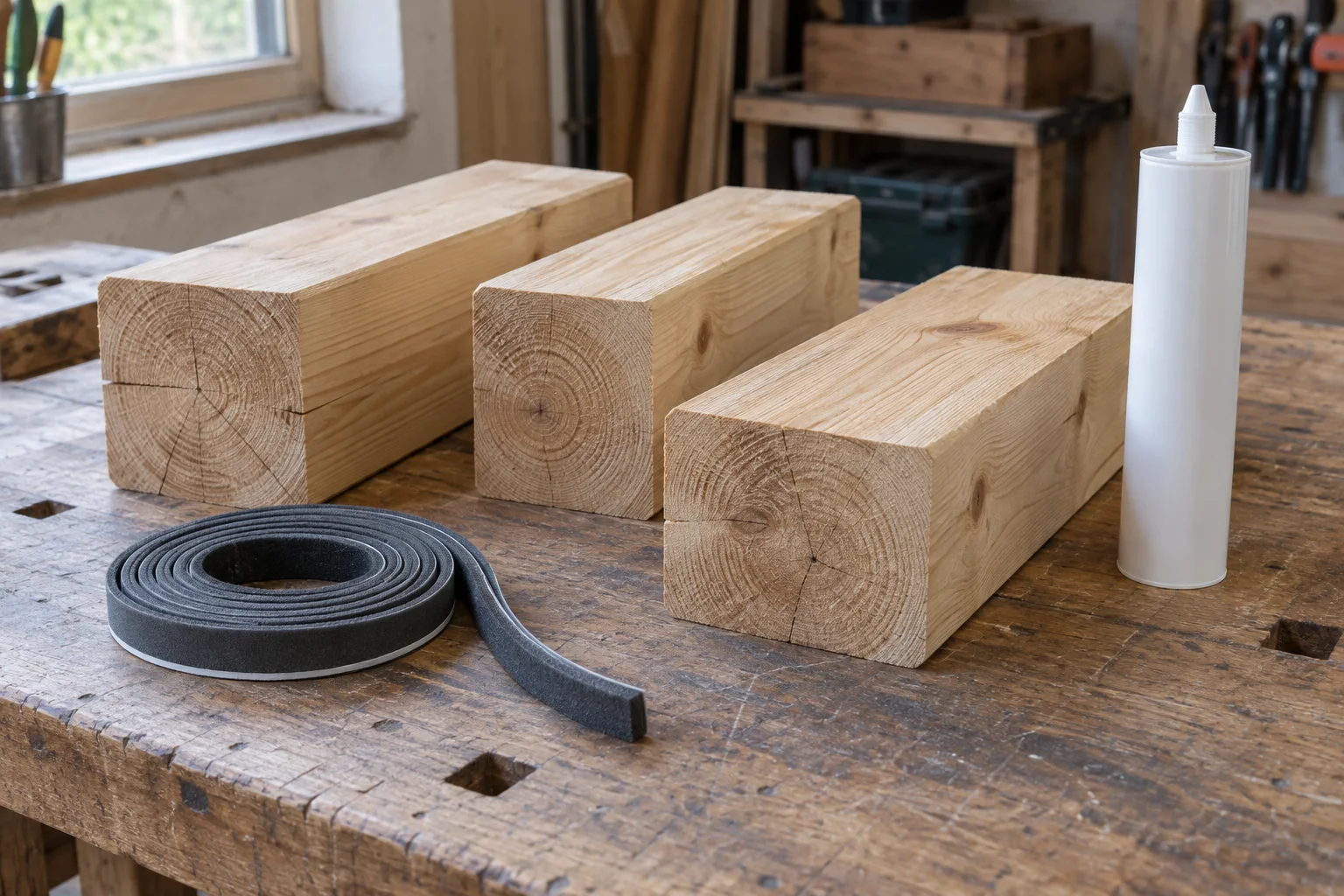
A buyer searching for log cabin insulation between logs may be asking about a joint gasket, compressible sealing material, visible chinking or an insulated wall build-up. Clarify which function is intended. Joint materials can help manage a specified gap or air path; their presence does not establish the thermal performance of the whole wall.
Confirm whether the cabin uses stacked logs, an interlocking profile, timber framing with cladding, or another system. Similar external appearances can conceal different assemblies. Obtain the profile drawing and the supplier's approved joint arrangement rather than transferring a detail from a different product.
Perma-Chink's sealing guidance distinguishes external sealing approaches from internal sealants and gasket tape used during log stacking. This manufacturer example shows that location and installation stage matter. It is not an endorsement of a particular material for CabinWild or a universal instruction for all log profiles.
For log cabin insulation strips, request the intended application, compatibility, dimensions specified by the system designer, movement provision and installation-stage instructions. Ask how corners, openings and service interfaces are coordinated. A roll described as insulating tape does not automatically satisfy an air-sealing, water-control or movement requirement.
Do not fill every visible gap indiscriminately. Some construction details intentionally accommodate movement or drainage. Where a joint appears defective, obtain a diagnosis and system-compatible repair detail. Expanding foam, rigid fillers and surface sealants should not be substituted without the responsible manufacturer's or designer's review.
Further reading: Perma-Chink: manufacturer guidance on internal and external log sealing; Distinguish log walls from timber-frame construction.
7. Ask how to keep a log cabin from rotting without hiding damage
A practical prevention plan focuses on limiting persistent wetting, maintaining designed water-control details and checking that affected materials can dry. It should include inspection access and responsibility, not just a product purchase. Track recurring moisture so small symptoms do not become normalised in routine maintenance.
If timber appears soft, distorted or persistently wet, arrange assessment rather than assuming a surface treatment restores its structural capacity. The appropriate response depends on extent, location and the building system. This article gives no repair sizing, structural acceptance criterion or promise that damaged timber can remain in place.
Visible mould also needs appropriate attention. EPA guidance emphasises that controlling the moisture problem is necessary; cleaning or covering a visible area without addressing its cause may not resolve recurrence. Substantial, concealed or recurring contamination, health concerns and uncertain building conditions warrant professional advice. Avoid disturbing suspect materials to obtain a better photograph.
Where there is active water near electrical equipment, significant deterioration or another immediate safety concern, restrict use of the affected area and contact the appropriate local professional. Commercial operators should follow their own safety and incident procedures rather than waiting for a supplier email before addressing urgent risks.
Further reading: US EPA: mould and moisture guidance for homes; Create an ongoing log cabin maintenance record.
8. Verify a response under comparable conditions
Consider a hypothetical rental cabin with droplets after occupied winter nights and a separate wall mark after storms. Treat those as two investigation tracks until evidence connects them. A ventilation adjustment might reduce the morning droplets while leaving the rain-related mark unchanged. Declaring the whole cabin repaired after one dry day would be premature.
Agree the intended outcome before work begins. Record the diagnosed cause, proposed action, responsible party and how effectiveness will be checked. Select an appropriate observation period and conditions with the assessor. A repair invoice confirms work was billed; it does not independently prove that the moisture source has been controlled.
For a new order, turn lessons into installation preparation and document requests. Ask which joints are completed during assembly, which require later inspection and which details must remain visible for agreed checks. Factory testing and shipment inspection should have defined scopes; neither replaces verification of destination weathering or ventilation.
Close the issue with the evidence and any continuing maintenance requirements. Record unresolved limits honestly, including inaccessible areas or conditions not yet repeated. For repeat orders, revise the relevant customer requirements only when the findings justify it. Do not generalise one site's moisture behaviour to every climate or product application.
A concise close-out record should distinguish the original symptom, the assessed cause, the completed action and the observation supporting closure. Include the assessor's limitations and any scheduled recheck. This makes the result usable by a future property manager without converting a conditional technical opinion into a permanent performance guarantee.
Frequently asked questions
Does condensation prove the cabin roof leaks?
No. Condensation and rain penetration have different mechanisms and can coexist. Record where and when water appears, weather and occupancy, then seek an appropriate investigation. A photograph alone rarely establishes the source or proves that a particular component is defective.
Will adding more insulation solve cabin dampness?
Not automatically. The cause may involve water entry, ventilation, air movement, cold surfaces or several factors. Additional insulation needs a coordinated assembly review. It does not repair a plumbing leak or establish that concealed wet material has dried sufficiently.
Are gasket strips the same as insulating a log wall?
No. A specified strip may serve a particular joint-sealing function. Whole-wall thermal performance depends on the complete assembly and its interfaces. Ask for the exact profile, material purpose and system instructions rather than assuming the name insulation strip proves a complete thermal solution.
Should I seal every gap before winter?
Do not seal unidentified gaps indiscriminately. Some details accommodate movement, drainage or required ventilation. Have the system and observed problem reviewed, then use a compatible approved detail. Preserve necessary openings and follow competent advice for any combustion or electrical systems.
What should a useful supplier moisture enquiry contain?
Include the cabin reference, construction details, dates, safe photographs, weather and use pattern, plus any professional findings. Separate observations from assumptions. Ask which supplied details and material documents can support the local assessment rather than requesting a guaranteed diagnosis from images.
Conclusion: match the intervention to an evidenced cause
Effective moisture management connects observation, diagnosis, compatible details and follow-up. Ventilation, weather protection, insulation and joint seals each have a role, but none is a universal cure. Preserve the evidence and involve local professionals where safety, concealed conditions or design changes are involved.
Contact info@CabinWild.com with your project location, intended use and enclosure questions. Request available product and joint documentation to support a properly scoped procurement or local technical review.
Clarify your cabin moisture-control requirements
Send CabinWild your location, intended use, cabin system and available drawings. Ask about supplied enclosure details and compatible joint information for review by your local professionals.
Prepared with AI assistance for CabinWild Editorial using the linked public sources. Examples are illustrative, not customer results or verified CabinWild test data. Project-specific design and local requirements need review by the appropriate professionals.