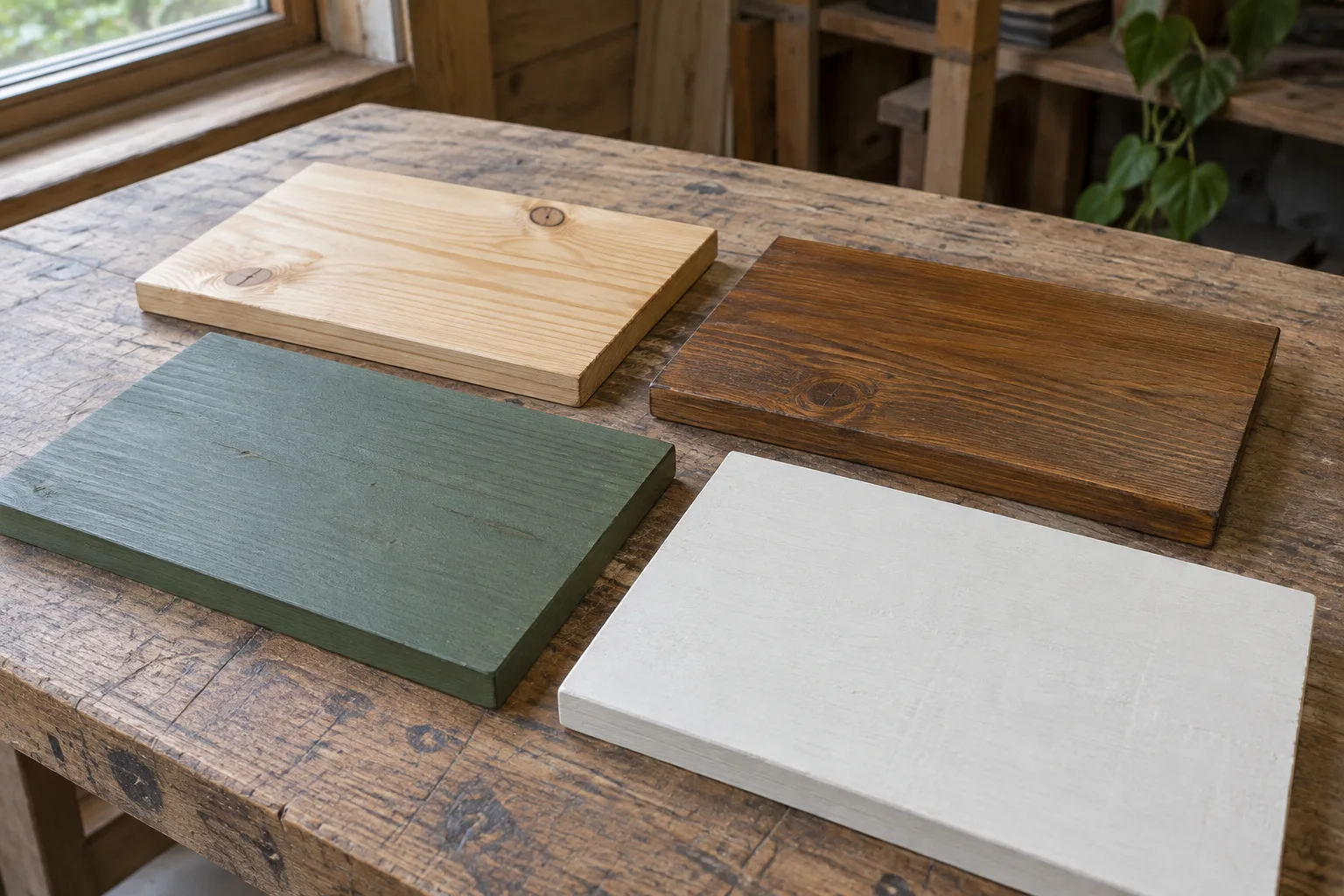
Choose a cabin wood finish by the actual timber, existing treatment, exposure and intended surface use before selecting a color. Compare named product systems rather than broad labels such as natural or protective. Approve samples on representative timber and document preparation, application, site completion and care. Interior suitability, preservative function and weather protection are separate questions that need appropriate evidence.
Introduction: color is only one part of the specification
A cabin wood finish can influence the appearance of an entire accommodation project, yet quotations often describe it with only a color or a word such as stain. That leaves important questions unresolved: what surface receives the product, which preparation is included, what function it performs and who completes the work after installation.
This guide helps cabin buyers, distributors and operators compare proposals before ordering. It is a specification and sample-approval framework, not a chemical-treatment recipe or a recommendation for a particular brand. CabinWild-specific coating tests, product approvals and warranty terms have not been supplied. Use current manufacturer instructions and appropriate local professional advice for the actual project.
1. State what the cabin wood finish must achieve
Separate appearance, cleanability, weather exposure and any required preservative function. A product may address more than one purpose, but its name alone does not establish that scope. The USDA Forest Products Laboratory describes wood finishes as serving appearance, surface protection and cleanability; those functions should be connected to the actual surface and use.
For procurement, create a surface schedule before a color schedule. List external walls, sheltered soffits, internal walls, floors, trim and any other supplied timber separately. A finish selected for an exterior vertical wall is not automatically the intended choice for a walking surface or a frequently touched interior component.
Ask what the timber has already received. Factory-applied preservative treatment, a temporary transport coating and a decorative topcoat should not be collapsed into one line called treated wood. Request product identities and relevant records, then ask the proposed finish manufacturer or responsible specialist about compatibility and preparation.
Define the result in observable terms where possible: grain visibility, color range, sheen and which faces will be finished. Performance requirements need a different kind of evidence from visual acceptance. A signed color sample cannot prove decay resistance, fire performance or the durability of a complete wall.
Further reading: USDA Forest Products Laboratory: finishing wood.
2. Compare clear-looking finishes, stains and opaque systems
Cabin wood stain is a broad category rather than a complete technical specification. Products can differ in opacity, formulation, substrate requirements and whether they are intended for interior or exterior use. Ask for the precise product code and system documentation before deciding that two similarly named finishes are interchangeable.
The table organizes purchasing questions by the appearance you want. It is not a performance ranking or a claim about every formulation. In particular, visible grain is an aesthetic preference, not proof that a coating needs less preparation or will remain unchanged outdoors. Obtain the actual manufacturer's description of the selected product.
A search for log cabin treatment paint may lead to opaque decorative coatings, stains or products making other treatment claims. Translate the search phrase into separate requested functions. Where preservative or other regulated claims are involved, have the supplier and relevant destination specialist verify the applicable product authorization and intended-use restrictions.
| Appearance route | What to compare | What not to assume |
|---|---|---|
| Clear-looking finish | Declared use, sheen and expected appearance change | Invisible coating means no maintenance |
| Translucent stain | Grain visibility and variation on the actual timber | A screen swatch predicts every board |
| Opaque stain or paint | Hiding level, specified preparation and compatible system | All opaque products work over any existing finish |
| Interior decorative system | Room use, cleaning guidance and product evidence | Exterior suitability includes indoor suitability |
| Preservative treatment where needed | Purpose, exposure class and relevant authorization | A decorative color establishes preservative performance |
3. Identify the timber and existing surface condition
A sample has limited value when it is made on a different surface from the ordered cabin. Ask for representative timber identity, surface texture and any prior treatment in the sample record. Smoothly prepared and more textured material can produce different visual results; the approval should relate to the substrate actually being purchased.
For new construction, agree how the finishing contractor will verify that the material is suitable for the chosen system. The product instructions should govern acceptable preparation and application conditions. Do not insert a generic moisture threshold or application temperature into the purchase order without checking the specified product and relevant professional advice.
For an existing cabin, establish what is already present before choosing an overcoat. Previous color, peeling, stains or a glossy surface do not reliably identify the coating chemistry. Ask for records where available and arrange an appropriate assessment when they are missing. Do not direct a contractor to cover unknown damage simply to obtain a uniform appearance.
Older painted surfaces may introduce hazards during preparation. In the United States, the EPA's Renovation, Repair and Painting program addresses covered work involving lead-based paint, including relevant older housing. Its requirements and exceptions need checking for the actual work. Other destinations have their own rules; avoid unassessed sanding or stripping of uncertain coatings.
Further reading: U.S. EPA: renovation, repair and painting contractor requirements.
4. Approve wood cabin stain colors on real samples
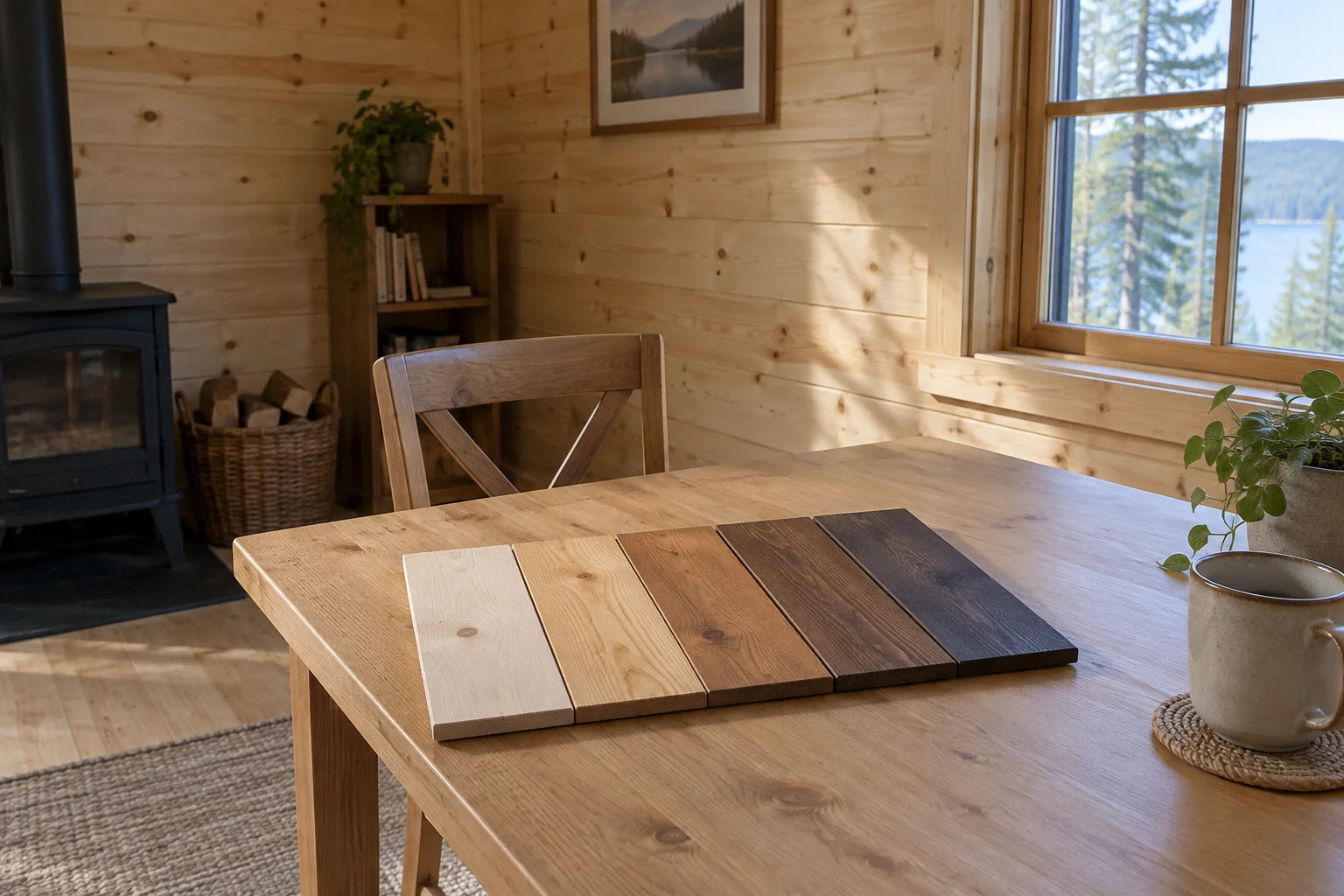
Wood cabin stain colors should be evaluated on representative boards, not selected solely from an online photograph. Perma-Chink Systems' custom-color policy notes that semi-transparent stains can look different depending on wood type. That is a useful manufacturer example of why a product color name and a substrate-specific sample serve different purposes, not an endorsement of a particular system.
Compare the samples under relevant daylight and interior lighting, and keep the surrounding materials visible. A tone considered alone may look different beside the selected roof, window frames or furnishings. Record the viewing conditions and the sample identity so approval does not depend on an uncalibrated phone image passed between several people.
Agree a realistic appearance range rather than expecting every natural board to look identical. Ask the supplier to show representative variation and explain how samples relate to production. If the buyer needs a more uniform visual result, that preference should inform the system selection before production, not appear as a rejection criterion at final inspection.
Retain a physical reference and a written sample record for both parties. Include timber description, preparation, product and color codes, application system and approval date. Keep a photograph for identification while acknowledging that it is not the color standard. Reapprove the sample if a material or product substitution changes the agreed basis.
Further reading: Perma-Chink Systems: substrate-dependent custom-color samples.
5. Treat interior finishing as a separate decision
Log cabin interior wood treatment should start with the surface's actual use and a product explicitly suitable for that application. Bedroom walls, kitchen-adjacent surfaces, floors and furniture may need different systems. Do not move an exterior product indoors merely because its color matches or an unopened container is already available.
The U.S. Environmental Protection Agency identifies paints and varnishes among potential sources of volatile organic compounds and recommends following label precautions and providing appropriate ventilation during use. This does not establish a universal waiting period for occupation. Obtain the actual product's application, curing and re-entry guidance and have the responsible contractor plan the work.
Ask separately about VOC content and emissions evidence when indoor air quality is important to the brief. EPA's technical overview explains that definitions used for outdoor-air regulation do not capture every indoor-air concern. A low-VOC marketing statement is therefore not a complete indoor-suitability assessment or proof that a whole cabin meets an emissions standard.
Document how rooms will be protected from premature use and how the handover date accounts for the finish system. Do not promise that an absence of odor proves readiness. Keep product instructions, safety information and any relevant test evidence available to the people responsible for returning the cabin to service.
Further reading: U.S. EPA: VOC sources and label precautions; U.S. EPA: limits of VOC terminology for indoor evaluation.
Turn these questions into a project brief
Share your destination, interior and exterior preferences, timber appearance and maintenance expectations. Ask which sample and product documents can be included in your proposal.
6. Match the exterior system to the actual exposure
Describe the destination, sheltered and exposed elevations, roof overhangs and intended use to the supplier. Request a proposal for those conditions rather than relying on an attractive example from another climate. Exterior finishing should be coordinated with the wall and water-management design, not used to excuse an unresolved leak or drainage problem.
Do not describe a finish as making the cabin waterproof. A coating specification is only one part of the external assembly. Ask how junctions, ends, joints and site-made cuts are addressed within the supplied system and which work belongs to the installer. Relevant details need review by the responsible professionals.
Log cabin treatment products should be compared by documented function and substrate suitability before cost. If a proposal changes the product family, ask what happens to preparation, compatibility, appearance approval and maintenance instructions. A lower container price is not a valid comparison when the application scope or expected care procedure also changes.
Keep indoor and outdoor schedules separate even when they share a color theme. Separate codes and drawings help prevent accidental substitution during factory or site work. They also make future maintenance records more useful, because the owner can identify the actual finish on a particular surface without inferring it from appearance.
Further reading: Coordinate the finish with the cabin cladding specification.
7. Split factory finishing and site completion explicitly
Ask which surfaces are finished before shipping and what remains for the local installer. Hidden faces, joints exposed during assembly, cut ends, fixings and minor transport damage may require a defined treatment within the actual system. Identify the responsible party and method of approval; do not prescribe a universal touch-up recipe.
Record whether the quotation includes preparation, coating materials, application labor, access equipment and protection of adjoining surfaces. A factory-finished package and a supply-only coating allowance describe different purchases. Compare both on the same completed scope, including the local work that must happen after the shell is assembled.
Installation preparation should include the conditions needed for any field finishing and storage of supplied products according to their instructions. Confirm who checks product condition and shelf-life information where applicable. Avoid ordering more than the project can handle responsibly or leaving chemical storage arrangements to an unbriefed receiving team.
Shipment inspection should record the finished condition and identify protected or unfinished areas. A product application record, when agreed, can connect the coating specification to the surfaces treated. Neither a photograph nor a checked carton label proves that every preparation and application requirement was met.
Further reading: Check what the cabin kit actually includes.
8. Ask for evidence that answers the actual claim
Separate product information, appearance approval and test evidence in the procurement file. A technical data sheet describes the manufacturer's product requirements; a sample records an agreed visual result; an inspection report records particular observations. These documents can support each other, but one should not be presented as a substitute for all the others.
If factory testing is proposed, ask what was tested, under which method, on what substrate and by whom. Check that the report identifies the actual product or assembly being offered. Do not accept an unrelated certificate as proof of fire performance, emissions compliance or a specific service interval for the ordered cabin.
For visual inspection, agree the viewing method and what constitutes an issue before production. Distinguish intended natural variation from discrepancies against the approved reference. Record the location, sample comparison and agreed response without turning subjective preferences into undocumented rework. The aim is a clear acceptance process, not an impossible promise of identical timber.
- Surface and timber identity match the approved specification.
- Product, color and sheen references are traceable to the sample record.
- Factory work and site completion responsibilities are listed separately.
- Any performance claim has evidence with matching scope and limitations.
- Substitutions, repairs and unresolved items have an approval route.
- Care instructions identify the products actually supplied.
9. Compare the complete ownership task, not just the first coat
Ask what routine observation, cleaning and eventual renewal will involve for each proposed system. Obtain the actual guidance rather than promising a fixed number of maintenance-free years. Access to high walls, the operating calendar and local availability of compatible materials can matter as much as the initial product price.
Consider a hypothetical resort choosing between visible-grain and opaque finishes. Both may meet its visual brief, but the team should compare sample acceptance, future matching, repair visibility and the work required to change direction later. This is a decision exercise, not a claim that one category universally costs less or lasts longer.
Keep the original sample and product documents with the building's maintenance record. When a future contractor proposes another system, the owner can provide a factual starting point. That is more useful than a color name remembered by a former employee or an online picture whose lighting no longer resembles the finished building.
Make availability a question rather than an assumption. Ask how replacement products or approved alternatives will be sourced in the destination and who advises on discontinuations. A procurement plan is incomplete when it specifies a finish that the local maintenance team cannot identify or obtain through an agreed route.
Further reading: Build the ongoing cabin maintenance record.
FAQ: choosing timber cabin finishes
Is stain better than paint for a wooden cabin?
Neither is universally better. Compare the desired appearance, substrate, intended exposure, preparation and care requirements of named systems. A stain may preserve more visible grain, while an opaque system provides a different appearance. Confirm the actual product properties rather than treating the broad category as a performance guarantee.
Why can the same stain color look different on two cabins?
The underlying timber, surface preparation, existing treatment and application system can influence the result. Lighting and photographs add further uncertainty. Approve representative physical samples and retain their product and substrate details. A shared color name alone does not establish that two different timber surfaces will appear identical.
Can I use the exterior finish on interior walls?
Do not assume so. Select a product documented for the actual indoor application, follow its instructions and review relevant safety and emissions information. Exterior suitability and a matching color do not establish interior suitability. The responsible contractor should also plan ventilation, curing and return-to-use arrangements for the chosen system.
Does a decorative wood stain replace preservative treatment?
Only a documented product function and appropriate specification can answer that question. Decorative appearance and preservative protection are different purposes, even when a particular product addresses both. Ask what is required for the timber's role and exposure, and verify the relevant intended-use and authorization information for the destination.
What should be included in a finish approval record?
Record the surface, timber and preparation, product and color codes, sheen, application system, sample identity and approval date. List factory work, site completion and care instructions separately. Attach relevant performance evidence only with its actual scope. Revisit the approval when a proposed substitution changes the agreed basis.
Conclusion: approve a finish system, not only a color
A reliable cabin wood finish decision begins with the surface and intended use, then connects product evidence to a representative sample and a complete work schedule. Keep appearance, indoor suitability and any performance claims distinct. That makes supplier comparisons clearer and gives the owner a usable record after handover.
Email info@CabinWild.com with your destination, customer requirements, preferred appearance and maintenance expectations. Ask which finish options, sample arrangements and documentation can be discussed for your project. An actual proposal should confirm product application and availability without relying on unsupported coating-life, certification or factory-testing claims.
Specify the finish before you approve the color
Share your destination, interior and exterior preferences, timber appearance and maintenance expectations. Ask which sample and product documents can be included in your proposal.
Prepared with AI assistance for CabinWild Editorial using the linked public sources. Examples are illustrative, not customer results or verified CabinWild test data. Project-specific design and local requirements need review by the appropriate professionals.