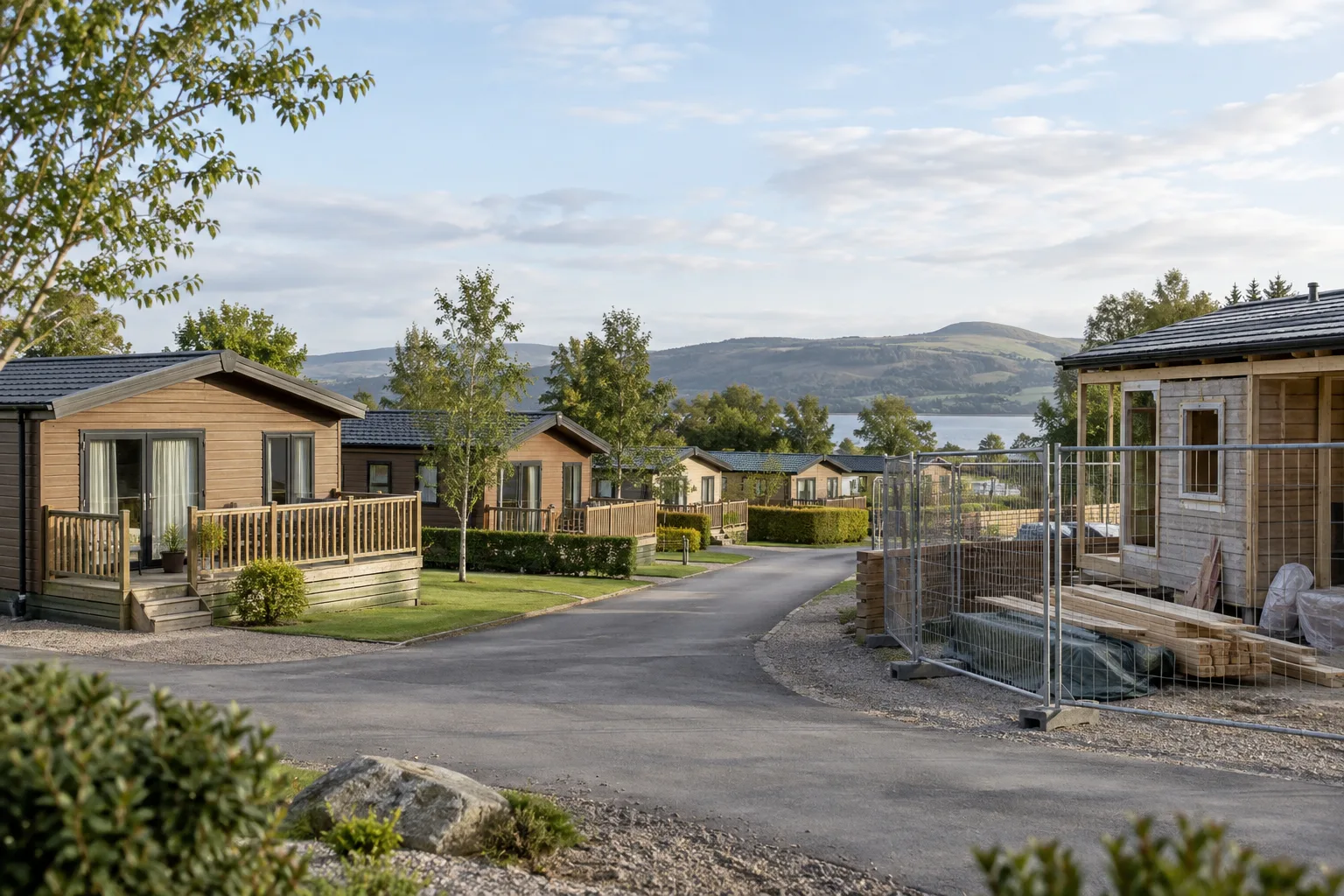
Replacing cabins in an operating park is a coordinated removal, construction and return-to-service project. Define each phase's guest boundary, access route, service isolation and acceptance criteria before placing orders. Existing pitches and connections are not automatically suitable for new units. Schedule reopening from verified completion dependencies, not simply from the factory dispatch date.
Introduction: replacing accommodation is not a standalone delivery
A holiday park can have mature landscaping, established services and returning guests, yet still require substantial coordination when cabins are replaced. The new units must reach their pitches, existing accommodation must be removed safely, and the operating park must remain manageable around the works. The purchase order is one part of that wider sequence.
This guide is for operators comparing cabins for caravan parks and similar accommodation sites. It uses hypothetical planning examples, not claimed CabinWild projects or promised turnaround times. Local planning, construction, fire, accessibility and operating requirements need professional review for the actual park and use. No generic replacement schedule can establish them.
1. Define what the replacement programme must achieve
State why the existing cabins are being replaced. The objective might be a different room configuration, improved maintainability, a refreshed product offer or the retirement of unsuitable units. Describe the required functions rather than assuming that a newer cabin automatically improves every aspect of operation. A clear brief makes the supplier comparison more meaningful.
Identify which parts of the park will remain open and which services must remain available. Include reception, guest routes, emergency access, waste collection and staff operations where relevant. The construction team needs to understand the live-site constraints before proposing a sequence, not after the first delivery has been booked.
Keep commercial targets separate from confirmed technical milestones. An intended reopening period can guide planning, but it should not be presented as guaranteed while design, approvals or site work remain unresolved. Record who has authority to release accommodation for sale and what evidence that decision will require.
2. Survey the existing pitches, units and services
Obtain an appropriate survey of the areas affected by the works. Ask the local professionals to identify the information needed on existing structures, supports, services and access. A park plan used for bookings may not be accurate enough for construction coordination. Confirm the actual conditions before reusing dimensions or connection assumptions.
Do not assume that an old foundation or pitch is suitable for a new cabin. The proposed configuration, loads and interface may differ. Have the engineer review the actual support arrangement and necessary work. A similar external footprint does not establish compatibility, and the buyer should not direct unreviewed adjustments to make the new unit fit.
Existing cabins should be assessed appropriately before removal, including any relevant material or service hazards. Use competent local contractors and the required procedures. This article does not provide demolition methods or hazardous-material advice. The procurement task is to ensure those assessments and responsibilities are included in the project scope.
3. Define phases around workable boundaries
A phase should be more than a list of cabin numbers. Map the work area, delivery route, material storage, service isolation and guest interface. Ask the construction team and operator whether the proposed boundary can be maintained throughout the phase. A small phase can still be impractical if it interrupts a critical route through the park.
HSE's construction planning guidance provides a Great Britain reference for managing and coordinating work. The relevant destination framework should govern the actual project. Have competent professionals plan the separation of construction activities from guests and staff. Do not treat a line drawn on a site plan as a complete safety arrangement.
Compare the operational effects of several possible sequences. One may remove adjacent units together, while another may prioritize an area with simpler service isolation. The preferred sequence depends on the actual park. Record the reasons and dependencies rather than claiming that one generic approach always minimizes disruption.
Further reading: HSE: planning and coordinating construction work.
| Phase decision | Question | Release evidence |
|---|---|---|
| Work boundary | Can guests and staff use retained areas appropriately? | Reviewed site-management arrangements |
| Removal | Are existing units and services assessed? | Required surveys and contractor plan |
| Site readiness | Are supports and connections suitable? | Relevant design and site verification |
| Delivery | Can the actual shipment reach the work area? | Confirmed route and handling plan |
| Reopening | Is the completed unit ready for its intended use? | Required acceptance and operational checks |
4. Coordinate isolation without assuming the network layout
Have qualified service professionals establish how affected units can be isolated while retained accommodation continues operating. Existing drawings may need verification. A valve, cable route or connection point should not be assumed to serve only the cabin beside it. The actual network matters to both safety and continuity of service.
Review whether the replacement specification changes demand or equipment. A new bathroom, kitchen or heating arrangement may require different service provisions. The relevant designers should assess capacity and connection suitability. Do not assume that a previous cabin's connection establishes acceptance for a different unit or occupancy.
For parks using onsite wastewater systems, consult the applicable local framework and professionals. EPA septic guidance offers a US reference, not approval for a particular park. Include commissioning, records and any required changes in the phase budget. Service readiness should be an explicit prerequisite to reopening, not an unfinished task after guests arrive.
Further reading: EPA: septic systems; Review remote-cabin water and wastewater planning.
Turn these questions into a project brief
Send the park location, proposed unit schedule, access constraints and operating requirements. Ask for available specifications and dispatch dependencies.
5. Standardize the replacement specification where useful
A repeatable room and component schedule can simplify purchasing and maintenance, provided it suits the actual pitches and guest requirements. Identify which elements should remain consistent across phases and which need local variation. Standardization is not a reason to ignore site constraints or required accessible accommodation.
For US projects within the relevant scope, the Access Board's accessible-route guidance is an authoritative starting point. Have the project team determine applicability and coordinate the whole guest journey. A cabin should not be described as accessible because one doorway appears wide. The approach, internal layout, fixtures and relevant facilities need coordinated review.
Ask the supplier how model revisions and substitutions will be controlled between phases. The first and last deliveries should be traceable to their agreed specifications. If a component changes, record the operational and maintenance consequences. Keep approved alternatives explicit rather than accepting a visually similar replacement without review.
Further reading: US Access Board: accessible routes; Review accessible resort-cabin procurement.
6. Match dispatch to real site readiness
Request the actual package or unit dimensions, weights and delivery requirements early enough for contractor planning. Confirm the route within the park and any constraints created by retained accommodation or landscaping. The competent contractor should determine safe handling arrangements. This guide does not prescribe a lifting method or assume a crane can reach every pitch.
Agree what must be completed before each dispatch is released. Relevant prerequisites may include approved documents, verified supports, suitable access and protected storage. The exact list belongs in the project programme. Sending units before those dependencies are resolved can move delay from the factory to an expensive or inconvenient site location.
For imported supply, clarify the named delivery point and transport responsibilities. ICC's Incoterms guidance helps explain the selected rule, but the purchase agreement must also address the broader obligations. Keep shipping milestones distinct from installation and operational handover. A vessel arrival date is not a guest-ready date.
Further reading: ICC: Incoterms 2020; Review cabin manufacturing lead-time dependencies.
7. Use the first completed unit as a controlled review point
Where the programme allows, complete and review an initial unit before releasing every later detail unchanged. The review can check the agreed layout, maintenance access, housekeeping practicality and document handover. Describe this as a proposed project process, not as evidence that a CabinWild pilot has already been tested.
Include the people who will operate the accommodation, not only the purchasing team. Ask them to walk through arrival, cleaning, replenishment and routine maintenance. Record specific observations and assign decisions. An operational walkthrough does not replace technical inspections, but it can reveal avoidable practical problems before they are repeated.
Manage any resulting changes through the same design and commercial controls as the original order. Identify affected drawings, components, costs and later phases. Do not make informal onsite modifications and assume the factory will infer them from photographs. The approved record should show what is now standard and what remains unique to the first unit.
A hypothetical phased replacement example
An operator might review one completed cabin's luggage storage and service-panel access before confirming the fitout for the remaining phase. If the changes are accepted by the relevant teams, update the room schedule and supplier documents. This example illustrates a decision sequence only; it does not claim a measured reduction in defects, downtime or operating cost.
8. Keep factory, arrival and site acceptance separate
Define factory testing and shipment inspection against the actual order requirements. Confirm unit identity, approved revision and the agreed evidence before dispatch. On arrival, record accessible condition and discrepancies through the agreed procedure. These checks do not establish that the local foundations, services or completed accommodation are acceptable.
Site acceptance should cover the work completed by the local team and any required authority or professional inspections. Identify hold points before concealed work is closed. Retain the final documents, test records and defect closures. A general statement that the cabin passed inspection is not useful unless the scope and responsible party are clear.
For sleeping accommodation in England and Wales, the government's fire-risk assessment guidance is an important reference within its scope. Other destinations require their own applicable review. Have the operator and appropriate professionals coordinate the completed arrangements before reopening. Do not rely on a factory document to answer every operational fire-safety question.
Further reading: UK government: fire-risk assessment for sleeping accommodation.
9. Set a return-to-service checklist and release owner
Create a checklist for the completed unit and the surrounding guest route. Include required technical acceptance, service operation, housekeeping, information, keys and operational readiness. The exact content should be established by the operator and relevant professionals. Appoint a person with authority to confirm that the necessary evidence is complete.
Keep booking availability aligned with that release process. A target date can be communicated internally, but unresolved defects or missing acceptance records should remain visible. Avoid treating a construction team's anticipated finish as a confirmed guest arrival date. The commercial team needs a reliable status, not optimistic language that hides dependencies.
After reopening, capture relevant operational observations and defects through a defined channel. Distinguish routine adjustments from issues requiring professional assessment. Use the findings to inform later phases without claiming every concern can be solved by changing a supplier component. Some issues may arise from site work, services or operating arrangements.
10. Compare the whole replacement programme
When comparing holiday cabins for sale, include removal, site preparation, service work, installation and handover alongside the new-unit price. Use actual proposals and clearly labeled allowances. Do not invent lost-revenue figures or assume the newest cabin will command a particular nightly rate. The operator should model commercial assumptions separately and transparently.
A search for resort cabins for sale or campsite cabins for sale can reveal many product choices, but the best fit depends on the operating programme. Ask suppliers to respond to the same phase schedule and specification. The useful offer is the one whose scope, evidence and dependencies can be integrated into the real park project.
Practical buyer workshop
Use one phase-status sheet across purchasing and operations
Create a status sheet for each phase showing the cabin configuration, site readiness, service dependencies, dispatch status and return-to-service evidence. Assign an owner to each unresolved item. The sheet should make it clear whether a delay concerns manufacturing, transport, local work or operational acceptance rather than describing every issue as a supplier delay.
For a hypothetical park retaining neighboring units, a delivery date might remain feasible while the intended internal route becomes unavailable because another contractor needs it. Record the conflict and have the competent teams revise the plan. Do not simply move the delivery through guest areas without the necessary review and coordination.
Give the bookings team an operational status that reflects the release criteria. Terms such as delivered, installed and ready for guests should have distinct meanings. This reduces the chance that an optimistic construction update is mistaken for permission to sell a specific arrival date.
At the end of the phase, retain the status sheet with the final documents and lessons relevant to the next phase. Record actual observations rather than invented performance improvements. The programme can learn from its own evidence while keeping each new phase subject to the site, design and operating conditions that apply to it.
FAQ: replacing cabins in an operating park
Can a new cabin use the existing foundation?
Only after appropriate project-specific review. The new configuration and support interface may differ even when the footprint looks similar. Have the local engineer assess the actual foundation and proposed unit. Do not assume that previous occupation or a similar catalogue size establishes suitability for the replacement.
Should all cabins be replaced at once?
There is no universal answer. Compare access, service isolation, guest separation, contractor arrangements and commercial constraints. A phased approach can be useful, but a poorly defined phase may create repeated disruption. Have the competent project team evaluate the actual park and document the chosen sequence and dependencies.
Can I reopen as soon as installation finishes?
Not necessarily. Required technical acceptance, services, safety arrangements, housekeeping and operational readiness must be confirmed. Establish a return-to-service checklist and an authorized release owner. Installation completion, supplier handover and permission or readiness to accommodate guests may be separate milestones.
Why review the first completed unit?
A controlled review can test the agreed operational layout and handover process before details are repeated. It does not replace professional inspection or prove a particular financial benefit. Record observations, obtain the necessary approvals and update the specification formally before changing later units or factory orders.
What should the supplier receive in an enquiry?
Provide the location, unit schedule, intended occupancy, phase plan, access constraints and required supply boundary. Identify the local project team and unresolved approvals or service questions. Ask for current specifications and dispatch dependencies. The supplier needs the operating context as well as the desired cabin appearance.
Conclusion: buy cabins as part of a controlled replacement sequence
Successful procurement for an operating park depends on more than selecting new accommodation. Define the phase boundaries, verify existing conditions, coordinate services and access, and establish a clear reopening process. Keep supplier milestones connected to the actual site readiness and acceptance requirements.
Send CabinWild your phased replacement brief to discuss available cabin specifications and supply scope. Use the response with your local project team's removal, installation and commissioning proposals before confirming the programme.
Build a phased cabin supply brief
Send the park location, proposed unit schedule, access constraints and operating requirements. Ask for available specifications and dispatch dependencies.
Prepared with AI assistance for CabinWild Editorial using the linked public sources. Examples are illustrative, not customer results or verified CabinWild test data. Project-specific design and local requirements need review by the appropriate professionals.