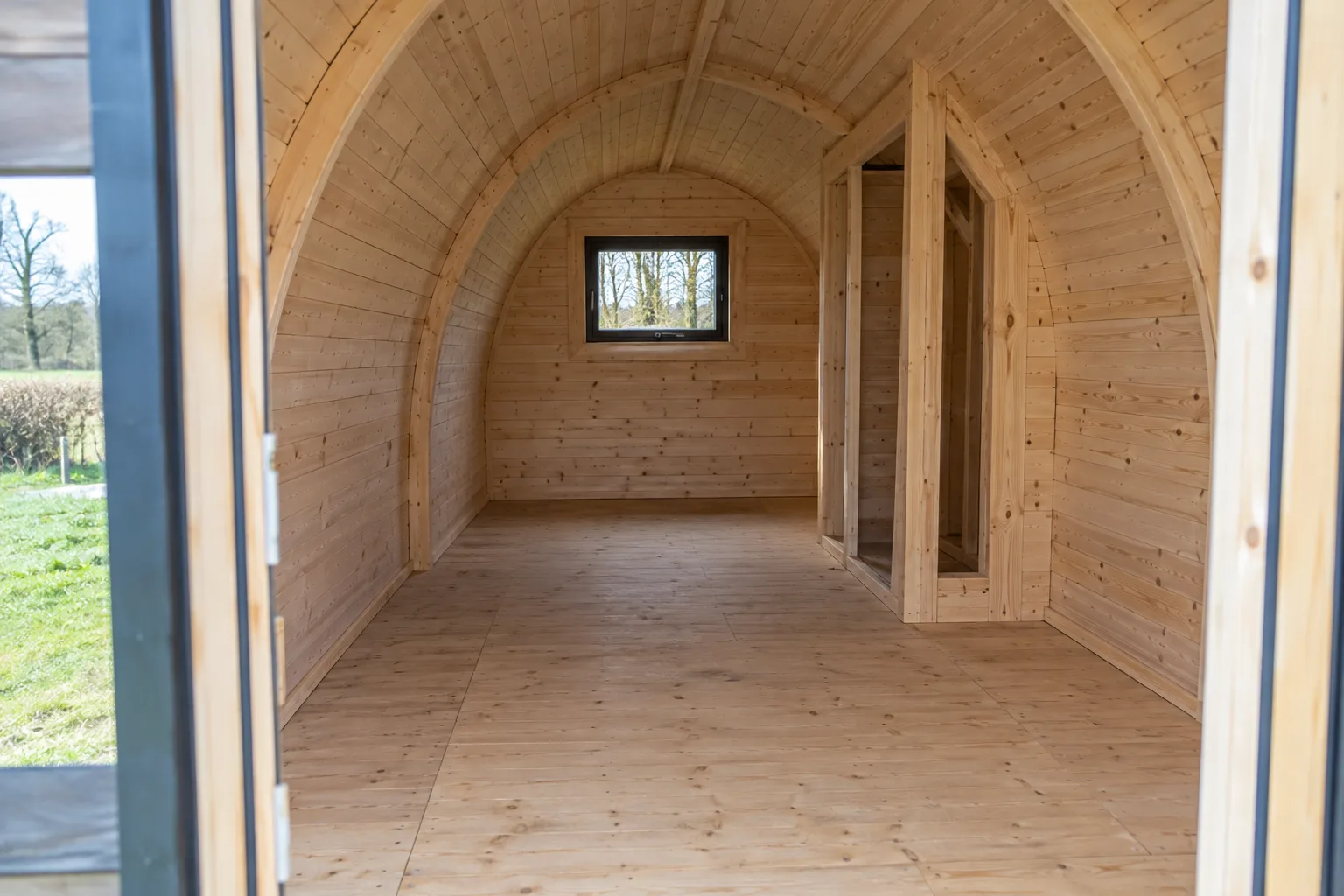
Glamping pod prices are comparable only when they describe the same shell, fitout, services and delivery boundary. Separate the factory package from foundations, site utilities, installation, approvals and opening preparation. An ensuite or ready-to-use label should be backed by an itemized schedule. Use current quotations rather than a generic price range that hides what the operator still needs to provide.
Introduction: buy an operating scope, not an ambiguous pod label
One camping pod quotation may include little more than a protected enclosure, while another shows a bathroom, kitchenette and furniture. The lower headline number can be useful for a buyer with an established local fitout team, but misleading for an operator expecting guest-ready accommodation. The first task is to make the completion boundary explicit.
This guide helps resort buyers, campsite operators and distributors compare offers. It does not provide current market prices, revenue forecasts or a guaranteed payback. All example budgets are frameworks, not CabinWild quotations. Request current supplier and local contractor figures for the actual destination, selected pod and proposed operating model.
1. Divide glamping pod prices into defined completion stages
Use your own written definitions for shell, enclosed package, fitted pod and opening-ready accommodation. Ask each supplier to confirm where its offer sits. A shell might include different combinations of structure, roof finish, windows and floor. A fitted pod may still exclude appliances, local electrical work or connection to site utilities. The label alone does not establish the boundary.
Create a schedule showing each major item and whether it is installed, loose-supplied, optional or excluded. Include the floor and roof layers, doors, windows, internal surfaces, bathroom, kitchenette, heating, ventilation, lighting and furniture. Mark the drawings and pictures that illustrate optional configurations so they cannot be mistaken for the accepted order.
For repeated units, record the standard specification separately from guest-facing upgrades. An upgraded finish or appliance should not silently alter a service requirement in every pod. Use model and revision references that remain traceable through production and handover. A clear tier structure helps both procurement and later replacement-parts planning.
| Stage | Define explicitly | Do not assume |
|---|---|---|
| Shell | Structure and enclosure components | All weathering and insulation included |
| Enclosed package | Windows, doors, roof and floor scope | Interior services installed |
| Fitted pod | Named fixtures, equipment and finishes | Site connections completed |
| Installed unit | Placement and local work | All operating approvals closed |
| Opening-ready accommodation | Accepted services and operator preparation | Guaranteed occupancy or financial return |
2. Match the fitout to the guest experience you will operate
Describe the target stay: short breaks, longer holidays, couples, families or shared-facility camping. Record expected guest numbers, cooking arrangements, luggage, wet clothing and cleaning routines. Do not select a package only because it supports the largest advertised sleeping capacity. The operator must be able to use, clean and maintain the arrangement at the intended service level.
A pod with shared site facilities can have a different internal brief from an ensuite unit. Compare the guest journey, distance and access to shared amenities, housekeeping tasks and local requirements. Removing the bathroom from a pod does not make sanitation costs disappear; it may move them into a separate site facility. Keep the comparison at the whole operating-system level.
Use a hypothetical arrival and turnover walkthrough before choosing upgrades. Where do guests put luggage, where does cleaning equipment go and which surfaces are repeatedly exposed to water? Those observations can justify a practical specification more clearly than a luxury label. They also help distinguish an essential requirement from a decorative option that can be deferred.
Further reading: Compare pod layouts and procurement requirements.
3. Itemize the ensuite rather than buying a bathroom icon
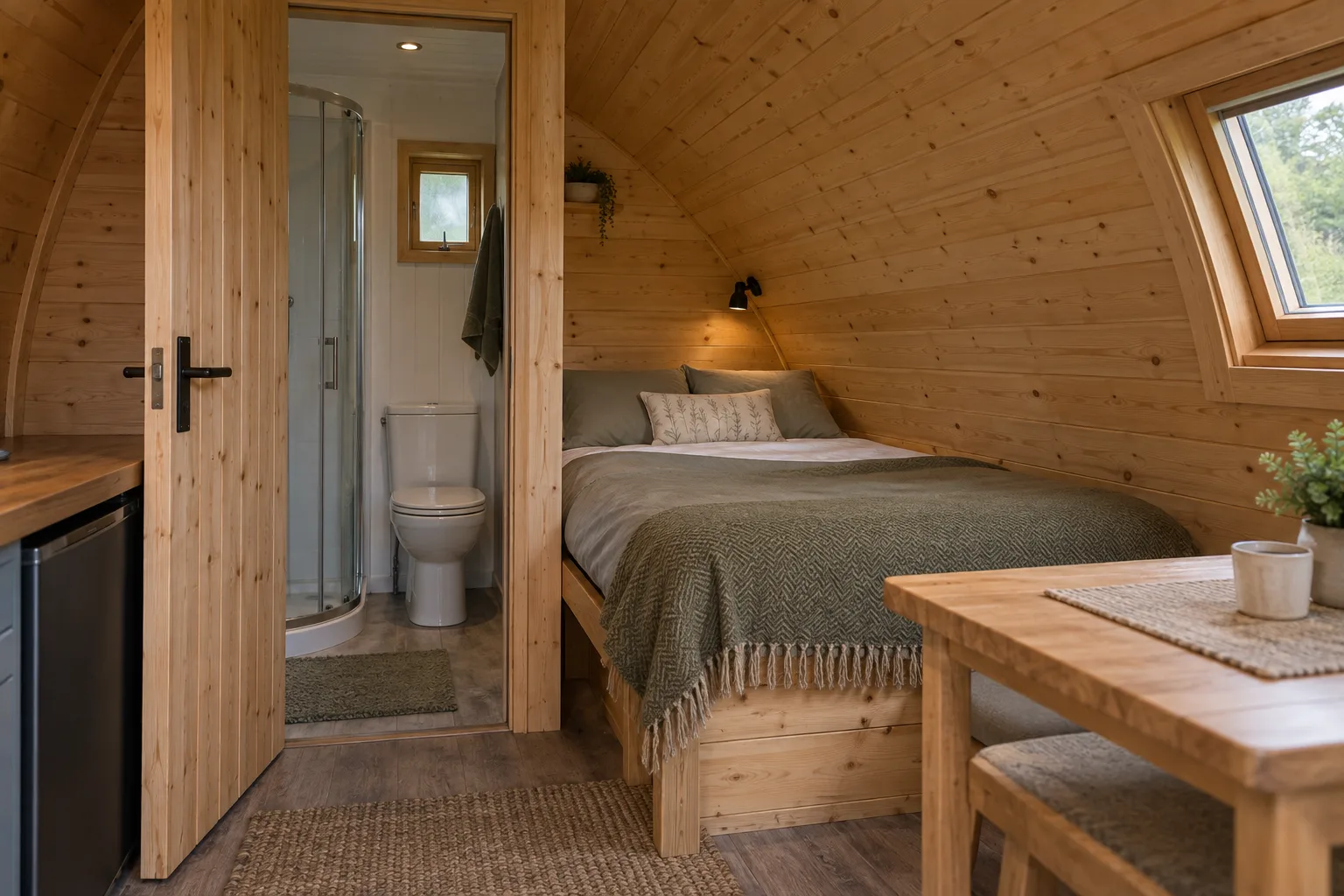
Ask for the actual fixture schedule and completed dimensions. Identify sanitary fittings, hot-water equipment, ventilation, finishes, waterproofing and access panels, then state who designs and installs each part. A bathroom symbol on a floor plan does not establish that those elements are included or coordinated for the destination.
Clarify the service boundary outside the pod. Where are water, wastewater and electrical connections located, and who confirms their compatibility with the site? A factory-fitted bathroom can reduce some site work while still requiring local connections and acceptance. Do not use a finished interior photograph as evidence that the entire sanitation arrangement is ready for occupation.
The US Environmental Protection Agency's onsite wastewater material explains that site wastewater is its own system and management topic. It is a US reference, not a design for an overseas campsite. Ask the appropriate local specialists to assess the actual site arrangement. That work belongs in the budget even when the pod supplier excludes it from the goods price.
Further reading: EPA: septic and onsite wastewater information; Define remote cabin water and wastewater responsibilities.
4. Ask what the installed equipment actually includes
List heating, cooling, ventilation, lighting, sockets, hot water and any cooking equipment by product and scope. Distinguish factory installation from destination connection and commissioning. Ask local qualified trades to review the proposed equipment and documentation before the fitout is fixed. A socket or appliance visible in a photograph is not evidence of local suitability.
The Department of Energy's building-science resources emphasize the role of insulation within the building enclosure. For a buyer, that means reviewing equipment with the selected envelope rather than assuming a small pod automatically needs minimal services. The actual climate, guest pattern and design determine the appropriate proposal; this article does not size equipment or forecast its running cost.
Keep maintenance access in the layout. A compact bathroom or kitchenette can be expensive to repair if a routine component is hidden behind permanent finishes. Ask how filters, valves, controls and equipment can be reached and replaced. A slightly different cabinet arrangement may be more valuable to an operator than a premium decorative finish.
Further reading: Department of Energy: insulation as part of the building enclosure.
Turn these questions into a project brief
Share the destination, quantity, guest capacity, bathroom preference and site-service information. Ask for separate shell, fitout and delivery lines.
5. Keep site infrastructure outside the pod price visible
List surveys, local design, foundations or supports, access, drainage, utility distribution and landscaping separately from the manufactured unit. Confirm the boundaries with the site contractor. A repeat pod design may help standardize some work, but ground and service conditions can vary across a site. Do not assume every pitch has the same preparation cost.
For a hypothetical first phase of four pods, separate shared infrastructure from costs that arise for each unit. A service route or plant area may support several units, while connections and installation are repeated. Record how the shared cost is allocated in the budget so the first unit does not appear artificially expensive or later units artificially cheap.
Avoid expanding capacity solely because a larger order reduces a unit quotation. The site must support the proposed number and use of units. Review permissions, services, access and operating constraints with the relevant professionals. A volume discount does not answer whether the additional accommodation can be installed or operated as intended.
6. Compare transport and placement responsibilities
A completed pod and a flat-pack package can have different transport and destination handling needs. Obtain actual dimensions, weights and packing information for the selected fitout. Added equipment or a changed shape can affect the shipment. Have the forwarder and placement contractor assess the real configuration rather than a standard catalogue outline.
Where Incoterms rules are used, identify the rule, named place and version. The International Chamber of Commerce describes the rules as allocating specified delivery-related responsibilities. Ask your advisers to explain the chosen term in the actual transaction. Do not assume included shipping means the pod will be unloaded and connected at the final pitch.
Separate port or terminal costs, inland transport, access preparation, unloading and placement. Agree who coordinates the sequence and what happens if the site is not ready. A complete pod waiting for a foundation can create a different storage problem from packed components. Include the realistic local handling plan in the comparison before selecting the supply format.
Further reading: ICC: Incoterms 2020 delivery responsibilities; Review pre-built cabin delivery and placement.
7. Budget for the actual hospitality review
Tell the design and approval teams that the units will be used as guest accommodation where that is the intention. Fire safety, accessibility, services and operating requirements should be reviewed for the relevant jurisdiction and site. Do not use a garden-room example as evidence for a commercial glamping proposal with sleeping guests.
The UK government's sleeping-accommodation fire-risk guidance is a primary reference for the jurisdiction and premises within its scope. It illustrates why a hospitality operator needs more than a product brochure, but it should not be applied as a worldwide pod specification. Obtain competent local advice and identify what records and actions are required for the actual operation.
Keep the cost of design and verification visible. If a supplier includes some supporting documents, list them; if local assessment remains necessary, price it separately. A generic certificate should not be assigned a financial value as though it closes all approvals. The useful question is which requirement the evidence answers and which decisions remain with local professionals.
Further reading: UK government: fire-risk guidance for sleeping accommodation.
8. Build a quote-based glamping pod cost to build schedule
Use one spreadsheet with columns for amount, currency, supplier, date, scope and certainty. Distinguish firm quotations from allowances and unresolved items. Keep taxes and exchange-rate assumptions visible and obtain appropriate professional advice. A total made from several provisional entries should be labelled provisional, even when the spreadsheet calculates it precisely.
Do not turn a shell price into a guest-ready total by adding an arbitrary percentage. Obtain actual fitout and local-work estimates where possible. A percentage contingency can be part of a professionally prepared budget, but it should not hide known missing tasks. Identify those tasks first, then discuss the remaining uncertainty with the project team.
For camping pod prices to buy comparisons, prepare a short difference schedule for each offer: what is included elsewhere, what remains unpriced and what support differs. This often explains the apparent price gap more usefully than a single ranked total. Keep the calculation traceable so a later specification change can be priced without rebuilding the comparison from scratch.
9. Include acceptance and after-sales work in the offer
Specify relevant factory testing and the records needed for installed systems. Shipment inspection should check the chosen fitout and accessible condition, while destination commissioning verifies the completed connections and operation. Do not treat these as interchangeable quality labels. A pod can be correctly fitted at the factory and still require competent local work before guests arrive.
Ask how defects, missing components and replacement parts are handled. Identify any limits on labor, freight or access costs in the written warranty and have important terms reviewed. A promise to send a part is not necessarily a promise to carry out the local repair. The operator needs to understand that difference before selecting a lower-priced package.
Retain the first-unit review and use it to refine later orders. Record practical observations from cleaning and maintenance without presenting them as a measured performance study. If a fixture or layout changes, update the supply schedule and spares list. Repeated purchasing should become more traceable, not increasingly dependent on informal assumptions.
10. Separate purchasing cost from commercial performance
Opening preparation may include furnishings, linen, operating supplies, staff familiarization and guest information. List the actual items needed for your operation and identify who provides them. Do not assume a ready-to-use supplier label covers every operator task. Inspect and accept the completed accommodation before using its photographs to sell a service level it cannot yet deliver.
Revenue, occupancy and return on investment require separate market and financial analysis. This article offers no predicted nightly rate or payback. Use the operator's own evidence and qualified advice for those decisions. A clearer glamping pod price to buy comparison improves the purchasing input; it does not establish whether the business model will succeed.
Practical buyer workshop
Price the route from shell to guest-ready room
Take one proposed pod and list every step between its quoted delivery condition and the intended guest-ready condition. Identify who supplies the bathroom equipment, completes connections, installs loose furniture and provides the relevant operating documents. Use actual provider quotations where available and mark the remaining items as allowances or unresolved work.
For a hypothetical comparison, a shell-only pod and a fitted pod might share the same external appearance but require different local trade packages. Ask both suppliers to respond to one room and equipment schedule. Do not assume that a fitted bathroom includes every destination connection or that a bed shown in the image is supplied.
Keep the handover condition explicit in the final order. The buyer should be able to describe what remains to be completed after delivery without relying on the word finished. That clarity helps the operator plan installation preparation and commissioning while avoiding an invented universal price for a guest-ready pod.
FAQ: glamping and camping pod budgets
Why are glamping pod prices difficult to compare?
Offers can describe different shells, fitouts, service scopes and delivery boundaries. Establish the same completion stage and itemize the package before comparing totals. Also separate site infrastructure, local work and opening preparation. A similar pod shape or interior photograph does not establish that two offers include the same accommodation.
Does an ensuite pod include wastewater treatment?
Not necessarily. A supplied bathroom and the site's wastewater system are separate scopes. Ask where the pod connections stop and who designs, installs and accepts the site arrangement. Obtain local professional advice for the actual property. A finished shower and toilet do not prove the external services are ready.
Is a shell always cheaper overall than a fitted pod?
No. A shell moves more work to the local team, where labor, coordination and component costs must be assessed. A fitted pod may shift work into the factory while changing transport and verification needs. Compare the same completed accommodation using current quotes, rather than choosing only the lowest initial goods price.
Can I estimate the full budget from a price per bed?
That ratio can hide major differences in bathrooms, services, usable space and site infrastructure. Define the intended guest experience and complete scope first. Use a traceable cost schedule with actual quotes and visible allowances. Do not treat additional bed symbols as equivalent capacity without the necessary design and local review.
What information produces a useful pod quotation?
Provide the destination, quantity, guest brief, bathroom and cooking requirements, intended season of use and known site-service arrangements. Ask for separate shell, fitout and delivery scope. Include local document requirements where available. Keep product pricing separate from unverified assumptions about occupancy, income or financial return.
Conclusion: price the accommodation you actually intend to open
Glamping pod prices become meaningful when the shell, fitout, services and local work are defined. Compare current offers against one guest brief, then retain the evidence and responsibility schedule needed for installation and operation. The right budget is transparent about both included work and unresolved assumptions.
Send CabinWild your destination, quantity and customer requirements through the inquiry form. Ask for a scoped quotation with separate package and delivery lines. Review the remaining local work with your site team before committing to the order.
Request a scoped glamping pod quote
Share the destination, quantity, guest capacity, bathroom preference and site-service information. Ask for separate shell, fitout and delivery lines.
Prepared with AI assistance for CabinWild Editorial using the linked public sources. Examples are illustrative, not customer results or verified CabinWild test data. Project-specific design and local requirements need review by the appropriate professionals.