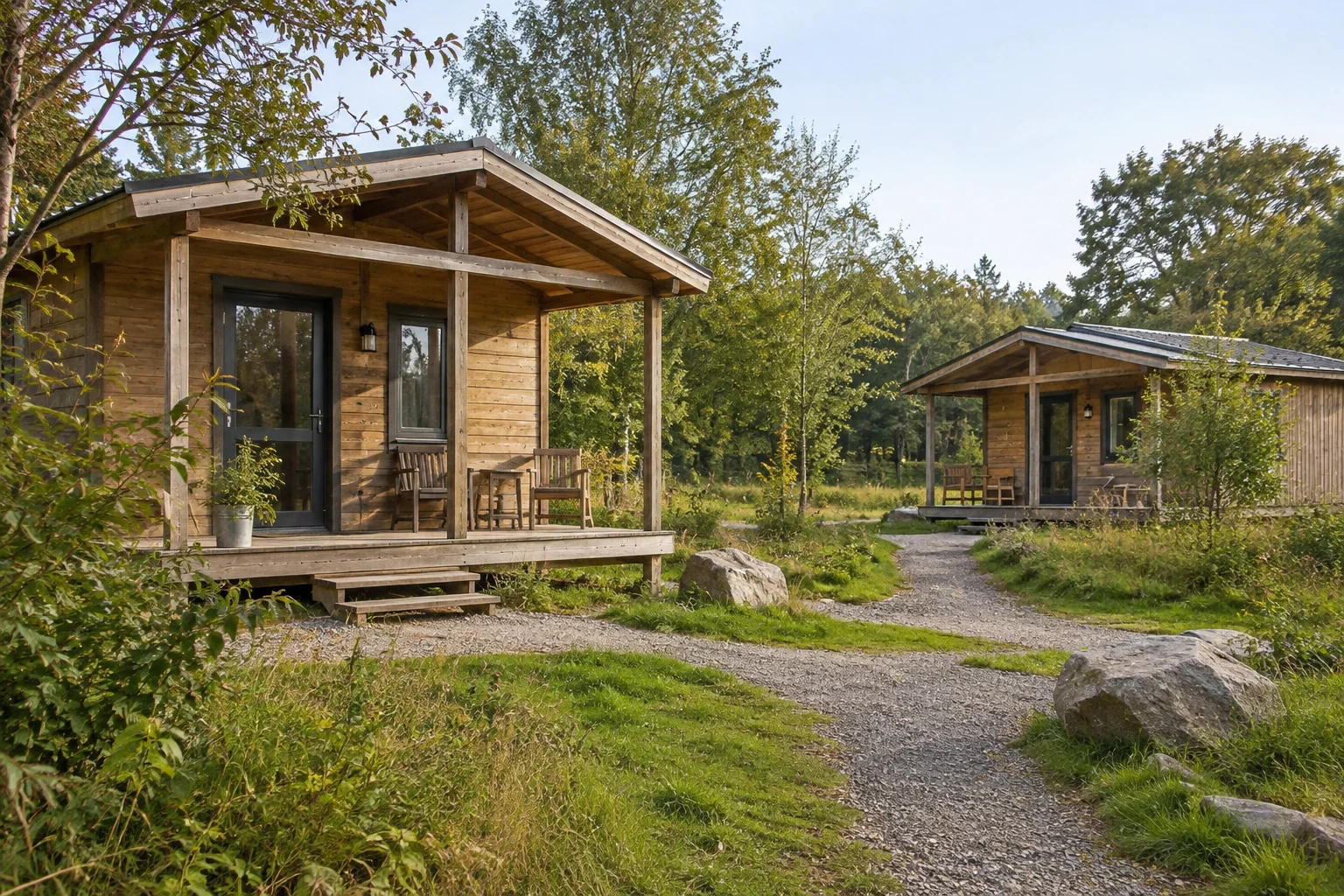
Compare glamping cabins for sale against a written guest and operating brief. Confirm the sleeping arrangement, bathroom and kitchen scope, seasonal comfort requirements, cleaning access, delivery format and site connections. A cabin purchase is only one part of opening accommodation: local approvals, utilities, installation and operational acceptance need their own responsibilities and budgets.
Introduction: buy for the stay you intend to deliver
Two cabins can look equally appealing in a photograph while creating very different work for an operator. One arrives as prepared timber components; another includes fitted finishes but still needs site connections. One suits short stays using shared facilities; another reserves substantial internal space for an ensuite bathroom. Those differences matter before finishes or furniture are selected.
This guide helps importers, campsite owners and resort developers turn those choices into a procurement brief. It is not a business-return forecast or a report of a completed CabinWild project. The operating scenarios are illustrative. Product suitability, installation scope and destination requirements must be confirmed for the actual order and site.
1. Define the guest brief before reviewing glamping cabins for sale
Start with who will occupy the cabin and how they will use it. A couple staying for two nights may prioritize an unobstructed view and a comfortable shower. A family staying longer may need separate sleeping areas, a dining surface, accessible luggage storage and somewhere to dry outdoor clothing. Neither brief is automatically a larger or more luxurious version of the other.
Record normal occupancy separately from occasional sleeping capacity. A sofa bed may add sleeping places while removing evening seating and blocking access to storage. Ask the designer to show both daytime and nighttime arrangements. Advertised bed count should not become the only basis for choosing the layout or estimating the operational suitability of a unit.
Describe the intended product application, arrival pattern and length of stay. Include whether guests cook, work indoors, bring sports equipment or rely on shared facilities. These customer requirements give camping cabin manufacturers something concrete to respond to. They also help your local team identify where the cabin specification and the wider site must work together.
Further reading: Prepare a cabin customization brief.
2. Choose a manageable range of room types
A first development does not necessarily need a different layout for every pitch. Consider a small family of room types with a shared material palette and selected common fittings. Standardization is a purchasing choice, not proof that every plot has identical conditions. Orientation, access, ground levels and utility connections still need a site-specific review.
Compare glamping cabin designs using the same operational questions: where guests sleep, change clothes, store bags, eat and move to the bathroom. If a feature adds a new maintenance task or replacement component, decide whether it provides enough guest value to justify that responsibility. A striking shape is useful only when the whole stay works.
| Operating brief | Cabin priorities | Question to resolve |
|---|---|---|
| Short couple stays | Comfortable bed, luggage space, privacy | Does the bathroom scope match the site offer? |
| Family stays | Separate sleeping, dining, storage | Does nighttime circulation remain usable? |
| Outdoor activity guests | Entry storage and robust finishes | Where do wet clothes and equipment go? |
| Longer seasonal stays | Kitchen scope and service access | Can utilities support the proposed use? |
| Inclusive accommodation | Coordinated room and arrival access | Has a qualified local reviewer assessed the complete route? |
Do not let the product name decide the specification
Cabin, lodge, pod and hut are commercial descriptions, not interchangeable technical specifications. Ask for the actual construction system, dimensions and supplied components. A product sold under one name in a particular market may serve a different use elsewhere. Choose from documented suitability rather than assuming that a familiar label establishes approval or year-round performance.
3. Decide the bathroom and kitchen boundary early
An ensuite bathroom changes more than the floor plan. It introduces water supply, drainage, hot-water demand, ventilation, waterproofing details and maintenance access. Establish who designs, supplies, installs and commissions each part. A fitted shower tray in a photograph does not establish that the complete wet-area system or the destination connections are included.
Shared facilities can be an intentional operating model, but the guest journey must support it. Consider the route in poor weather, privacy, cleaning provision and the needs of the intended guests. Do not present a cabin without plumbing as a finished alternative to an ensuite unit without acknowledging what services the campsite must provide elsewhere.
Kitchen specifications also need a boundary. A kettle station, kitchenette and full cooking arrangement impose different equipment, ventilation and cleaning demands. Record the actual appliances and connection requirements rather than using the word equipped. Coordinate equipment choices with the local services designer and confirm whether the proposed products can be used in the destination market.
4. Specify comfort for the operating season
Tell the supplier when the accommodation will operate and what indoor conditions the project team expects. A seasonal retreat and an all-year rental require different design conversations. Ask for the complete wall, roof, floor and opening specifications, including how the supplied package manages air leakage and the interfaces between components.
The U.S. Department of Energy's building-science guidance treats climate, glazing, insulation, air sealing and building services as interdependent parts of a whole-house approach. The procurement implication is to review the cabin as an assembled system. A heater size, insulation thickness or attractive glazed front cannot by itself demonstrate comfort for your location.
Large windows should be considered alongside orientation, shading, privacy and the intended use of the interior. Request a design review of likely summer and winter conditions rather than a generic all-season claim. Ask how guests will operate ventilation and heating controls, and how staff can inspect or service them without disrupting unrelated parts of the room.
Further reading: DOE: a whole-house approach to performance; Review year-round wooden cabin considerations.
5. Design cleaning and maintenance into the purchase
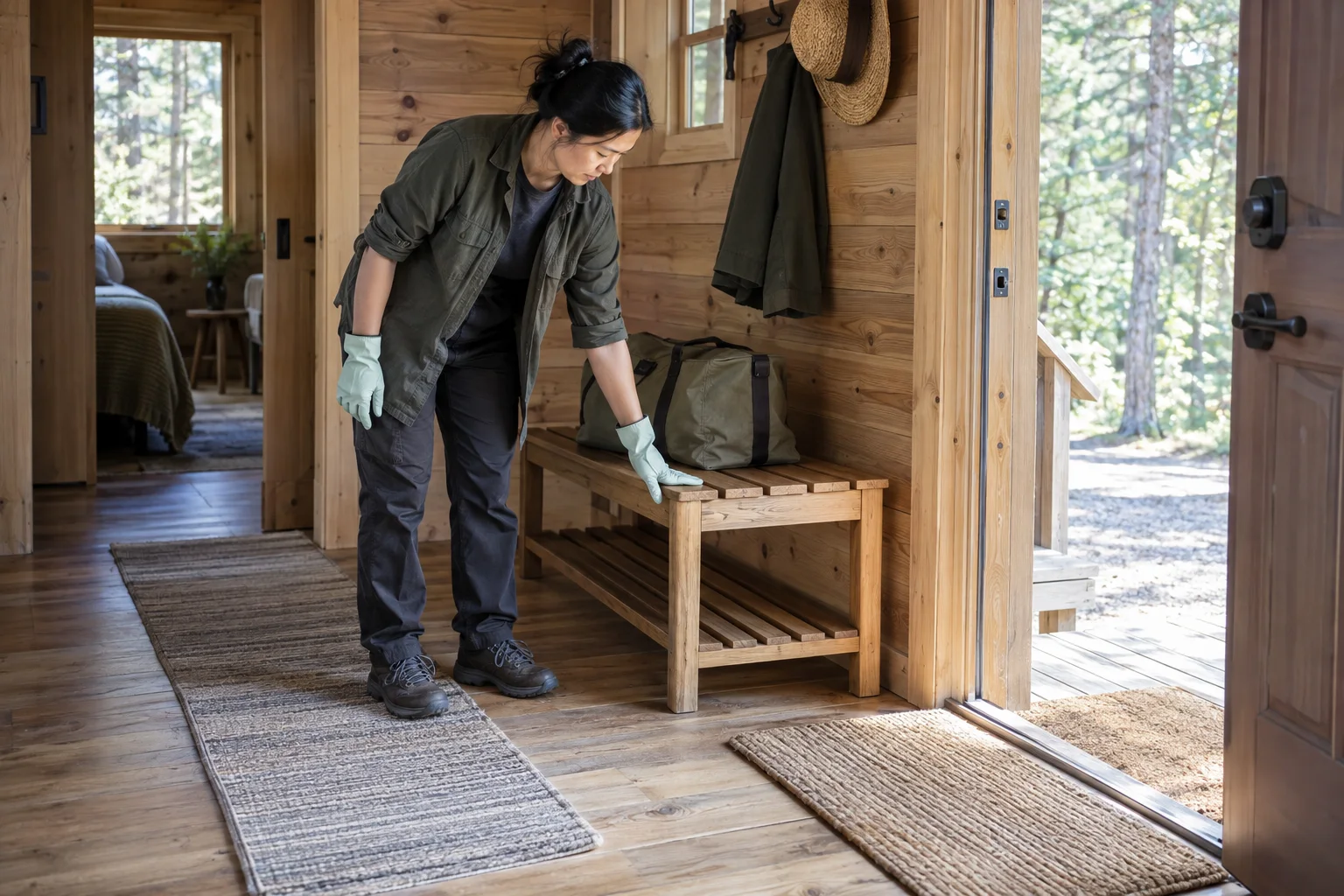
Walk through a hypothetical changeover before approving the layout. A cleaner enters carrying supplies, removes bedding, reaches the shower, opens storage and checks the room. If those tasks require repeatedly moving heavy furniture or crawling into an inaccessible corner, the purchasing team should see the issue while changes are still practical.
Specify finishes by their intended use and supplied care instructions. Ask how thresholds, wall corners and frequently handled fittings can be repaired or replaced. Avoid an unsupported claim that one finish is maintenance-free. The USDA Wood Handbook explains that wood moisture and finishing decisions affect service performance; the appropriate treatment depends on the material, exposure and specified system.
For resort cabins, replacement consistency can matter as much as the first installation. Record finish references, hardware identifiers and access-panel locations. Decide which consumables or replacement items will be stocked locally and which depend on the supplier. This is a practical operating decision, not a reason to promise that every component will remain available indefinitely.
Further reading: USDA Wood Handbook: moisture, finishes and service performance.
Use a housekeeping review as an acceptance exercise
Invite the person responsible for daily operations to review a representative room, sample or agreed mock-up. Have them check bed-making access, shower cleaning, luggage movement and visible snagging points. Record the observations against the drawing revision. This review complements technical inspection; it does not replace checks of electrical, structural or wet-area work.
Turn these questions into a project brief
Share your destination, intended guest group, operating season, cabin quantity and bathroom requirements. Ask which supply scope and supporting documents can be proposed for your project.
6. Treat the cabin and its site as one guest journey
Review the route from arrival to the door, not only the interior. Ask the local project team to consider surfaces, levels, drainage, lighting and the relationship between cabins and shared facilities. A level-looking product photograph does not show the finished ground conditions of your site or establish an accessible guest journey.
Accessibility is jurisdiction-specific and involves more than a wider doorway. For example, the U.S. Access Board's ADA standards address accessible routes and transient lodging guest rooms for covered facilities. That is a U.S. reference, not a universal checklist or a determination that the rules apply to your project. Obtain local advice before fixing room types and quantities.
Privacy also belongs in the site review. Draw the position of neighboring windows, paths and outdoor seating areas rather than assessing each cabin in isolation. A room that works on a standalone plan may feel exposed when repeated across a site. Resolve the arrangement with the design team before treating an attractive rendering as a complete development proposal.
Further reading: U.S. Access Board: ADA accessibility standards.
7. Compare kits and completed units by work remaining
Glamping cabin kits can package prepared components for assembly at the destination. A more completed unit may shift some work into the factory while introducing different transport and placement constraints. Neither format is inherently the right answer for every campsite. Compare the actual package with the skills, access and working conditions available locally.
Ask for a schedule showing work completed before shipment and work left after arrival. Identify weather protection, foundations, connections, finishes and commissioning separately. Installation preparation should include a competent local review of unloading, temporary storage and assembly sequence. Do not assume that a delivery date is also the date the cabin can accept guests.
Further reading: Plan flat-pack cabin delivery and receiving.
- Confirm the supplied construction format and drawings.
- Identify every locally supplied finish, fitting and service.
- Assign responsibility for assembly information and technical queries.
- Review packing, unloading and protected storage requirements.
- Keep operational opening separate from physical delivery.
8. Normalize quotations before comparing prices
When comparing campground cabins for sale, place every quotation against one controlled schedule. Start with the same occupancy brief, layout, construction format and completion stage. Record included items, excluded work, optional upgrades and unresolved questions. A lower cabin price may describe a smaller supply scope, but price alone does not prove poor or superior quality.
Keep the procurement comparison separate from a revenue forecast. This guide cannot establish nightly rates, occupancy or payback for a location. Those depend on market evidence and an operating plan. Your immediate task is to understand what each quotation buys and which local costs need separate professional or contractor input.
For illustration, two proposals might both list an ensuite. One includes specified fixtures and factory-fitted pipework; the other includes only a room partition and openings for later work. Before negotiating a price difference, ask both suppliers to identify the same completion boundary. That clarification is more useful than comparing a broad label such as turnkey.
Further reading: Build a complete prefab cabin project budget.
9. Review a representative unit before repeating it
A representative unit can help test whether the chosen specification works as intended. Define the review purpose before ordering it: layout, appearance, housekeeping, connection access or another agreed question. A sample should not be described as proof of structural or thermal performance unless the relevant evaluation actually covers those claims.
Ask for factory testing appropriate to the supplied scope, with agreed procedures, acceptance criteria and records. Check that any dimensional or fit-up review uses the approved drawing revision. Shipment inspection then addresses whether the correct items, protection and documents are ready for dispatch. Keep those activities distinct from local installation and operational handover.
Use a simple issue log for the first unit: observation, affected component, proposed correction, responsible party and evidence of closure. If the change affects repeat units, update the drawings and schedules. Do not rely on a conversation at the sample review to carry a revision through every later batch.
10. Set a clear release and handover sequence
Separate order approval, factory release, destination acceptance and guest opening into distinct decisions. A cabin can be ready to leave the workshop while its site is not ready to receive it. Conversely, a prepared site does not make an unresolved product specification acceptable. Assign an owner and a document set to each decision.
Before dispatch, reconcile the final layout, component list, finish references and installation information. At the destination, record arrival condition and outstanding work. Before opening, have the appropriate local professionals complete required checks and have operations staff confirm that the room can be cleaned, serviced and used according to the agreed brief.
Retain the handover information where the people running the site can find it. Include care documents, service access locations, supplier contacts and replacement-part references. The procurement team should pass on limitations as well as attractive features. That record becomes the baseline for future purchases, maintenance discussions and any proposed change to the accommodation offer.
If the business closes for part of the year, request a seasonal shutdown and reopening checklist for the supplied systems. Clarify who will protect water services, inspect finishes and document any work before guests return. Do not infer those procedures from the cabin's appearance. The appropriate instructions should come from the relevant product suppliers and local service professionals.
FAQ: buying cabins for a hospitality business
What should a glamping cabin quotation include?
It should identify the layout, construction system, supply format, materials, openings, finishes and any fitted services. Ask for clear exclusions, delivery responsibilities, inspection information and assembly support. Bathroom and kitchen descriptions need itemized scope. A quotation is easier to compare when every proposal refers to the same project brief.
Are ensuite cabins always the better choice?
No. The decision depends on the guest offer, site services, available space and operating model. An ensuite introduces plumbing, ventilation, cleaning and maintenance responsibilities. Shared facilities can be intentional, but their location and standard must suit the intended guests. Compare the complete accommodation experience rather than the cabin alone.
Can glamping cabin kits be ready for guests immediately after delivery?
Delivery alone does not establish readiness. Kits generally require assembly and may leave substantial local work, depending on the contract. Even a fitted unit can need foundations, connections, commissioning and approvals. Request a work-remaining schedule and agree who confirms completion before the operator accepts reservations for the new accommodation.
How many different cabin designs should a small site buy?
There is no universal number. Start with the guest groups you intend to serve and the practical differences between pitches. A limited family of layouts can simplify purchasing and replacement information, but accessibility, orientation and site constraints may require variation. Evaluate operational needs before expanding the range for visual variety alone.
Can this guide confirm that a cabin meets local regulations?
No. It is a procurement guide, not a project approval or engineering assessment. The destination, site, intended use and final specification determine which requirements need review. Ask the supplier for relevant documents and engage appropriate local professionals before committing to a configuration or describing it as approved accommodation.
Conclusion: specify the accommodation, not just the shell
The strongest way to compare glamping cabins for sale is to connect the guest brief with the supplied product and the work required on site. Clear room types, service boundaries and handover responsibilities make supplier conversations more useful. They also keep unresolved operating questions visible before a design is repeated across a development.
Send CabinWild your destination, intended guest group, operating season, approximate quantity and preferred bathroom arrangement. Use the inquiry form or email info@CabinWild.com to request a project-specific discussion of the proposed supply scope and available supporting information.
Further reading: Discuss a hospitality cabin project.
Plan your campground cabin specification
Share your destination, intended guest group, operating season, cabin quantity and bathroom requirements. Ask which supply scope and supporting documents can be proposed for your project.
Prepared with AI assistance for CabinWild Editorial using the linked public sources. Examples are illustrative, not customer results or verified CabinWild test data. Project-specific design and local requirements need review by the appropriate professionals.