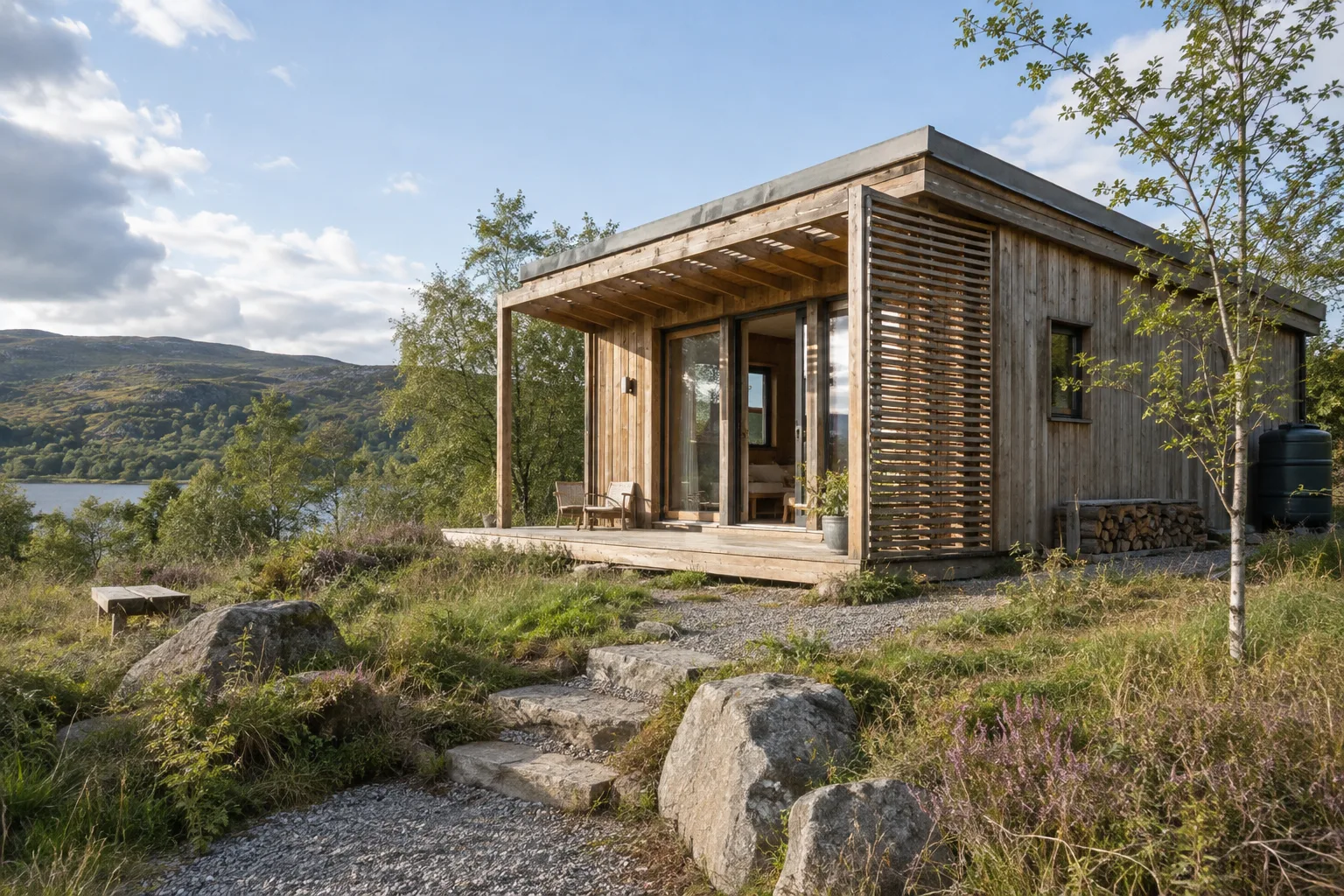
Eco cabins should be compared through specific, documented attributes rather than an overall green label. Ask what a claim covers, which product and lifecycle stages it applies to, and what evidence supports it. Timber sourcing, manufacturing impacts, operating energy and end-of-life options are separate questions. None alone proves that a complete cabin is carbon neutral or environmentally preferable in every respect.
Introduction: turn an eco label into answerable questions
A timber exterior, a woodland photograph or a solar panel can make a cabin look environmentally considered. None of those images explains the complete product. A buyer needs to know what materials are supplied, how the building will operate, what maintenance it needs and which claims have evidence behind them.
This guide helps procurement teams evaluate eco cabins for sale without treating environmental language as a substitute for specifications. It does not claim that CabinWild has a verified carbon-neutral product, a particular certification or measured customer energy results. The approach is to request bounded evidence and compare alternatives on the same basis, with specialist review where needed.
1. Replace broad claims with a defined attribute
Ask the seller to state the precise environmental attribute being claimed. Is the claim about a timber component, packaging, energy used in manufacture or the completed building's operation? Identify the product configuration and the period or conditions covered. A statement that cannot be tied to a defined subject is difficult to evaluate in a purchasing decision.
The US FTC's Green Guides caution against broad, unqualified environmental-benefit claims and encourage clear, specific qualifications. Use that as a useful discipline when reading marketing, while obtaining appropriate advice for the actual market. A certification mark or a natural-looking material does not justify every possible environmental implication.
Create a claims register with the exact wording, evidence requested and current status. Mark claims supported, partially supported or unresolved based on the documents actually reviewed. Do not convert missing evidence into a favorable assumption. The register also helps the operator avoid repeating a supplier's vague statement in its own accommodation marketing.
Further reading: FTC: summary of the Green Guides.
2. Check what a label or certificate actually covers
EPA distinguishes labels that address a single attribute from those considering multiple attributes or lifecycle stages. That distinction matters when comparing products. A label addressing one material issue should not be read as an assessment of transport, operational energy, maintenance and disposal of the whole cabin.
Request the issuing organization, current document, product scope and relevant limitations. Match the evidence to the item in the quotation. A document for a different product line or component may not establish the claim being made for your order. Ask the supplier to identify that connection rather than leaving the buyer to infer it.
Record the date and the version reviewed. If the product changes, ask whether the supporting evidence still applies. A substitute material can alter the basis of a claim even when it looks similar. Treat environmental requirements as part of the change-control process alongside structural, enclosure and commercial requirements.
Further reading: EPA: ecolabels and environmental performance standards.
| Claim area | Question | Evidence boundary |
|---|---|---|
| Material sourcing | Which supplied items carry the stated claim? | Supplier, product and transaction scope |
| Manufacturing | Which processes and period are included? | Defined facility and production data |
| Energy in use | Which climate, occupancy and equipment are assumed? | Model or measurement conditions |
| Service life | What maintenance and exposure are assumed? | Documented design and care scope |
| End of life | What recovery route is actually available? | Local facilities and separation requirements |
3. Verify timber sourcing without extending the claim
For a specified FSC claim, request the relevant supplier and transaction documentation and verify that it applies to the materials being purchased. FSC describes chain of custody as the system for tracking qualifying forest-based materials through production and distribution. A timber-sourcing claim should remain tied to that scope.
Do not assume that a cabin is fully certified because a supplier shows a certificate for some of its activities. Ask which products and supplied components are covered and how the claim is reflected in the order documents. Keep the evidence linked to the actual shipment. This article does not establish that CabinWild or any selected package has an FSC certification.
Timber sourcing is one part of the purchasing review, not a whole-building carbon or energy assessment. Keep other material records, including panels, insulation, finishes and hardware, in the specification register. A cabin is an assembly of products, and a claim about one category should not conceal unanswered questions about the others.
Further reading: FSC: chain-of-custody certification scope; Review timber traceability documents.
4. Compare environmental data on an equivalent basis
If the supplier provides a lifecycle study or environmental product declaration, ask a qualified reviewer to explain its scope and whether it supports the proposed comparison. Identify the product, declared unit, included stages, assumptions and verification information. Numbers from different boundaries should not be placed side by side as though they describe the same thing.
For prefabricated timber homes, a component-level declaration is not automatically a complete-building assessment. The project may add foundations, services, finishes and transport that are outside that document. Ask which parts are included and which require additional information. Do not add or subtract figures without an appropriate consistent method.
Keep comparative claims modest until the evidence is genuinely comparable. If one offer has better documentation, that is a useful procurement observation, but it does not by itself prove lower overall impact. State what can be concluded and what remains unknown. A transparent uncertainty is more credible than a precise ranking built from incompatible data.
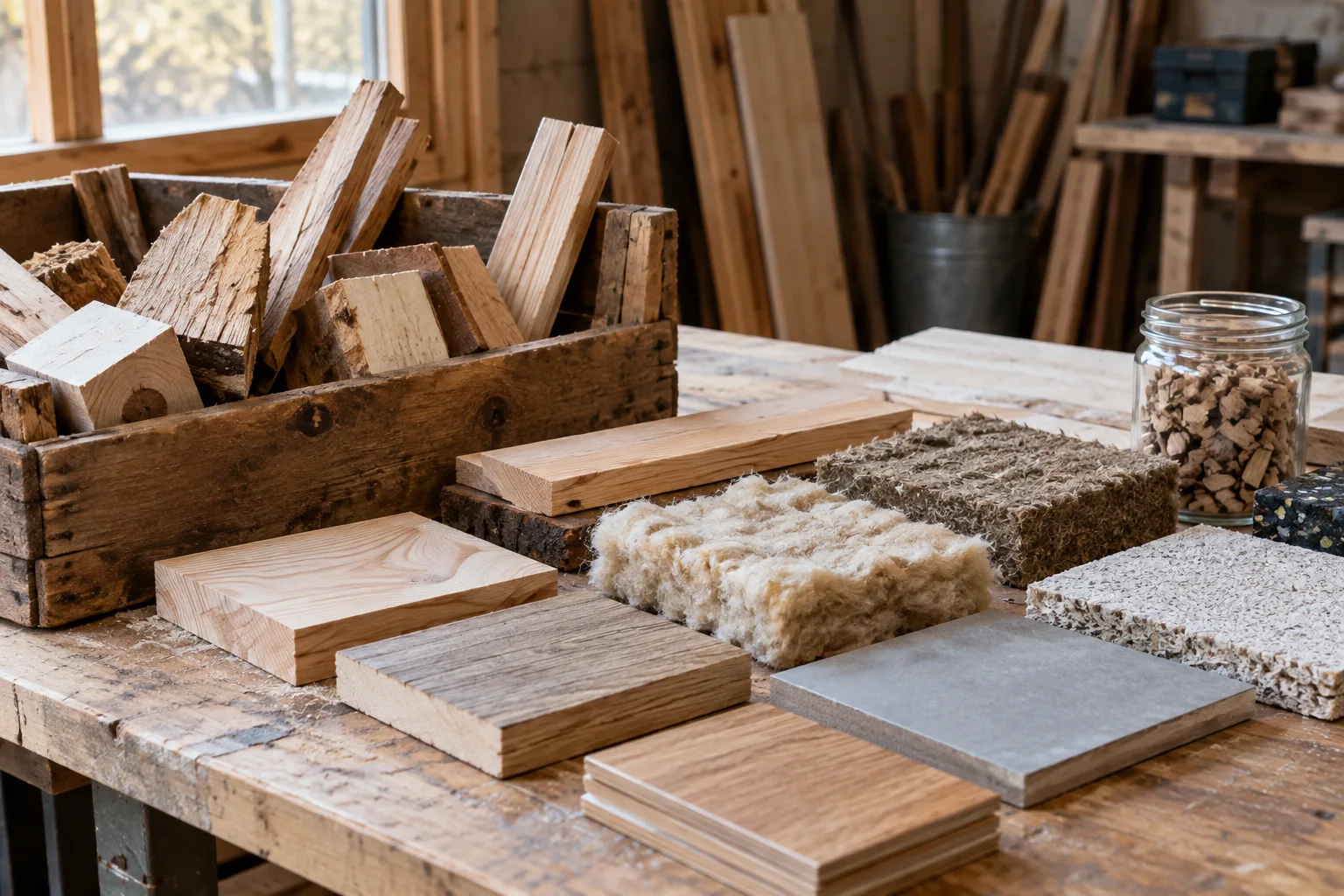
Turn these questions into a project brief
Tell us which material and environmental requirements matter to your project. Ask what supporting product documents are available for review.
5. Separate operating-energy assumptions from measured results
Ask whether an energy statement is a design calculation, a product test or a measurement from an occupied building. Those forms of evidence answer different questions. Record the climate, occupancy pattern, equipment, enclosure and operating assumptions. A result from another configuration should not be presented as a guaranteed energy bill for your site.
The US Department of Energy provides building guidance and case-study resources across climates. Those resources can support a design discussion, but they do not validate a particular cabin package. Have qualified professionals evaluate the actual project and required performance. Avoid assuming that timber construction or factory production alone establishes energy efficiency.
Review the control and handover information as well as equipment specifications. A system that is poorly understood or operated differently from its design assumptions may not produce the expected outcome. Ask how the operator will receive commissioning records and practical instructions. Keep predictions clearly distinguished from future measured performance.
Further reading: Department of Energy: building guides across climates.
A useful comparison scenario
For a hypothetical year-round guest cabin, ask the design team to compare two enclosure options using the same climate, occupancy and equipment assumptions. Record the differences and the limits of the calculation. This is a method for evaluating options, not a claimed CabinWild test result. Do not transfer the conclusion to another site without checking the assumptions again.
6. Include maintenance and moisture management
A materials discussion should include the conditions needed to keep the building serviceable. Ask for the intended exposure, maintenance instructions and replacement access. Do not promise a universal cabin lifespan from a timber species name. The actual design, installation, use and care all need to be considered by the project team.
EPA moisture guidance provides a coordinated building-design reference covering assemblies and services. It is relevant because unresolved moisture problems can undermine the intended use and lead to corrective work. The guide does not certify your cabin. Have the actual details reviewed and retain the relevant inspection and maintenance information.
The Forest Service Wood Handbook is a useful technical reference for understanding wood as a construction material. Use it to support informed questions about the specified products, not to turn a general property into a guarantee for an entire building. Ask the supplier to identify the material records and care requirements that apply to the actual order.
Further reading: EPA: moisture control guidance; US Forest Service: Wood Handbook; Compare timber species, exposure and maintenance.
7. Ask what offsite production changes in practice
Prefabrication can change where work is carried out, but the environmental result should be demonstrated rather than assumed. Ask which processes are included in the supplier's claim and what records support it. A tidy factory photograph is not a measurement of material yield, energy use or waste. Nor does it show how the complete project performs after transport and installation.
If waste reduction is claimed, request the comparison basis, relevant period and treatment of offcuts or rejected components. Avoid treating material placed in a recycling bin as proof of a completed recovery outcome. Ask what happens next and which records are available. The appropriate evidence depends on the exact statement being made.
Factory testing and shipment inspection can verify specified aspects of an order, but they should not be renamed environmental certification. Keep their purposes clear. For example, checking component identity may help confirm that the reviewed material was supplied, while it does not establish the entire lifecycle impact of the cabin.
8. Review transport and packaging without simple slogans
Ask for the actual shipment arrangement and what information is available for a project assessment. Distance alone does not provide a complete transport comparison; the route, mode, load and handling assumptions matter. Have the relevant specialist use a consistent method if quantified comparisons are required. This article does not supply generic carbon factors or a universal local-versus-imported ranking.
Packaging should protect the specified components and meet applicable destination requirements. Reducing packaging without considering damage can create a different problem. Ask which materials are used, how they are separated and which recovery routes exist at the destination. Do not call packaging recyclable everywhere based on a theoretical material property.
Keep customs and transport records aligned with the product description. The International Trade Administration explains common export documentation, which supports accurate shipment records rather than an environmental claim. Where a buyer needs additional data, request it before shipment so the supplier understands the required evidence and its purpose.
Further reading: International Trade Administration: common export documents.
9. Test repair, reuse and end-of-life statements
Ask how damaged components can be identified and replaced without unnecessary disturbance to other work. Request parts information and the relevant maintenance instructions. A repairable design should be described through actual access and component arrangements, not simply through the claim that wood is easy to work with.
For reuse or disassembly claims, ask which connections and assemblies are intended to be separated and what condition or professional assessment would be required. Do not assume that a cabin designed for one delivery is suitable for repeated relocation. Retain final drawings and alteration records so later decisions can be based on evidence.
If recycling or disposal is part of the claim, consider the complete material assembly and available local facilities. Coatings, treatments and combined materials may require specific handling. Obtain appropriate advice rather than promising that every component will return to a circular material stream. A plausible future option should remain an option until the conditions for it are established.
10. Make environmental requirements part of the order
Put the agreed attributes and evidence requirements into the procurement documents. Identify the product configuration, required records, review responsibility and process for substitutions. This gives the supplier a concrete requirement to answer and prevents marketing language from becoming an undefined expectation after production has started.
At acceptance, check that the delivered materials and documents match the reviewed scope. Keep a record of unresolved claims and avoid using them in guest-facing or investor-facing statements. Buyers comparing prefab homes in a cabin style should apply the same discipline as those buying another construction format: claims need evidence, boundaries and accurate communication.
Practical buyer workshop
Keep the buyer's public claims narrower than the evidence
When preparing a product page or accommodation listing, review every environmental statement against the evidence register. Identify the exact product and attribute being described, and avoid implying that a limited document covers the whole building. A buyer can accurately explain a documented material choice without promoting an unsupported overall environmental ranking.
For a hypothetical operator receiving a supplier's material certificate, the next question is whether the supplied products and transaction fall within its scope. Until that connection is established, do not convert the document into a claim that all cabins on the site are certified. Retain the review record and any limitations alongside the approved wording.
Update public wording when specifications change. If a later phase uses different materials, an earlier claim may no longer describe it. Assign a person to check that sales, purchasing and operations use the same current information. This is a practical content-control process, not a promise of certification or search visibility.
Where evidence remains incomplete, state the specific information that is available rather than filling the gap with broad language. The resulting description may sound less dramatic, but it gives a prospective buyer a clearer basis for comparison and leaves room for proper specialist assessment.
FAQ: evaluating eco-cabin claims
Does timber automatically make a cabin carbon neutral?
No. A whole-building claim requires an appropriate defined assessment and supporting evidence. Material sourcing, manufacture, transport, operation, maintenance and end-of-life questions should not be collapsed into one timber label. This guide makes no carbon-neutral claim for CabinWild or any particular cabin package.
Does FSC evidence cover the cabin's energy use?
No. FSC chain-of-custody evidence concerns the relevant forest-based material supply chain and claim scope. Operating energy is a separate question requiring appropriate project information and assessment. Check that any certificate and transaction records apply to the supplied materials, without extending the claim to unrelated performance attributes.
Are prefab timber cabins always lower impact than site-built cabins?
A universal ranking is not supported here. Compare the actual designs and evidence using consistent boundaries and assumptions. The location of production alone does not establish the complete environmental outcome. A qualified reviewer can identify what the available data supports and what additional information is needed.
Can an energy estimate predict my exact running bill?
Not by itself. The result depends on its assumptions, including climate, occupancy, equipment and operation, as well as the actual completed building. Distinguish calculations from measured results and guaranteed contractual commitments. Ask the project team to explain the limits instead of presenting a modeled figure as a certain bill.
What should I ask a supplier first?
Ask which specific environmental attributes are being claimed, which supplied products they cover and what current evidence is available. Provide your project's requirements and intended use. A short, clear evidence schedule is more useful than requesting an unspecified eco-friendly cabin or assuming that attractive natural materials answer every question.
Conclusion: prefer precise evidence to a broad green promise
Environmental procurement becomes more useful when claims are specific and comparable. Check the scope of material records, operating assumptions and lifecycle information, then retain the evidence through changes and delivery. Do not allow one documented attribute to imply that every aspect of the cabin has been assessed.
Send CabinWild your material and environmental requirements to ask what product information is available. Use that evidence with your local design and specialist teams to evaluate the actual specification before ordering.
Request specification evidence for your cabin brief
Tell us which material and environmental requirements matter to your project. Ask what supporting product documents are available for review.
Prepared with AI assistance for CabinWild Editorial using the linked public sources. Examples are illustrative, not customer results or verified CabinWild test data. Project-specific design and local requirements need review by the appropriate professionals.