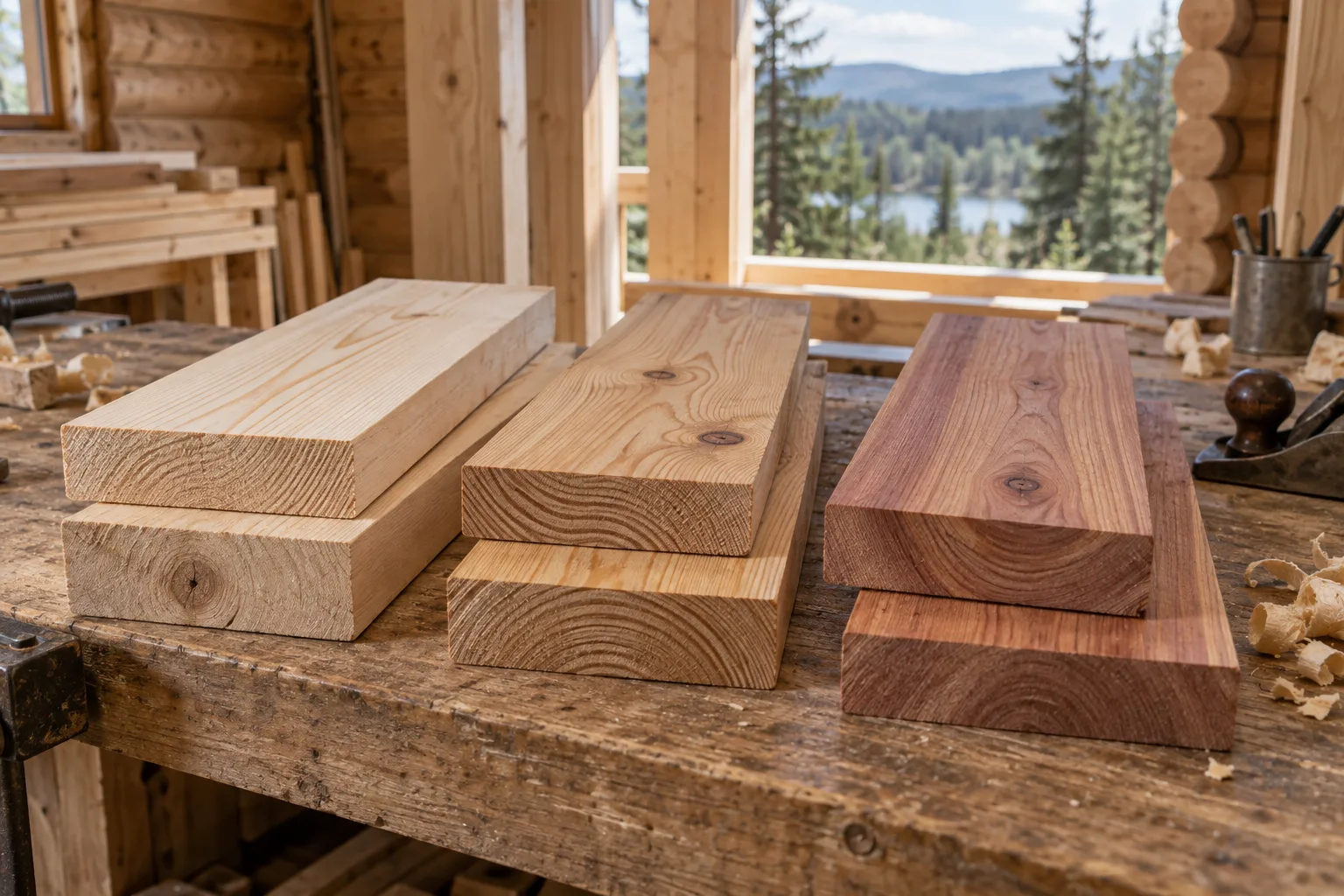
The best wood for a log cabin is timber whose identity, grade, moisture condition and durability strategy suit the building system and destination. A species name alone does not establish structural capacity, resistance to decay or service life. Compare the complete material specification, exposure details and maintenance obligations before accepting a substitution or a premium price.
Introduction: choose a material specification, not a favourite species
A buyer comparing two wooden cabins may see one described as premium pine and another as durable cedar. Those descriptions do not reveal which components use that timber, how it is graded, whether the supplied logs are dry enough for the proposed system, or what protection is required after installation. The more useful comparison starts with an itemized material schedule.
This guide is for overseas purchasers, distributors and project teams choosing cabin materials. It explains the questions to ask before approving a species or substitute, not how to engineer a log wall or prescribe a preservative. Examples are hypothetical. No CabinWild species availability, test result, certification or lifespan is asserted here; each must be established for the actual offer.
1. Define what the supplier means by the timber name
Request the commercial name and, where needed to avoid ambiguity, the botanical identity of the timber. Names such as pine and cedar can refer to different species in different markets. Also identify the country of harvest separately from the country of manufacture. A cabin assembled in one country may contain timber harvested and processed elsewhere; those are different facts in the supply record.
Ask where each timber is used. Wall logs, roof members, floor joists, cladding and decorative trim do not perform the same job. A quotation that names one attractive species may apply that species only to an exposed finish. Mark every major component on the material schedule and require the supplier to identify substitutions before production, including a change between solid and engineered timber.
The United States Forest Service Wood Handbook separates species characteristics, moisture behaviour, mechanical properties and preservation into different chapters. That separation is useful for purchasing: do not turn a single favourable property into an overall quality score. Use the technical reference as background for a qualified designer's assessment of the specified material, not as evidence about an unidentified shipment.
Further reading: US Forest Service: Wood Handbook and individual chapters.
2. Keep structural grade separate from visual appearance
A smooth surface and consistent colour make a sample attractive, but they do not establish the design properties required for a structural member. Ask which grading system applies to load-bearing components and what marking or documentation accompanies them. The project engineer should confirm that the information is usable under the destination's accepted design and approval route.
Visual acceptance also deserves a written definition. Clarify how knots, resin pockets, surface checks, machining marks and colour variation will be evaluated on visible faces. Do not treat every natural variation as a structural defect, or assume that every visible defect is harmless. Record who decides when an observation needs technical review rather than cosmetic acceptance.
For repeated purchases, keep an approved sample with its date, finish and material description. A photograph under warm showroom lighting is not a reliable colour standard. Ask for representative samples rather than only the cleanest available piece. A broader sample set can help the buyer understand normal variation before several cabins arrive with slightly different appearances.
3. Review moisture condition and movement together
Drying is not a promise that timber will never move. Wood exchanges moisture with its surroundings, and dimensional changes can affect joints, openings and finishes. The Forest Service's moisture-control reference explains that handling and storage are part of managing these changes. It also notes that coatings can slow moisture-related movement but do not eliminate it.
Ask for the moisture specification at the agreed inspection stage, the measurement method and the sampling plan. A single reading from an easily reached surface should not become a statement about every component in a shipment. Record instrument identification and any species or temperature adjustments required by the method. An independent inspector can help interpret readings without inventing a universal pass value.
For a log-wall system, request the manufacturer's movement details at windows, doors, posts and service penetrations. Your designer needs to know how the proposed assembly accommodates movement. Do not request a tighter trim detail merely because it looks neater in a rendering. An appearance change can affect a deliberate allowance that belongs to the engineered system.
Further reading: Forest Service: drying and dimensional change; Compare log-wall and timber-frame systems.
4. Match durability to the component's exposure
Describe the actual site rather than asking for weatherproof timber. Is a component sheltered by the roof, repeatedly wet by wind-driven rain, close to splashback, or difficult to inspect? Will vegetation be allowed to touch the wall? These observations help the designer and supplier distinguish exposure conditions instead of applying one vague durability claim to the entire cabin.
Natural durability, preservative treatment and construction detailing are separate parts of a durability strategy. Ask what evidence supports the proposed species and treatment for each use. If a supplier recommends a change of timber, compare the intended exposure and maintenance obligations as well as the purchase price. A substitution should not silently transfer additional upkeep to the operator.
Ground separation, drainage and protection of vulnerable junctions deserve attention even when the timber has a favourable reputation. The US Environmental Protection Agency's moisture guidance addresses site drainage, foundations, walls and roofs as connected concerns. A buyer can use that scope to request coordinated drawings; the guidance is not a certification of a particular cabin.
Further reading: EPA: moisture control across building assemblies.
Turn these questions into a project brief
Send your destination, cabin use, exposure conditions and preferred appearance. Ask which species, grades and treatment records can be supplied for your order.
5. Specify log cabin wood treatment by purpose
Ask whether the proposed product is a decorative finish, water-repellent treatment, preservative or part of a combined system. Similar-looking liquids can have different purposes and application restrictions. Request the exact product name, intended substrate, relevant technical information and instructions for recoating or treating site cuts. The word treated is not a complete specification.
The US Environmental Protection Agency explains that wood preservatives are used against particular deterioration agents and that permitted uses differ between products. That is a reason to check the actual label and destination rules, not a recommendation to apply a chemical yourself. Have a competent provider select and apply a suitable product; do not import another country's approval as universal permission.
Clarify compatibility with the final coating, sealants, fixings and any factory-applied finish. Ask what happens when a part is cut or damaged during assembly. The order should identify who supplies touch-up materials and who provides the approved repair instructions. Keep product records with the cabin handover information so a future maintenance contractor can identify the original system.
Further reading: EPA: overview of wood preservative products and use restrictions; Choose a compatible exterior finish.
6. Treat log cabin lifespan as a conditional outcome
There is no defensible universal lifespan for an unspecified log cabin. A useful answer identifies the materials, design assumptions, exposure, inspection access and expected maintenance. Ask the supplier to distinguish any written product warranty from an estimate of service life. A warranty period describes a contractual promise with conditions; it is not a prediction of how long the whole building will remain usable.
Compare replaceability as well as durability. Can a damaged trim board be removed without dismantling adjacent finishes? Are the wall profile and connection details documented for future repairs? Does the operator have an accessible route to inspect the roof edge and lower wall? These practical questions can matter more than an unsupported claim that one species lasts a fixed number of years.
For a resort with repeated units, document which components are common across the fleet and which are special. A more standardized component may be easier to repair, but only if replacement supply and identification are maintained. Ask how discontinued profiles, finishes and hardware will be handled. Record the answer in the purchasing program rather than assuming indefinite availability.
7. Use a component-by-component timber comparison
The following schedule is a buyer's template, not a set of approved construction values. Complete it with the supplier and local design team. Leave unknown fields visibly unresolved until someone with the appropriate responsibility supplies the evidence. Comparing two complete schedules is more useful than comparing two species names and a per-square-metre price.
If one offer changes species between the sample and production, reopen the affected rows. A substitution may need a fresh review of grading, appearance, treatment compatibility or movement assumptions. Agree the approval route in advance so the factory does not have to guess which alternatives the buyer would accept when a particular stock length becomes unavailable.
| Component | Record in the offer | Question before approval |
|---|---|---|
| Structural wall or frame | Species, grade, dimensions and system | Can the destination designer use the evidence? |
| External finish | Visible grade and coating system | What variation and maintenance are expected? |
| Lower exposed elements | Exposure and durability strategy | How are wetting and inspection addressed? |
| Openings and junctions | Movement and compatible seals | Which details must not be altered on site? |
| Replacement components | Profile, finish and part reference | How can an equivalent part be identified later? |
8. Make factory testing and shipment inspection specific
Factory testing should identify a question, a method and a record. A dimensional check shows something different from a moisture measurement or a structural product test. Ask which checks are part of the order and which are merely available on request. Do not describe a general factory visit as proof that every cabin has passed every relevant performance test.
Shipment inspection should reconcile the supplied material with the approved schedule, including component identification, visible condition and any required treatment or grading records. Photograph accessible samples and exceptions with their package references. If an item cannot be examined without unsafe or destructive unpacking, record that limitation and agree a destination inspection step.
Sourcing claims need their own records. The Forest Stewardship Council describes chain-of-custody certification as a way to track eligible material through supply stages. Request the relevant supplier and transaction evidence when such a claim is made. A certificate should not be used as a substitute for structural grading or presented as certification of an entire cabin without checking its scope.
Further reading: FSC: chain-of-custody certification scope; Plan a documented factory inspection.
9. Plan wood cabin maintenance before the order
Installation preparation should include dry storage arrangements, protection for unfinished surfaces and a process for reporting wet or damaged packages. Ask the installation contractor how materials will be handled if the site is not ready. A carefully selected timber specification can be undermined by avoidable exposure while components wait beside an unfinished foundation.
For operation, request a maintenance schedule tied to the supplied products and the site's exposure. Identify the observations that trigger review, the safe access needed and the records to keep. This is how to protect log cabin wood in a repeatable way: combine the specified materials with inspection, prompt investigation of moisture problems and compatible maintenance, rather than relying on a single coating purchase.
Consider a hypothetical coastal rental unit and a sheltered inland office. They may look similar in a catalogue but have different wetting, occupancy and access patterns. Do not infer a treatment specification from that short comparison alone. Use it to explain customer requirements clearly so the supplier and local professionals can propose and review an appropriate material strategy.
Practical buyer workshop
A material sample review that produces a usable decision
For a hypothetical buyer comparing two timber options, ask for samples identified to the proposed specification rather than an anonymous selection of attractive offcuts. Record which surface is intended to be visible, the proposed finish and any limitations of the sample. A small clear piece does not represent the appearance of every full-length member, so ask what variation is expected in the actual supply.
Review the samples under ordinary light with the people responsible for purchasing and maintenance. Separate appearance preferences from technical acceptance. The darker grain may be preferred aesthetically, while suitability for a structural role or exposure still requires the relevant documentation and professional review. Do not mark a species technically approved solely because the sample has an appealing color.
Keep a dated sample record linked to the quotation revision. If the supplier proposes a different species, grade or finish later, reopen the affected decisions instead of assuming visual similarity means equivalence. The practical output is a material schedule with evidence, accepted appearance expectations and unresolved questions. That record is more useful at shipment inspection than a remembered conversation about choosing the best wood. Retain the approved reference for future replacement enquiries, while recognizing that natural material variation will still need to be discussed.
FAQ: choosing cabin timber
Is cedar always better than pine for a cabin?
No species is universally best for every component and destination. Compare the exact species, structural grade, moisture condition, exposure and maintenance strategy. Confirm what the supplier actually uses in walls, framing and trim. A favourable reputation for one property does not establish the performance of the whole building.
Does kiln-dried timber eliminate movement?
No. Drying establishes a condition at a particular stage, while timber can exchange moisture with its surroundings later. Ask for the specified measurement method and the building system's movement details. The designer should review openings and junctions rather than assuming the words kiln dried remove those coordination tasks.
Can a treatment replace good weathering details?
Do not treat it as a replacement. Ask for the intended treatment use and the complete exposure strategy, including drainage, protected junctions and inspection access. Product selection and application must follow relevant instructions and destination requirements. Unresolved leaks or water traps need investigation rather than another unsupported coating recommendation.
How long should a log cabin last?
A useful answer is conditional on the actual specification, design, exposure and maintenance. Request those assumptions and distinguish them from the written warranty. Avoid using an unsupported universal number in purchasing or sales material. Repairability, component identification and accessible inspection should form part of the longevity discussion.
What should I send when requesting a timber recommendation?
Provide the destination, intended use, site exposure, cabin system, preferred appearance and available drawings. Describe maintenance access and any sourcing requirements. Ask for a component-level material schedule with evidence and exclusions. That information supports a more useful response than asking for the strongest or most durable wood in isolation.
Conclusion: approve the timber and its supporting evidence
Choosing the best wood for a log cabin means choosing a documented material strategy. Confirm identity and grade, review moisture and movement, match protection to exposure, and plan maintenance and replacement. The right decision is the one your supplier and local professionals can explain for the actual project, not the species with the broadest marketing claim.
Send CabinWild your location, intended use, exposure conditions and preferred cabin layout. Request a proposed material schedule and the records available for your order. Use the inquiry form to share your customer requirements and identify the questions your designer needs resolved before production.
Request a timber specification for your cabin
Send your destination, cabin use, exposure conditions and preferred appearance. Ask which species, grades and treatment records can be supplied for your order.
Prepared with AI assistance for CabinWild Editorial using the linked public sources. Examples are illustrative, not customer results or verified CabinWild test data. Project-specific design and local requirements need review by the appropriate professionals.