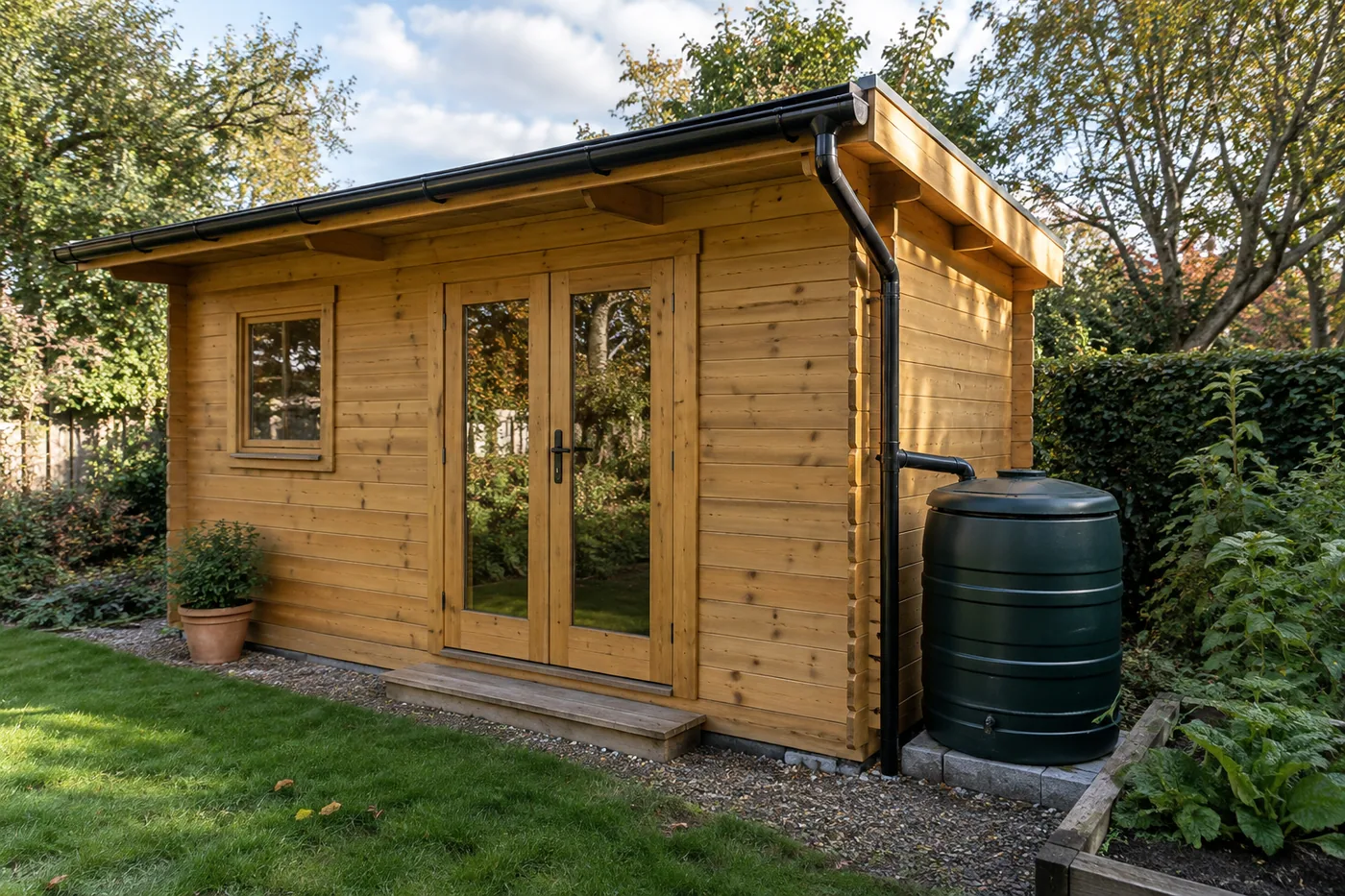
For eco cabins, define what collected rainwater will be used for before selecting the roof collection and storage package. Coordinate roof materials, gutters, treatment where required, plumbing separation, access and maintenance with qualified local providers. Collected rainwater is not automatically safe for drinking, and an installed tank does not establish usable yield or environmental benefit.
Introduction: a water tank needs a use and an owner
Rainwater collection can fit the thinking behind an eco cabin project, but the purchasing decision should begin with its intended function. A tank connected to a downpipe may serve garden watering, another defined non-potable use or a more demanding water-supply proposal. Those applications need different information, competent input and operating responsibilities.
Buyers comparing eco cabins for sale should ask which parts of the collection arrangement are actually included. Roof covering, gutters, downpipes, storage, pumping, treatment and internal plumbing may be supplied by different organizations. A photograph of a tank beside a cabin does not establish that the complete system has been designed or commissioned.
This guide helps structure the enquiry and compare scopes. It is not a plumbing design, water-quality assessment or verified CabinWild installation. No rainfall yield, tank capacity, savings or drinking-water result is claimed. Use qualified destination providers and the relevant local health and building requirements for the actual application.
1. State the intended water use precisely
Begin with a list of intended uses and users. Distinguish outdoor irrigation from any service entering the occupied building. Describe whether guests, staff or a maintenance contractor will operate the system. Ask the qualified designer which local requirements apply and what evidence is needed before the proposed use is accepted.
The CDC explains that collected rainwater can contain germs and chemicals and that intended use and appropriate treatment matter. This is a health-related reason to obtain proper assessment; it is not a treatment specification for a cabin. Do not present roof collection as a source of drinking water unless the actual system and ongoing verification support that use.
Keep the water-use description consistent in the purchase scope, operating manual and guest information. A site that collects water only for a garden should not imply that it supplies all cabin needs. An accurately bounded amenity is more credible than a broad self-sufficient label that the installed configuration cannot substantiate.
Further reading: CDC: collecting rainwater and your health.
2. Coordinate the actual collection roof
Give the water-system provider the proposed roof plan, covering, relevant accessories and available material information. Ask what compatibility and maintenance information is required for the intended water use. The cabin supplier should identify the exact products it offers rather than describe the collection area only as a timber cabin roof.
For cabin plans with shed roof arrangements, a simple-looking roof does not complete the collection design. The provider still needs to assess drainage, collection routing and the relevant roof interfaces. Have the cabin designer and water-system team coordinate their scopes before gutter positions or service paths are fixed.
If the roof covering, finish or an accessory changes, return the information to the responsible water-system provider. A material substitution may be commercially minor to the cabin seller while changing the basis of the collection proposal. Preserve the exact accepted configuration and document who reviews later additions or repairs.
Further reading: Compare cabin roof materials and package scope.
3. Ask for a yield and demand assessment
Ask the qualified provider to assess the local rainfall information, collection area, intended demand and relevant losses or interruptions. The assessment method should be explained for the proposal. A roof area alone does not establish how much useful water will be available, especially when demand and rainfall vary through the operating season.
Record assumptions about occupancy, opening months and the activities supplied. A small private garden cabin and a continuously occupied guest unit may have very different demand patterns. Customer requirements should describe actual use rather than choosing a tank size simply because it fits beside the building.
Ask what happens when stored water is unavailable or the system is out of service. Any backup connection or alternative supply needs the appropriate design and responsibility. An operator should understand the practical limitation before promising an amenity or relying on the collection arrangement for a critical service.
| Decision | Information needed | Question to resolve |
|---|---|---|
| Intended use | Activities, users and local requirements | What water quality and controls are needed? |
| Collection roof | Exact materials, roof layout and interfaces | Is the proposed roof suitable for this application? |
| Storage | Site space, demand and assessed yield | What capacity and access does the design require? |
| Distribution | Equipment and service destinations | Who designs and accepts the connections? |
| Operation | Maintenance resources and backup plan | What happens during shortage or system interruption? |
4. Review tank position and ordinary service access
Place the proposed storage equipment on the site plan and ask the responsible design team to assess its support, access and interfaces. Consider guest circulation, deliveries and maintenance activities. The most visually discreet position may be impractical if routine inspection requires moving furniture or entering a restricted area.
Ask for the equipment instructions and identify which tasks require a competent specialist. The owner needs to know how the relevant components can be accessed and who will perform the work. A purchaser should not infer safe maintenance methods from a catalogue photograph or rely on untrained staff to enter or repair unfamiliar equipment.
Coordinate storage with the cabin and surrounding works. Foundations, paths, drainage and landscaping may be completed by separate parties. Put the accepted equipment position and connection route into the project schedule so a later site decision does not block access or alter the arrangement already reviewed by the provider.
5. Establish distribution and separation responsibilities
Have the qualified plumbing team define any connections and separation from other supplies for the actual destination requirements. Record the design and acceptance responsibilities in writing. A buyer should not connect systems based on a generic sketch, especially where the intended use could create a water-quality or cross-connection concern.
Ask which components are factory-supplied and which are installed locally. A cabin may include an internal fixture without including the relevant water source, pump or external connection. Use a responsibility schedule to connect those boundaries. Terms such as plumbing ready need a precise definition on the quotation.
Installation preparation should include the final service-entry positions and access provisions. Ask the cabin supplier for the relevant wall or floor interface information before the installer makes a penetration. The enclosure and water-system details need coordination so an added service route does not create an unreviewed moisture-management problem.
Further reading: Coordinate remote cabin water and wastewater.
Turn these questions into a project brief
Send your destination, proposed water use and local system requirements. Ask CabinWild which roof, gutter and service-entry information can be provided for the qualified design team.
6. Compare complete supply packages
Separate the commercial scope into collection provisions, storage, distribution equipment, installation, testing and operating support. Ask each provider to identify included documents and exclusions. A low tank price can omit the work needed to turn it into a useful system, so compare the complete proposed arrangement rather than isolated components.
For garden cabin roofing or log cabin roofing sheets, identify whether the quoted gutters and downpipes match the water provider's accepted plan. Confirm the exact products and interfaces. A standard drainage package may be designed to discharge water away from the building without supplying the additional collection provisions the owner expects.
Ask for current service and replacement information, including the responsible provider and relevant manuals. Avoid promising savings or environmental performance based on the presence of a collection tank alone. Any claim should be tied to an explained baseline, measured or assessed use and a clear method appropriate to the actual project.
7. Define inspection and commissioning evidence
Cabin factory scope
Factory testing can address agreed cabin provisions available before shipment, such as supplied drainage components or a defined assembly check. It cannot establish final-site water quality, collection yield or plumbing acceptance. Request the exact test scope and preserve the distinction between a component check and the commissioned water system.
Shipment inspection
Use the packing list to verify supplied roof accessories and identified water-system components where they belong to the order. Separate local purchases from the cabin kit and record missing or damaged items. A photographed tank or accessory establishes only what the record actually shows, not the future system's operating performance.
System handover
The qualified provider should define the applicable tests, records and operating instructions for the actual use. Obtain the accepted configuration, maintenance schedule and any relevant water-quality verification process. If an intended use remains unresolved, keep it out of guest claims and operating reliance until the appropriate evidence and decisions are complete.

8. Give the system a maintenance owner
Assign routine observations, scheduled specialist tasks and fault response to specific roles. Use the provider's actual instructions and local requirements. An operator needs a practical way to report a blocked, damaged or unavailable component, together with a decision about when the intended water use must be suspended.
Keep operating records where the owner can retrieve them. Record work performed, configuration changes and any verification required for the accepted use. When staff or contractors change, hand over the instructions and responsibilities as well as the equipment itself. A system without an operating owner can become an overlooked liability rather than a useful amenity.
Review the collection arrangement after relevant roof work, equipment replacement or changes in demand. The original assessment may no longer describe the property. Ask the provider what needs reconsideration and preserve the updated record. This is especially important when a garden-only system is proposed for a new internal use.
9. Rainwater questions for an eco cabin enquiry
- What exact water use and user group is proposed?
- Which local requirements and qualified assessments apply?
- What roof, gutter and accessory information does the system provider need?
- How are yield, demand, storage and shortage assumptions assessed?
- Who designs distribution, supply separation and service interfaces?
- Which tests, operating instructions and maintenance records are required?
- What claims can the final accepted system actually support?
Separate a water-saving aim from a measured result
An owner may reasonably aim to reduce use of another water supply, but the installation alone does not show how much has been displaced. If a quantified claim matters, ask the appropriate provider to define the baseline, observations and calculation method. Keep the scope tied to the actual use rather than the cabin's environmental marketing category.
Record periods when the collection system is unavailable or serves a different demand from the original proposal. A seasonal closure, changed occupancy or altered garden use can affect interpretation. Measurements without that operating context may be unsuitable for the claim the owner wants to make.
Use accurate descriptive wording while evidence is incomplete: for example, identify the intended collection use and commissioned configuration without adding an unsupported saving. Review any later numerical statement through the relevant evidence process. This approach allows a useful system to be explained clearly without turning an environmental objective into an invented performance result.
Hypothetical decision worksheet: Rainwater System Scope Worksheet
A hypothetical eco-cabin buyer wants to collect roof runoff and is considering both landscape watering and use inside the cabin. The chosen roof and gutter products were selected for weather protection rather than water collection. The quotation includes a tank option but does not describe treatment, overflow, maintenance or any interface with a drinking-water supply. The worksheet should first define the intended water use and the responsible system designer.
Compare a simple outdoor-use collection system, a separately designed indoor-use system and deferring the collection feature while reserving a suitable location. Outdoor use may reduce complexity but still needs a practical overflow and maintenance arrangement. Indoor use adds questions about quality, separation and operation. Deferral can be sensible where roof compatibility or local permissions are unresolved, provided the building design does not falsely imply a finished sustainable system.
Request the roof and gutter material information, collection route, storage location, overflow destination and access for cleaning. Ask the local water or health adviser what rules, quality checks and treatment apply to the proposed end use. Identify which supplier supplies the tank, pump, controls and any connection to other water systems. Keep general public-health guidance separate from a design or acceptance statement for this particular cabin.
The unresolved choice is whether the owner can maintain and monitor the selected use reliably. A system that looks complete on delivery can depend on periodic cleaning, replacement components and water-quality decisions after installation. The operator should identify who responds to contamination concerns or a failed pump and what users are told while the system is unavailable. Do not assume clear water or a filter proves suitability.
Defer release if the intended use is undefined, the collection materials have not been reviewed, or there is no agreed way to keep the relevant water systems appropriately separated. Reject a sustainability claim that omits maintenance or assumes all rainwater is safe to drink. Release requires a bounded system scope, local advice for the intended use and an owner who can carry out the operating plan.
Frequently asked questions
Is collected rainwater safe to drink?
It is not automatically safe for drinking. The actual source, intended use, treatment where applicable and verification need appropriate assessment under local requirements. Use qualified providers and relevant health guidance. Do not infer drinking-water suitability from clear appearance, a roof material label or the presence of a filter.
Can the tank size be chosen from roof area alone?
The provider should consider local rainfall information, demand, storage, system losses and operation. Roof area is one input rather than a complete sizing decision. Describe the intended use and opening pattern, then ask for an explained assessment and a plan for shortage or interruption.
Does a standard gutter package include harvesting?
Only if the accepted scope includes the specific collection provisions and interfaces required by the system design. Ordinary drainage and rainwater use are different functions. Confirm exact components, routing and responsibilities with the cabin supplier and qualified water-system provider before comparing prices.
Can rainwater harvesting prove a cabin is eco-friendly?
It can form part of an environmental strategy, but its presence alone does not prove a quantified benefit or overall cabin performance. Define the use, baseline and assessment method for any claim. Prefer accurate descriptions of the installed arrangement to unsupported savings or self-sufficiency promises.
Conclusion: define the use before buying the components
An eco cabin rainwater project needs a clear use, coordinated roof and service scope, qualified assessment and an operating owner. Compare complete packages, obtain the relevant commissioning evidence and retain maintenance responsibilities. Describe the final system accurately so its practical value and limits remain understandable to the owner and guests.
Define your cabin rainwater interfaces
Send your destination, proposed water use and local system requirements. Ask CabinWild which roof, gutter and service-entry information can be provided for the qualified design team.
Prepared with AI assistance for CabinWild Editorial using the linked public sources. Examples are illustrative, not customer results or verified CabinWild test data. Project-specific design and local requirements need review by the appropriate professionals.