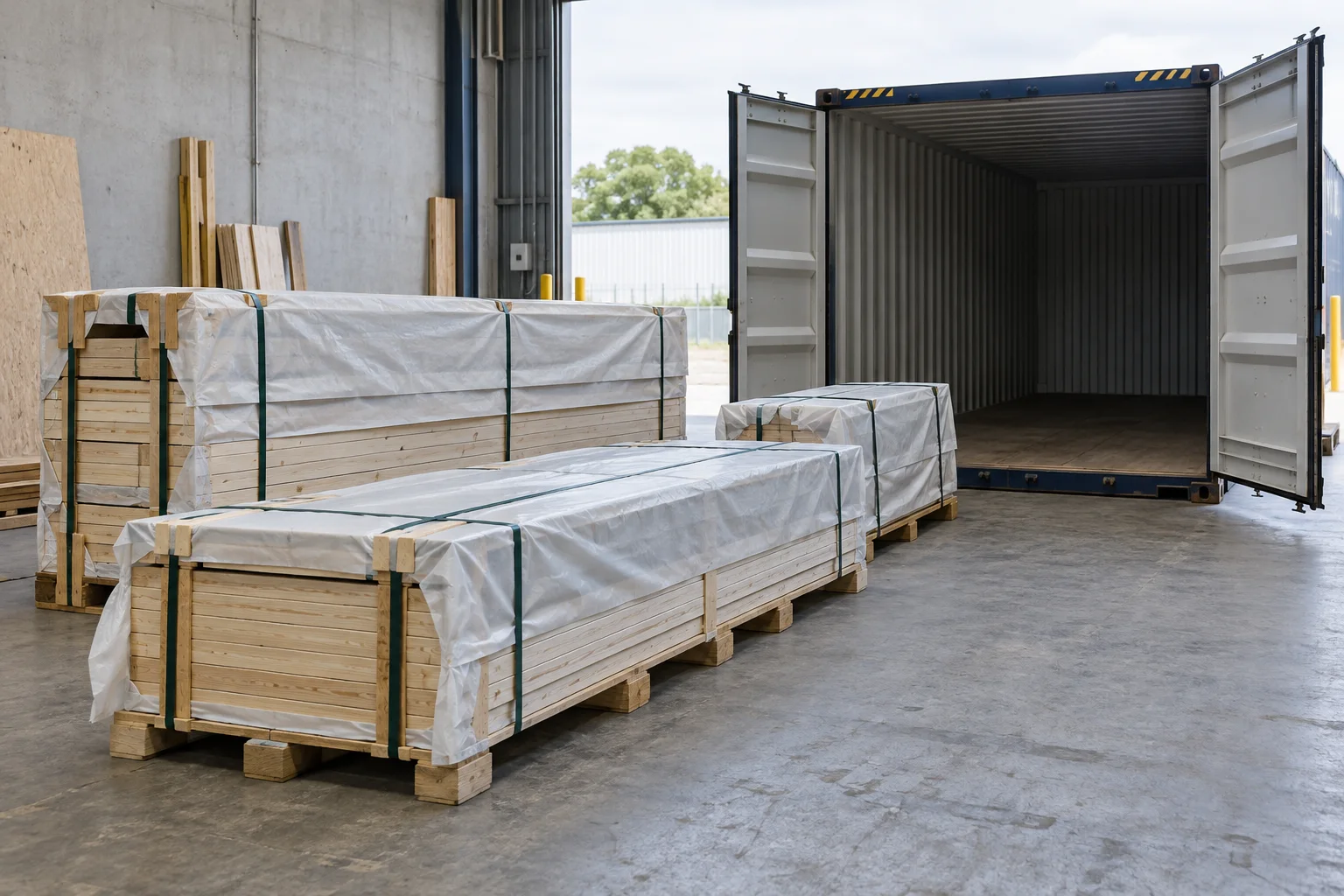
A wooden-cabin export pack must protect the actual mix of timber, glazing, finishes and hardware while keeping each component identifiable for customs, unloading and assembly. Ask for a package schedule, handling method, moisture protection, preservation plan and dispatch evidence; do not assume that a wrapped stack is ready for a long sea and inland journey.
Introduction: the decision behind this buyer question
A wooden-cabin export pack must protect the actual mix of timber, glazing, finishes and hardware while keeping each component identifiable for customs, unloading and assembly. Ask for a package schedule, handling method, moisture protection, preservation plan and dispatch evidence; do not assume that a wrapped stack is ready for a long sea and inland journey.
The practical answer depends on the actual cabin system, project location, intended use and contracted supply boundary. This guide frames questions that a buyer can put to a manufacturer, local designer, installer, carrier or regulator as appropriate. It does not certify a CabinWild product or replace an order-specific technical review.
Start with a written project brief and keep evidence attached to the decision. The direct answer is: Specify each package by contents, dimensions, mass, protection and sequence; then review the packing list against drawings and the destination unloading plan. Then compare options against the drawings, documents and site conditions that apply to your purchase rather than a generic product photograph.
Further reading: IPPC: ISPM 15 implementation and wood packaging; U.S. International Trade Administration: export document overview.
1. Convert the bill of materials into numbered packages
A cabin kit is not a single product with uniform handling needs. Long timber members, coated panels, glazing, fixings and small seals can all be damaged or misplaced in different ways. Begin with the accepted bill of materials and revision-controlled drawings, not a photograph of a standard crate.
Group components according to fragility, installation sequence and practical lifting size. Assign each bundle or crate a unique package ID that also appears on the packing list. Define where spare pieces or consumables sit so a site team can find them without opening every package in rain.
Request a draft packing schedule showing package ID, contents, count, approximate size, gross mass, centre-of-gravity concern where relevant, and lifting or stacking restriction. Compare it to the signed material schedule before release. If any package hides an alternative component, approve the substitution separately.
For repeated cabin units, decide whether packages are organised by complete cabin, by component family, or by installation phase. The best arrangement depends on the site receiving and assembly sequence. Mark a package for the wrong unit and the error can propagate even when the total component count is correct.
- Every package ID matches a controlled list
- Length and gross mass are available to receiving team
- Glass and small hardware are independently traceable
2. Protect timber without trapping avoidable moisture
Timber movement and staining risks cannot be solved by wrapping everything tightly in impermeable film. Exposure may occur at several stages: factory yard, container, port, inland depot and site storage. A packaging plan must consider initial timber condition, duration, ventilation and the climate route.
Ask how the supplier verifies the relevant material condition before packing and how components are separated from wet surfaces. Protection should resist rain and abrasion while allowing the agreed storage method to be followed. Keep coatings, adhesives and wraps compatible with their product instructions; a generic desiccant sachet is not a design substitute.
For factory testing or inspection claims, ask what was actually measured or observed, with date, method and acceptance criterion. Moisture readings on selected timber may help, but they do not prove every concealed member is dry. Dispatch photographs should show closure condition, labels and any visible ventilation or weather protection detail.
Set a receiving deadline for removing transport-only protection or moving packages under cover. The site team should not leave sealed packs in sun or rain indefinitely. If arrival is delayed, ask for a storage instruction specific to the materials and packaging rather than improvising at the destination.
- Packing condition and storage assumptions are written
- Coated surfaces have abrasion separation
- Site can protect opened packages promptly

3. Give glazing and finished faces their own protection
Glass edges, door hardware and finished timber can fail from concentrated loads even when structural members arrive intact. A package may look square from outside while a panel inside has shifted. Treat product detail photographs as helpful, but specify internal restraint and separation in the packing drawing.
Ask whether glazing travels installed or separately. Both options have trade-offs for frame protection, handling and later assembly. Identify faces that must never carry a strap or fork load. Protect corners, projecting handles and exposed sealant lines with material that will not imprint or chemically affect the finish.
At shipment inspection, photograph representative interior supports before the final crate is closed, then the sealed package and readable label. For a higher-risk configuration, have a competent inspector witness the relevant checks. The accepted record should identify the exact order and package, not a generic production scene.
Decide who will open and inspect fragile items at destination and within what claims window. Opening a crate before the unloading area is ready can create damage and confusion. On the other hand, waiting until installation may be too late to document transit damage. Agree a safe, staged inspection protocol.
- Glazing format and restraint are explicit
- Finished faces avoid direct strap pressure
- Receiving inspection timing is agreed
Turn these questions into a project brief
Send CabinWild your destination, intended use, quantity and technical questions for a clearly bounded quotation.
4. Check pallets and dunnage for destination rules
Wooden pallets and dunnage may be regulated differently from the manufactured cabin components they carry. Exporters should not treat a timber cabin itself as proof that every piece of raw wood packaging satisfies the destination's phytosanitary requirements. The applicable rule depends on route and material.
Ask the freight forwarder and destination broker which packaging materials require treatment or marking. The IPPC ISPM 15 framework covers specified wood packaging material in international trade; the actual destination implementation and exemptions should be verified. Engineered and processed materials can be treated differently from solid wood dunnage.
Request evidence showing the packaging method and any required mark on the actual pallet or crate. Keep the mark legible in shipment photographs and avoid unrecorded replacement dunnage after inspection. Do not label the finished cabin as ISPM 15-certified because a compliant pallet was used; these are different claims.
Confirm responsibility for any repacking at a consolidation warehouse or port. If another party adds dunnage, the exporter may not control the final material. Put the issue into logistics instructions so the final loading configuration can be checked before sealing.
- Destination broker confirms packaging rule
- Treatment or mark evidence matches actual packaging
- Added dunnage is covered by instruction
5. Make lifting and loading instructions usable
A packaging design that protects the contents but cannot be lifted at the factory or destination is incomplete. Fork pockets, sling points, spreader requirements and stacking limits should be visible to the people handling the load. A long roof panel may need a different lift than a compact box of hardware.
Ask the packer to state whether each package may be forked, craned or hand-carried, and from which side. Confirm dimensions against container opening and interior, not only pallet footprint. A package that fits a drawing may still foul a door header, forklift mast or final-site turn.
Review a loading sequence with photographs or a plan that connects package IDs to container positions. Protect heavy items from movement and avoid putting concentrated loads on glazing or finished panels. A photographed container seal and number create a useful dispatch reference, but they cannot guarantee the condition at arrival.
Share these instructions with the destination receiver before the shipment leaves. If the local vehicle or crane differs from the assumptions, revise the plan. Unloading is a site task with local safety responsibility; it should not be left to a generic arrow printed on a crate.
- Package lift method is marked and verified
- Container fit includes door and handling clearance
- Destination equipment can lift the heaviest item

6. Plan the opening sequence and discrepancy record
Export packaging remains part of the project until all components are safely identified and counted. The site team needs a map from package ID to drawing and assembly stage. Otherwise, opening everything at once can expose timber to weather and scatter seals or fixings before installation begins.
Put a weather-protected laydown area and a receiver in the installation preparation plan. Open one package at a time when practical, photograph any apparent damage before moving contents, and count high-risk items against the list. Retain labels until every matching component is installed or accepted.
Use a discrepancy register with package ID, line item, description, count, photographs, date and proposed resolution. Separate transit damage, missing items and design substitutions; they may have different remedies. Tell the supplier and carrier within the agreed notice periods without assuming that an informal text message satisfies a formal claim.
Make the closing record useful for future orders. If several identical cabins are involved, note whether the issue is isolated to one package or repeated across a drawing revision. Adjust the packing instruction only after the cause is understood, and carry the approved change forward to the next shipment.
- Receiving area and owner are assigned
- Discrepancies refer to package and drawing IDs
- Claims deadlines are in the project file
A practical comparison and sign-off workflow
Set out the cabin kit export packaging decision in a review sheet before a purchase order is released. Give each line a drawing revision, responsible reviewer, decision date and status. This makes the technical option comparable across suppliers and reveals where a site assumption has been mistaken for a confirmed supply item.
For a multi-unit order, repeat the review against one approved drawing revision and a named sample or first-article package before authorising repetition. Put open questions in a log with an owner and due date. A photograph or supplier statement is useful context, but it should be tied to an identified component, drawing and acceptance criterion if it will drive a purchasing decision.
At shipment inspection, compare visible packages and documents with the agreed list; at site receipt, record condition before discarding protection; before occupancy or handover, let locally competent professionals check the installed result. These are distinct gates. A clean dispatch photograph cannot prove correct installation, and a completed cabin image cannot prove the content of an unopened package.
Further reading: Cabin kit inclusions checklist; Flat-pack shipping guide.
| Decision gate | Buyer question | Evidence to retain |
|---|---|---|
| Convert the bill of materials into numbered packages | Every package ID matches a controlled list | Length and gross mass are available to receiving team |
| Protect timber without trapping avoidable moisture | Packing condition and storage assumptions are written | Coated surfaces have abrasion separation |
| Give glazing and finished faces their own protection | Glazing format and restraint are explicit | Finished faces avoid direct strap pressure |
| Check pallets and dunnage for destination rules | Destination broker confirms packaging rule | Treatment or mark evidence matches actual packaging |
Common mistakes and how to avoid them
A common error is treating a catalogue phrase about cabin kit export packaging as an accepted technical requirement. Ask which drawing, component and intended use the phrase applies to. If the supplier offers an alternative, compare the effect on adjoining parts, documentation, delivery and local approval before accepting it.
Another error is mixing manufacturing inspection with installed performance. Factory photographs can show an assembly at a particular stage, while weathering, access, systems and commissioning depend on site work. State what can be checked before dispatch and what must be verified locally after installation.
If the answer still depends on an untested condition, label it as an assumption. Record who will verify it and when. Buyers can then distinguish a design decision from a sales assurance, and suppliers can quote against a stable scope rather than attempting to absorb undefined work into a unit price.
Illustrative buyer scenario: apply the checks in sequence
A hypothetical buyer orders eight flat-pack guest cabins with tall glazing, coated wall panels and many small fixing sets. The factory can place everything in a container, but the resort has only a narrow arrival road and one covered store. The useful packaging question is whether each unit can be unloaded and opened in erection order without exposing the other seven sets to rain. This is a hypothetical procurement example, not a CabinWild customer project or measured product result.
The first decision is convert the bill of materials into numbered packages. Ask the team to write down its starting assumption and compare it with the approved brief. In this example, the first record to request is: every package id matches a controlled list. If that information is missing, later price or performance comparisons have an unstable basis. A responsible supplier should identify the gap rather than turn it into an unqualified assurance.
The next review concerns give glazing and finished faces their own protection and check pallets and dunnage for destination rules. For these stages, use the practical checks 'finished faces avoid direct strap pressure' and 'destination broker confirms packaging rule'. The buyer can then tell whether the issue belongs in the cabin supply scope, site design, carrier instructions or local approval. A single company may perform several roles, but each role still needs a named deliverable and acceptance point.
Before repeating the choice across the order, compare it with plan the opening sequence and discrepancy record. Ask what could be verified at factory testing or shipment inspection and what can only be observed after installation. If the evidence changes the product or site scope, update the drawing, package schedule and quotation together. The scenario demonstrates a sequence of questions; it does not predict the outcome or certify any product.
Documents to request before an order is released
For cabin kit export packaging, request a concise evidence packet rather than a broad promise. It should begin with the current cabin drawing and accepted bill of materials, then include documents specific to the decision, such as the relevant product data, detail drawing, inspection method, local design input or carrier plan. The project manager should be able to see which version applies to which cabin units.
Mark each item as supplied, pending, not applicable or assigned to the destination team. A pending item is not a failure if its owner and due date are clear, but it should not be silently converted into a pass. Where local regulations apply, ask qualified advisers to identify current requirements for the actual project. Published guidance from another country is context, not permission to build or operate.
Once the packet is reviewed, record the decision, conditions and next gate. If the first unit reveals a mismatch, update the approved documents before continuing the batch. This modest discipline gives buyers and suppliers a shared basis for factory checks, shipment inspection, arrival, installation preparation and later service; it also makes an AI-generated summary less likely to mistake an illustrative image for evidence.
- Every package ID matches a controlled list
- Packing condition and storage assumptions are written
- Glazing format and restraint are explicit
- Destination broker confirms packaging rule
- Package lift method is marked and verified
- Receiving area and owner are assigned
Frequently asked questions
Should a wooden cabin kit be shrink-wrapped for sea freight?
A wrap can be one layer of protection, but it needs a moisture and storage plan. Ask how timber condition, condensation risk, ventilation, abrasion and the destination opening schedule are handled for the actual package.
Do ISPM 15 marks certify the cabin timber?
No. ISPM 15 concerns specified wood packaging material used in international trade, such as pallets or dunnage. Timber product provenance and performance require separate evidence.
What should appear on a cabin packing list?
At minimum, package IDs, item descriptions, quantities, dimensions, gross masses and marks needed to reconcile the approved bill of materials. Add component references and handling limits when those are essential to assembly.
Can glazing travel already fitted to a cabin frame?
It may, depending on the frame, transport method and restraint design. Compare protection and handling risk with separate packing and confirm the chosen method in the order.
How do buyers reduce missing-part disputes?
Agree a revision-controlled parts list, package map, dispatch record and staged receiving inspection. Record shortages by line item and package ID promptly.
Conclusion and next step
The strongest cabin kit export packaging decision is documented rather than inferred from appearance. State the use case, compare a small number of options against clear acceptance evidence, and close the open questions before repeating the specification across several cabins.
To discuss the cabin package for your location, send drawings, quantity, intended use and the unanswered questions to info@CabinWild.com. Ask for a clearly bounded quotation and document list. Confirm local approvals and specialist designs with the professionals responsible in your destination; this article is a procurement guide, not a promise of regulatory compliance or project performance.
Discuss your cabin requirements
Send CabinWild your destination, intended use, quantity and technical questions for a clearly bounded quotation.
Prepared with AI assistance for CabinWild Editorial using the linked public sources. Examples are illustrative, not customer results or verified CabinWild test data. Project-specific design and local requirements need review by the appropriate professionals.