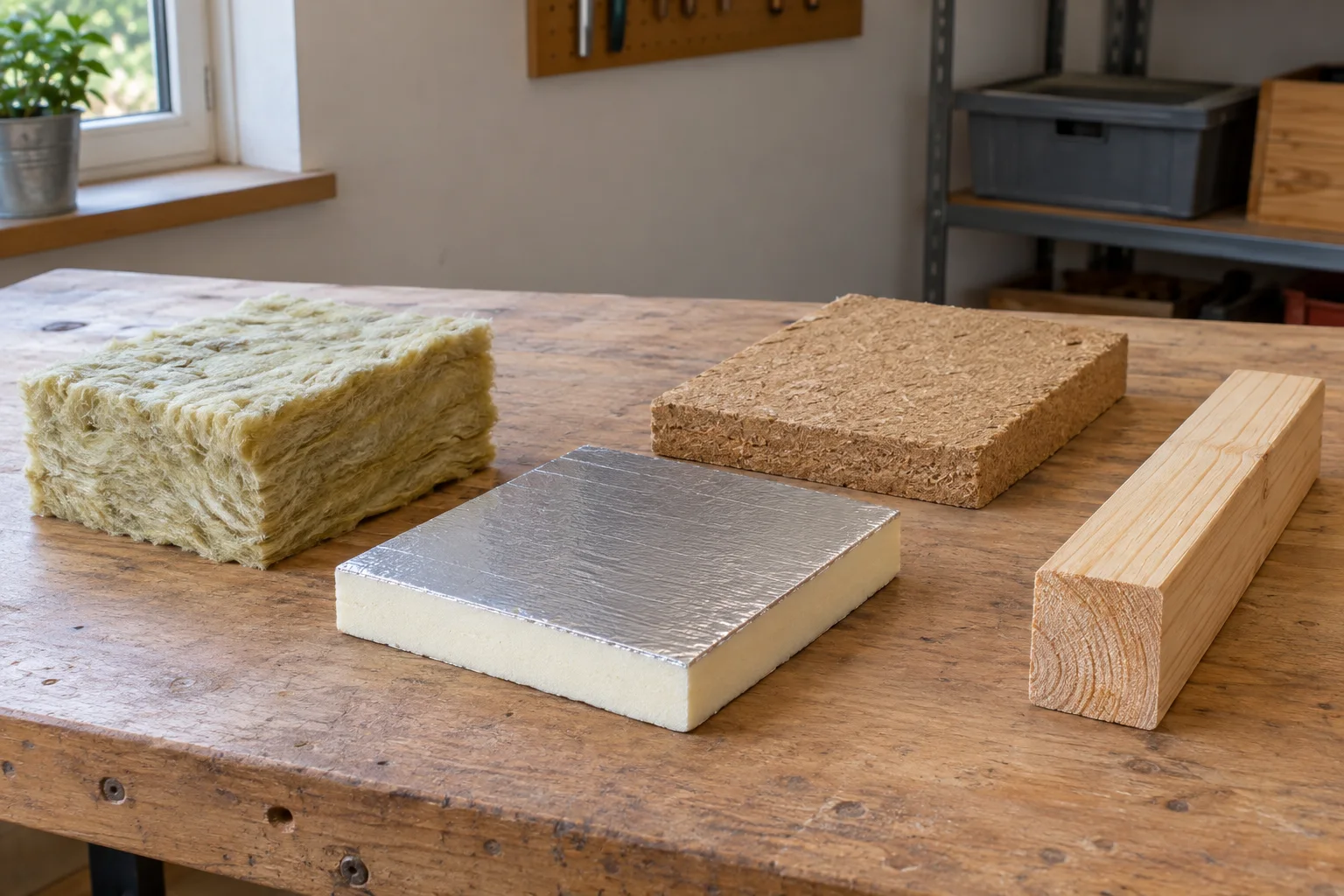
Select cabin insulation as part of a designed wall, roof and floor system. Compare named products at their specified installed thickness, supported by relevant thermal evidence and current application instructions. Check joints, framing, moisture control, fire-related requirements and local installation responsibilities. A material name, thickness or certification logo alone does not establish the performance or approval of the completed cabin.
Introduction: turn an insulation label into a specification
A cabin quotation may describe thick insulation, premium boards or a four-season package without identifying the product or explaining where it is installed. Those descriptions are difficult to compare. One offer may refer to roof insulation only; another may include walls and floor but leave junctions or site installation unresolved.
For importers, distributors and accommodation operators, the useful question is not simply which material sounds best. It is whether the proposed product suits the actual assembly, whether its supporting evidence applies, and whether the ordered package can be installed and inspected as designed. That requires a specification rather than a marketing adjective.
This guide is a procurement framework, not a thermal calculation or installation manual. No CabinWild R-value, tested assembly, certification, factory result or energy saving is verified here. Qualified designers and installers must resolve the destination-specific thermal, moisture, fire and construction requirements of the complete cabin.
Further reading: Review the wider year-round enclosure and comfort strategy.
1. Define what the insulated cabin must do
Record the destination, occupied season and intended use before selecting material. A continuously occupied dwelling, an intermittently used garden room and a guest cabin can have different operating assumptions. Identify the actual enclosure and any planned heating, cooling or ventilation equipment so the technical review addresses the whole building.
Ask the designer to establish the required performance for each part of the enclosure using the applicable local method. Keep the roof, wall and floor requirements separate. A single statement that the cabin is insulated does not show which areas are included or whether the proposed assemblies meet the project requirements.
Include practical constraints: available cavity depth, internal space, exterior appearance, transport configuration and local installation competence. These influence the shortlist without creating a universal best material. Where information is provisional, mark it as provisional rather than allow an early assumption to become the final purchase specification.
For an existing cabin, first establish the current construction and condition. Adding insulation can affect moisture behaviour, finishes and service routes. The review should identify what is known, what needs inspection and which changes require design approval before materials are ordered or existing layers are concealed.
2. Separate insulation material from product form
A cabin insulation material has both an identity and a form. Mineral wool, for example, is a material family; batt and rigid board describe product forms. A reference to panels can mean loose insulation boards, insulated lining products or a prefabricated building element. Ask exactly which product the supplier means.
The U.S. Department of Energy's consumer guide distinguishes blankets, loose fill, sprayed products, rigid insulation and reflective products. ENERGY STAR's product-type guidance further shows that materials can appear in different forms and that installation requirements vary. These are useful classification references, not a declaration that every listed product suits every cabin.
Use the comparison below to structure enquiries. It deliberately avoids generic thermal or fire ratings: products within a family differ, and the relevant evidence must match the item actually proposed. Brand, product code, facing, installed thickness and intended application belong in the quotation.
Do not assume a familiar appearance identifies the material. Two foil-faced boards can have different cores or product requirements. Request the current technical sheet and packaging identity, and keep the approved reference with the drawing and component schedule used for purchasing.
Further reading: U.S. DOE: consumer guide to home insulation; ENERGY STAR: insulation types and installation considerations.
| Form to compare | Identity to confirm | Question for the proposed assembly |
|---|---|---|
| Batts or rolls | Fibre type, product reference and thickness | How is the specified fit maintained around framing and services? |
| Rigid boards | Core, facing, edges and application | How are board joints, supports and adjoining layers coordinated? |
| Loose-fill products | Material and specified installation conditions | Who verifies the installation requirements in the actual cavity? |
| Sprayed products | Exact system and installer requirements | What preparation, safety and acceptance documentation is required? |
| Reflective products | Tested configuration and associated air space | Does the proposed assembly match the basis of the claim? |
| Factory-built insulated elements | All component layers and their functions | Is the quoted result for insulation alone or the complete element? |
3. Compare thermal evidence on the same basis
R-value describes resistance to heat flow. A higher value represents greater resistance when the quantities and conditions being compared are equivalent. Confirm the units, thickness and test or calculation basis before ranking offers. An unlabelled number is not a meaningful international procurement specification.
Distinguish a product's stated performance from the performance of the completed wall, roof or floor. Framing, joints, openings and other layers affect the complete assembly. Ask the designer for an appropriate assembly assessment rather than treating the insulation manufacturer's product value as the cabin's whole-building result.
As a hypothetical comparison, one quotation might identify a board at its actual proposed thickness, while another gives a value for a thicker version of its product. The buyer should request matching installed configurations before deciding which offer performs better. No material or capacity figure needs to be invented to reveal that mismatch.
Where a supplier presents a U-value or another performance measure, request its definition, units and calculation scope. Do not compare it numerically with an R-value as though they were the same quantity. Have the responsible technical reviewer confirm that each value addresses the same component and project requirement.
4. Understand what cabin insulation panels include
Cabin insulation panels are not automatically structural building panels. A rigid insulation board may serve one layer of a wall, while a factory-built element may combine framing, insulation and linings. Clarify which functions are claimed and which parts of the assembly must be provided by another party.
Request a section showing all layers and the responsibilities at joints, corners and openings. The insulation product should appear with its approved identity and thickness. If the panel includes a facing or membrane, ask what function it performs in this assembly and how continuity is maintained at connections.
For factory-prepared elements, identify which joints are completed on site and what instructions and materials are supplied. A well-documented panel centre does not answer the interfaces between panels. Those interfaces should remain visible in the installation and inspection plan rather than disappear behind a general factory-built description.
Ask whether transport or storage conditions affect the specified products and what protection is required. Have the supplier identify damaged or unsuitable material through the applicable product guidance. The buyer should not improvise a repair or substitution that changes the approved assembly without review.

5. Coordinate insulation with moisture and air control
Thermal insulation, air control and water management are related but different functions. Ask the designer to identify which layer performs each function and how it continues around openings and service penetrations. A material should not be assumed to provide every function simply because it occupies the wall cavity.
DOE's research summary on high-R wall systems examines moisture behaviour alongside insulation, air leakage and material permeance. It supports reviewing the complete assembly rather than increasing insulation in isolation. The source's particular recommendations are not universal details for every climate or timber construction system.
For a proposed retrofit, discuss the existing layers and drying opportunities before adding new boards or internal linings. Avoid prescribing a universal vapour-control location from a generic article. The correct arrangement depends on the whole construction and conditions, and should be established by an appropriate project-specific assessment.
Coordinate the enclosure with ventilation and occupied use. A bathroom, cooking activity or intermittent heating changes the questions the team needs to consider. Insulation alone is not a guarantee against condensation, and a ventilation appliance does not resolve an unreviewed wall assembly. Keep both responsibilities explicit.
Further reading: U.S. DOE: moisture performance of high-R wall systems; Define ventilation and temperature-control responsibilities.
Turn these questions into a project brief
Share your destination, intended cabin use and drawings. Ask CabinWild to clarify proposed materials, installed scope and the documentation available for local technical review.
6. Review log cabin insulation against the actual wall system
Log cabin insulation can refer to several different tasks: improving a roof or floor, adding a lining system, or addressing joints in a solid-log wall. These should not be combined into one generic package. Start by identifying whether the cabin uses solid logs, a framed wall or a different construction system.
A joint-sealing product is not interchangeable with bulk insulation, and decorative log-effect cladding does not establish the thermal construction behind it. Ask for a section and the proposed function of each product. This prevents a discussion about appearance or draughts from being mistaken for a complete thermal specification.
Where additional layers are proposed for an existing log wall, have the designer assess moisture behaviour, movement, fixings and finishes. Do not copy a detail intended for a conventional framed wall without review. The supplier should identify which parts of the proposal depend on the particular cabin system and condition.
Keep exposed timber preferences in the brief. If the buyer wants an uninterrupted internal wood surface, that choice may constrain some approaches. Discuss the trade-offs before selecting the package rather than discover that the proposed improvement changes the interior appearance the customer intended to preserve.
Further reading: Distinguish log and timber-frame cabin construction.
7. Request product evidence without overstating certification
Ask for documents that identify the exact product, relevant declared properties, intended applications and current installation instructions. Where testing or certification is claimed, request the reference and scope. Confirm that the named product and proposed configuration match the evidence rather than rely on an isolated logo in a brochure.
ENERGY STAR's insulation criteria identify different test approaches for thermal and surface-burning characteristics, including conditions associated with reflective products. This illustrates why a test result must be read in context. It does not mean an ENERGY STAR material label certifies a completed cabin or grants approval outside the programme's scope.
Separate reaction-to-fire information about a material from any fire-resistance claim for a complete assembly. Have the relevant professional determine the evidence required for the project. Avoid describing a cabin as fireproof or compliant because one constituent product carries a favourable classification.
For environmental claims, ask which property is being described and what document supports it. Recycled content, a particular fibre source and a life-cycle assessment are different matters. None should be treated as an automatic guarantee that the whole cabin is sustainable or has a verified carbon advantage.
Further reading: ENERGY STAR: insulation product criteria and test-method scope.
8. Compare cabin insulation options through installed scope
Use a comparison schedule with one row for each proposed assembly. Record product identity, installed thickness, applicable performance evidence, supporting layers, local work and inspection access. This makes cabin insulation options comparable without reducing the decision to a material price or a single catalogue rating.
Consider the installation competence and facilities available at the destination. A product requiring specialist application may create different responsibilities from factory-cut components. Ask who supplies consumables, protective measures, application records and any required checks. Follow the current manufacturer's instructions and local safety requirements rather than this article for execution.
When reviewing cabin insulation ideas, separate new-build design from retrofit advice. A product that is straightforward to accommodate before linings are installed may be difficult to introduce into an occupied, finished cabin. Access, disruption and reinstatement belong in the comparison, along with the condition of the existing construction.
Assess substitutions through the complete assembly. Changing the core, facing, thickness or product form can affect more than the quoted thermal number. Require technical review of the proposed replacement and update the drawings and component schedule before the purchasing team accepts it as equivalent.
Further reading: Clarify the supplied cabin kit and local work.
9. Agree inspection points before layers are concealed
Factory testing and shipment inspection should have a defined purpose. Product identity, quantities, visible condition and agreed installation observations can be checked against the purchase documents. A stack of insulation packages or a single photograph is not proof of the whole cabin's thermal performance.
Agree what evidence will be retained before internal or external finishes conceal the work. Relevant records may identify the location, product and completed stage, linked to the current drawing. The appropriate acceptance criteria should come from the design and product requirements, not from a generic photograph checklist.
Allocate responsibility for the work completed after delivery, especially joints between elements, openings and service penetrations. Inspection preparation should make those interfaces accessible at the right stage. A local alteration needs review and documentation if it changes the arrangement assumed by the original specification.
At handover, retain the approved material schedule, technical documents, installation records and unresolved observations. If a performance test has been commissioned, state exactly what was measured and under which conditions. Do not present a different type of test, or a result from another model, as verification of this cabin.
- Exact product and installed configuration are named.
- Performance evidence uses a consistent comparison basis.
- Wall, roof and floor interfaces are coordinated.
- Moisture, fire-related and destination requirements have qualified review.
- Factory and local installation records match the approved drawings.
FAQ: specifying cabin insulation materials
Which insulation material is best for a cabin?
There is no universal winner. Compare suitable products within the actual wall, roof or floor assembly, considering climate, performance requirements, available space, moisture strategy and installation competence. Ask a qualified designer to shortlist appropriate options, then compare product evidence and complete installed scope rather than material names alone.
Is thicker insulation always the better purchase?
Thickness alone does not identify performance or suitability. Confirm the exact product, its relevant rating at the proposed thickness and the complete assembly. Additional thickness may affect space, interfaces or moisture behaviour. Compare a coordinated design against project requirements instead of ranking quotations by millimetres alone.
Are cabin insulation panels structural?
Not necessarily. The phrase may describe loose insulation boards or a factory-built element containing several layers. Ask which functions the product is designed to perform and request the relevant drawings and evidence. Do not assume structural capacity from the word panel or from the presence of rigid insulation.
Will insulation prevent condensation in a log cabin?
Insulation alone is not a guarantee. The complete enclosure, moisture sources, air control, ventilation and operating conditions need assessment. Existing log construction may introduce additional interface and movement questions. Obtain a project-specific review before adding layers or applying a detail intended for another wall system.
What should an insulation quotation include?
Request product references, installed thicknesses, assembly drawings, relevant performance documentation and installation responsibilities. Identify supporting layers, joints, local work and inspection points. The offer should distinguish material evidence from complete-building claims and explain how proposed substitutions or changes will be reviewed before manufacture and installation.
Conclusion: compare evidence and the completed assembly
Good cabin insulation procurement connects product identity, design and execution. Compare the specified materials on a consistent basis, keep thermal ratings separate from whole-building claims and require coordinated treatment of moisture, interfaces and local work. Inspection evidence should match the package actually supplied and installed.
Send your destination, intended use and cabin drawings to info@CabinWild.com. Ask for a clear discussion of proposed insulation materials, supply scope and available documentation for local review. That provides a sound basis for comparing options without relying on unverified performance promises.
Request a Clear Insulation Specification
Share your destination, intended cabin use and drawings. Ask CabinWild to clarify proposed materials, installed scope and the documentation available for local technical review.
Prepared with AI assistance for CabinWild Editorial using the linked public sources. Examples are illustrative, not customer results or verified CabinWild test data. Project-specific design and local requirements need review by the appropriate professionals.