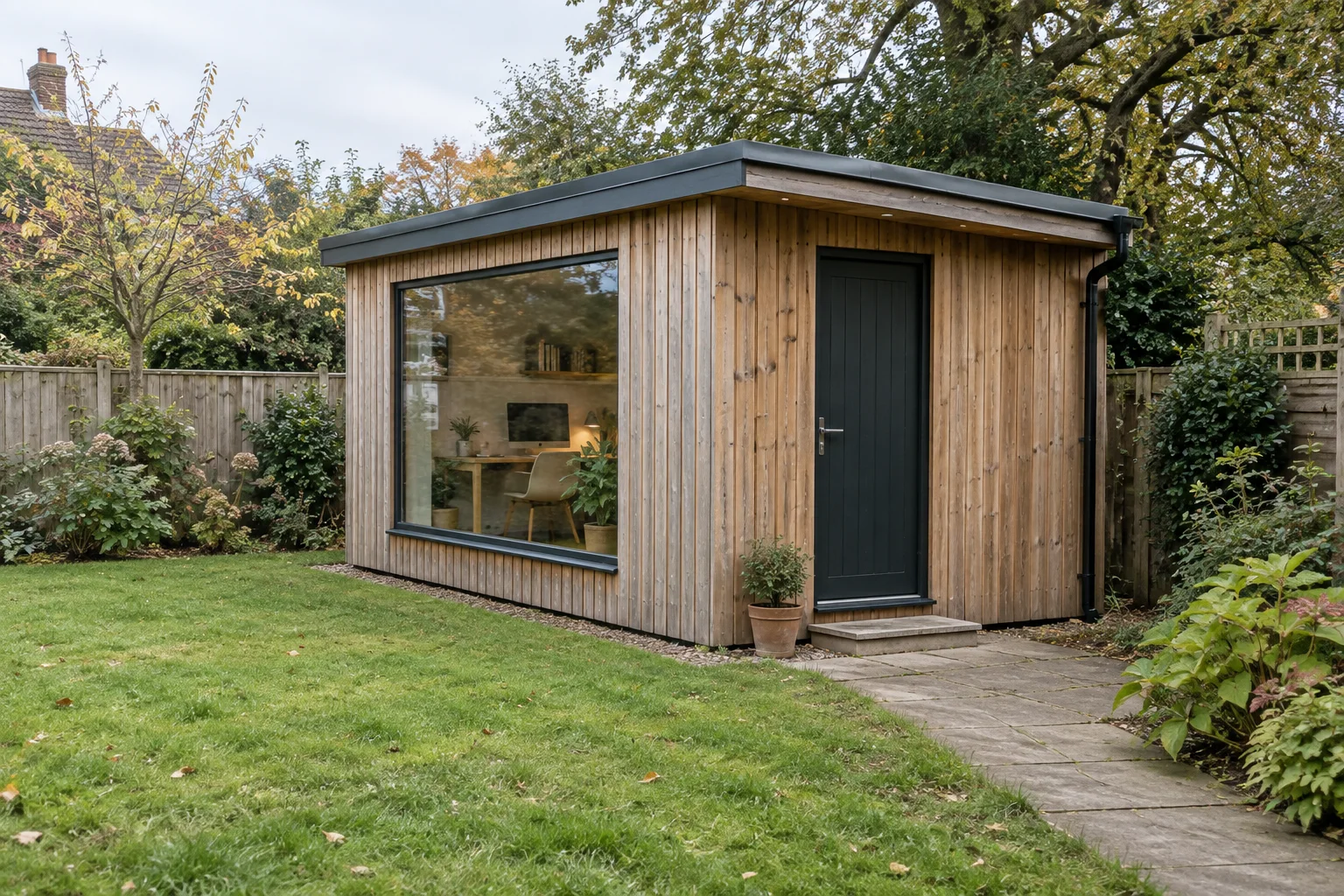
A woodworking workshop cabin requires a machine and process brief. Define cutting, sanding, assembly, finishing, material storage and the actual dust-extraction system. Heavy equipment and local exhaust need specialist review. A general timber studio should not be described as workshop-ready simply because a bench fits inside.
Introduction: inventory processes and machines
A woodworking room has moving stock as well as stationary machines. Long boards can swing through aisles while dust and noise affect the wider site. The first drawing should show infeed, outfeed and how the operator maintains equipment.
A woodworking workshop cabin requires a machine and process brief. Define cutting, sanding, assembly, finishing, material storage and the actual dust-extraction system. Heavy equipment and local exhaust need specialist review. A general timber studio should not be described as workshop-ready simply because a bench fits inside.
This guide is written for makers and small woodworking businesses buying a separate workspace. Its examples are hypothetical purchasing and operating situations. Use the checks to prepare a precise brief for the cabin supplier and destination team; they do not establish that an unspecified cabin meets a particular performance level or local approval route.
Further reading: HSE: wood dust guidance.
1. Inventory processes and machines
Record exact machine dimensions, mass, power, guarding and working clearances. Show timber infeed and outfeed; a saw footprint without stock movement is misleading. Distinguish light hand-tool assembly from powered machining or spray finishing, which may need different specialist controls. Do not claim universal workshop suitability from a hobby label.
Turn this requirement into a review item using machine data and material movement drawings. Start with the actual intended activity and identify the information that could change the room or package choice. If the purchaser and supplier use different assumptions, compare them explicitly before discussing upgrades. Keep the baseline visible so a later request can be recognized as a change in scope rather than a missing original inclusion.
A common failure is placing a machine from its footprint without infeed clearance. Check the consequence against the stated customer requirements rather than adding a generic premium feature. If the answer remains uncertain, preserve it as an open item with a responsible reviewer. The next purchase decision should use the accepted scope, not an optimistic assumption borrowed from another product application.
A question to put in the buyer brief
Can each tool run with the longest intended stock without crossing the exit?
2. Design extraction from source data
HSE wood-dust guidance identifies the need to consider local exhaust and dust capture for relevant operations. Select the actual extractor and connection method with competent advice. A room fan or open window is not a substitute for source control. Keep duct routes and filter maintenance accessible. Avoid inventing airflow numbers from another machine.
Use process-specific extraction design and maintenance instructions to assess the proposed arrangement. Ask the reviewer to distinguish what is shown on a concept plan from what is specified for manufacture. A realistic review includes the occupied or working condition, not only an empty presentation image. Where a supplier proposes an alternative, record how it answers the same requirement and whether any operational limitation remains.
A common failure is assuming a small cabin volume makes dust exposure harmless. Check the consequence against the stated customer requirements rather than adding a generic premium feature. If the answer remains uncertain, preserve it as an open item with a responsible reviewer. The next purchase decision should use the accepted scope, not an optimistic assumption borrowed from another product application.
Further reading: HSE: manual handling at work.
A question to put in the buyer brief
Which dust-producing tasks and capture points are included in the reviewed plan?
3. Check local floor and fixing loads
Machine feet, timber stacks and workbenches create local demands. Provide weights and positions to structural reviewers. Vibration and fixing arrangements may affect the cabin structure and neighbouring uses. Rubber pads do not establish floor capacity. Wall-mounted clamps and racks require identified supporting members.
The next evidence item is a loaded layout and structural/fixing review. Check its relationship to the adjoining work before approving it. In a small building, an adjustment to one detail can affect another activity, service route or maintenance task. Do not judge this item in isolation simply because it can be purchased separately. Identify which team member coordinates its interfaces and which supplier information they still need.
A common failure is using surface-board thickness as the whole load check. Check the consequence against the stated customer requirements rather than adding a generic premium feature. If the answer remains uncertain, preserve it as an open item with a responsible reviewer. The next purchase decision should use the accepted scope, not an optimistic assumption borrowed from another product application.
A question to put in the buyer brief
What loads and fixings are considered for the actual equipment and stock?
4. Separate finishing and combustible storage
Paints, solvents, oils or other products need their exact instructions and a specialist operating plan where relevant. Do not assume a general workshop can contain spraying, hazardous storage or a stove. Keep storage and waste handling distinct from clean assembly. The quotation should identify exclusions rather than silently including every workshop process.
Discuss a materials and process-control inventory with the people who will install and operate the cabin. Ask them to walk through a normal use sequence and point out where the proposal depends on an unstated assumption. Keep a distinction between a design requirement, a manufacturer's instruction and an operating preference. That distinction helps the quotation remain precise without presenting every preference as a verified technical result.
A common failure is adding solvent finishing to an unreviewed enclosed woodshop. Check the consequence against the stated customer requirements rather than adding a generic premium feature. If the answer remains uncertain, preserve it as an open item with a responsible reviewer. The next purchase decision should use the accepted scope, not an optimistic assumption borrowed from another product application.
A question to put in the buyer brief
Which processes are excluded pending specialist design?
Turn these questions into a project brief
Send your destination, quantity, intended use and this specification question. Ask for a clearly bounded quotation and document list.
5. Control noise and temperature
Identify loud operations, hours and nearby receptors. Building insulation for warmth is different from assessed sound isolation. Machinery and operators produce heat, while fresh-air and extraction affect comfort. Seek project-specific acoustic and services review. Do not guarantee neighbour acceptance from timber thickness or decorative panels.
Before choosing an upgrade, compare an operating-hours, noise and thermal brief. Assess how the proposed detail will be reached, cleaned and corrected after furniture or equipment is in place. A lower initial price may leave a costly access problem, while a more expensive feature may solve no relevant operational issue. Review the exact configuration and the practical upkeep task rather than assigning a benefit from appearance alone.
A common failure is assuming timber cladding makes powered tools quiet outside. Check the consequence against the stated customer requirements rather than adding a generic premium feature. If the answer remains uncertain, preserve it as an open item with a responsible reviewer. The next purchase decision should use the accepted scope, not an optimistic assumption borrowed from another product application.
Further reading: HSE: manual handling at work.
A question to put in the buyer brief
What will be heard and felt at the nearest sensitive location?

6. Plan cleanup and service access
Wood dust settles on surfaces and equipment. Follow appropriate extraction and cleaning methods; avoid practices that redisperse dust. Keep filters, electrical isolation and tool maintenance accessible. Design scrap storage and delivery path for long boards. A workshop that photographs neatly may fail after the first stock delivery.
Close this decision with a cleanup, scrap and maintenance route plan. Identify the remaining work at the destination and keep its owner visible in the purchase comparison. A delivered component, a completed building interface and an operating facility are different stages. The buyer should be able to explain which stage the supplier price reaches and what additional evidence is needed before the intended use begins.
A common failure is using the only clear aisle for offcuts and filter access. Check the consequence against the stated customer requirements rather than adding a generic premium feature. If the answer remains uncertain, preserve it as an open item with a responsible reviewer. The next purchase decision should use the accepted scope, not an optimistic assumption borrowed from another product application.
A question to put in the buyer brief
How are materials, waste and maintenance handled between tasks?
Use a decision matrix to compare the complete proposal
A buyer can turn the questions above into a comparison sheet for woodworking workshop cabin. Keep the original requirement in one column and each supplier's proposed answer in another. Compare like-for-like scope first; then assess how convincing the supporting evidence is. A missing answer should appear as pending, not as a zero-cost inclusion or an assumed pass.
Use three practical statuses: accepted with evidence, accepted subject to a named condition, and unresolved. Conditional acceptance needs an owner and a deadline before the affected work begins. It may be sensible to proceed with unrelated work while a detail is developed, but the team should explicitly identify the boundary. That is different from letting an unresolved detail silently spread across a multi-unit order.
Further reading: Related CabinWild buyer guide; Related CabinWild buyer guide; Browse cabin options; Discuss a project.
| Review item | Evidence to compare | Question that closes the gap |
|---|---|---|
| Inventory processes and machines | Machine data and material movement drawings | Can each tool run with the longest intended stock without crossing the exit? |
| Design extraction from source data | Process-specific extraction design and maintenance instructions | Which dust-producing tasks and capture points are included in the reviewed plan? |
| Check local floor and fixing loads | A loaded layout and structural/fixing review | What loads and fixings are considered for the actual equipment and stock? |
| Separate finishing and combustible storage | A materials and process-control inventory | Which processes are excluded pending specialist design? |
| Control noise and temperature | An operating-hours, noise and thermal brief | What will be heard and felt at the nearest sensitive location? |
| Plan cleanup and service access | A cleanup, scrap and maintenance route plan | How are materials, waste and maintenance handled between tasks? |
Worked buyer scenario: an illustrative decision sequence
An illustrative small workshop starts with a table saw and bench. A full-size board template shows that the saw cannot safely feed long stock without crossing the exit. The operator changes machine location and considers what tasks belong in a separate area.
Extraction equipment and duct positions are chosen using actual machine information. The structural review includes timber storage and machine feet, while a specialist addresses finishing products separately.
This is not a CabinWild workshop installation, extraction test or safe-use certification. It demonstrates the information needed before a timber shell can be quoted for such a process.
Translate the application brief into factory, shipment and site checks
Factory testing should be requested only for a defined question and with an agreed method. For woodworking workshop cabin, begin by confirming which proposed details are factory-completed and which are installed locally. Ask for an identified configuration, conditions and acceptance criterion where a test is specified. An attractive demonstration does not verify loads, acoustic privacy, regulatory suitability or the complete occupied result.
Shipment inspection should compare the delivered scope against the accepted application brief. Review the component references and condition needed to support the decisions above. Photograph any discrepancy with its package or unit identification. The inspection does not create evidence for a feature that was never specified, and it should not be described as destination approval of locally connected systems.
Installation preparation needs to preserve the accepted operating arrangement. Give the local team the drawings and information behind inventory processes and machines. Check the interfaces before they are concealed, and return proposed changes to the responsible reviewer. Keep the actual equipment, furniture or use requirements available instead of asking installers to reconstruct them from a promotional image.
At handover, walk through the intended use and maintenance tasks with the operator. Pay particular attention to control noise and temperature and plan cleanup and service access. Confirm instructions, remaining specialist checks and replacement information. A completed checklist should describe its scope and limitations; it should not convert a short demonstration into an unsupported long-term performance promise.
- Machine data and material movement drawings.
- Process-specific extraction design and maintenance instructions.
- A loaded layout and structural/fixing review.
- A materials and process-control inventory.
- An operating-hours, noise and thermal brief.
- A cleanup, scrap and maintenance route plan.
RFQ handoff: six questions to send with the site plan
A useful request for quotation for woodworking workshop cabin should include the intended use, destination and actual equipment or stock. Ask each supplier to distinguish included work, local specialist work and exclusions. Keep open decisions visible when comparing different layouts.
- Inventory processes and machines: attach machine data and material movement drawings. Ask: Can each tool run with the longest intended stock without crossing the exit? Mark the answer, owner and remaining site work.
- Design extraction from source data: attach process-specific extraction design and maintenance instructions. Ask: Which dust-producing tasks and capture points are included in the reviewed plan? Mark the answer, owner and remaining site work.
- Check local floor and fixing loads: attach a loaded layout and structural/fixing review. Ask: What loads and fixings are considered for the actual equipment and stock? Mark the answer, owner and remaining site work.
- Separate finishing and combustible storage: attach a materials and process-control inventory. Ask: Which processes are excluded pending specialist design? Mark the answer, owner and remaining site work.
- Control noise and temperature: attach an operating-hours, noise and thermal brief. Ask: What will be heard and felt at the nearest sensitive location? Mark the answer, owner and remaining site work.
- Plan cleanup and service access: attach a cleanup, scrap and maintenance route plan. Ask: How are materials, waste and maintenance handled between tasks? Mark the answer, owner and remaining site work.
Frequently asked questions
Can a garden cabin be a woodshop?
Suitability depends on the processes, machines, loads, extraction, noise and destination review. A basic garden room is not automatically ready for powered woodworking.
Is a window enough for wood dust?
No general conclusion follows from having a window. Relevant operations need an appropriate dust-control approach based on machinery and specialist guidance.
Will thick timber walls block saw noise?
Not necessarily. Review the full enclosure, openings, machine and neighbours under a specific acoustic objective.
Can I spray finishes inside?
Do not assume so. Product, ventilation and fire risks need specialist assessment for the exact process.
What details should be in an RFQ?
Provide machine models, stock lengths, operating hours, extraction plan, material storage and utility needs.
Conclusion: Design the process before the workshop walls
A credible woodshop brief starts with moving timber, equipment and dust control. Quote the cabin as one part of that work system.
Send CabinWild your destination, intended use, quantity, drawing stage and the questions that remain open. Include the evidence you need in the quotation rather than asking only for a model price. Contact info@CabinWild.com to discuss the proposed cabin supply boundary and supporting documents. Local design, installation and approval responsibilities should be agreed with the destination professionals.
Discuss woodworking workshop cabin
Send your destination, quantity, intended use and this specification question. Ask for a clearly bounded quotation and document list.
Prepared with AI assistance for CabinWild Editorial using the linked public sources. Examples are illustrative, not customer results or verified CabinWild test data. Project-specific design and local requirements need review by the appropriate professionals.