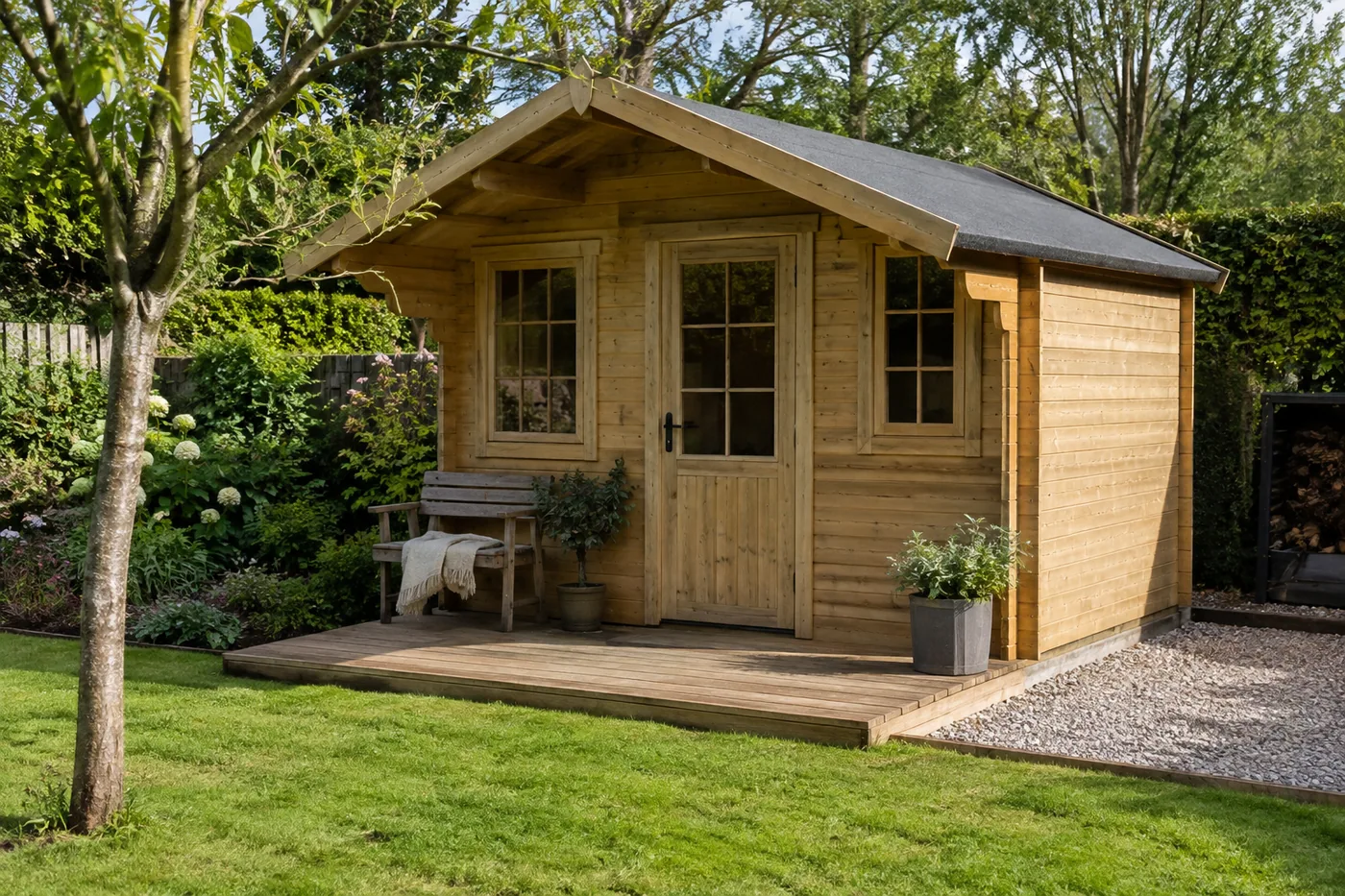
Assess log cabin roofing felt by identifying the existing roof system and documenting its condition before selecting a repair. Review the covering, edges, penetrations, drainage and substrate with a competent roofer. A patch or extra layer is not automatically compatible, and a dry-looking ceiling does not establish that the complete roof is sound.
Introduction: choose the repair after understanding the roof
A lifted edge, stain or worn-looking surface can lead a cabin owner to search immediately for a roll of roofing felt. The visible symptom is a reason to investigate, but it does not tell the owner whether the covering alone is responsible or what repair will be compatible with the existing assembly.
A useful condition review describes the roof and the problem before comparing quotations. It gives a roofer enough information to identify missing records, plan access and explain whether a limited repair or broader work should be considered. It also helps the owner distinguish an immediate concern from a purely cosmetic observation.
This article is a condition-documentation and procurement guide. It is not a roof-access instruction or a verified CabinWild repair case. Use a competent roofer and the actual covering manufacturer's instructions for assessment and work. No universal lifespan, patch product, installation method or guaranteed waterproofing result is offered.
1. Identify the existing covering and build-up
Look for the original roof schedule, product information, invoice and installation instructions. Ask the supplier which covering was actually supplied, including any substitution. The description felt can refer to different systems, and a photograph may not establish the relevant product or installation arrangement.
Record the roof form, known substrate, insulation arrangement and relevant accessories from available documents. Mark unknown details rather than guessing. The roofer can decide what further assessment is needed. A useful starting pack tells the contractor which information is verified and which comes from an owner's preliminary observation.
For a repeated cabin site, identify the specific unit and roof version. Two buildings with similar finishes may have been installed at different times or repaired with different products. Keep each configuration traceable so a successful method on one roof is not automatically copied to another without review.
Further reading: Scope a cabin reroofing project.
2. Record symptoms from safe, accessible positions
Use ground-level observations and accessible interior views to describe the concern. Note where stains, drips, displaced edges or visible damage appear and when they were noticed. Ask the professional to arrange any necessary roof inspection. Do not climb onto the covering or disturb materials simply to complete a buyer's photograph checklist.
Separate current observations from historic marks. A dry stain may relate to an earlier event, while a newly observed mark may need prompt assessment. Record the date and relevant weather context without diagnosing the cause. Give the roofer a concise chronology rather than an unsupported statement that the whole roof has failed.
Include recent work near the roof, such as a changed gutter, added service penetration or external fitting. Those facts help frame the inspection but do not prove responsibility. Preserve before-and-after information where available, and ask the contractor what additional evidence would be useful before an alteration conceals the condition.
3. Ask the roofer to inspect the complete water path
A roof condition review should consider the covering and relevant edges, laps, drainage points and penetrations within its agreed scope. Water observed inside may not enter directly above the visible mark. The competent roofer should determine the appropriate investigation method rather than relying on an owner's isolated close-up.
Ask how the substrate and adjoining details affect the proposal. A new surface covering cannot be assessed independently if the support or water-management arrangement is uncertain. Where further opening-up is proposed, agree the purpose, extent, temporary protection and process for recording what is found.
Log cabin roofing ideas from social media can be useful visual references but should not replace the actual roof information. A decorative change, added trim or different covering may alter several interfaces. Have the responsible providers explain the complete arrangement before treating the change as a simple like-for-like repair.
| Observed concern | Question for the professional | Useful owner record |
|---|---|---|
| Interior stain or drip | Where is the relevant water path? | Location, timing and conditions |
| Displaced edge or surface damage | What has changed and what lies beneath? | Safe context photographs and roof identity |
| Problem near a penetration | How is that interface constructed? | Service and roof-detail records |
| Repeated repair history | Are products and methods compatible? | Prior invoices, instructions and work locations |
| Broad deterioration concern | What scope of assessment is needed? | Unit age records without a guessed remaining lifespan |
4. Use manufacturer guidance for the actual system
IKO's DIY support material provides manufacturer guidance for its relevant roofing products and applications. Use such information to identify the applicable instructions and system boundaries. It does not establish that an unidentified existing roof can accept any felt patch or that a generic repair will provide a particular service life.
Ask the roofer to identify the proposed repair products and explain their relationship to the existing system. Relevant questions may include substrate condition, preparation, adjoining materials and the product instructions. The owner needs an understandable scope and product identity, not an improvised mixture chosen from several unrelated tutorials.
If the existing covering cannot be identified, record that limitation and ask how it affects the available options. A competent contractor may need further assessment or a different scope. Uncertainty should be visible in the quotation so the buyer can compare assumptions rather than treating every price as a proposal for identical work.
Further reading: IKO: manufacturer roofing support and application guidance.
5. Compare repair and replacement on the same basis
Ask each contractor to state the diagnosed or assumed cause, affected area, proposed method and included interfaces. Separate investigation from the permanent work if the cause remains uncertain. This makes it easier to see whether a lower quote excludes substrate repairs, accessories, disposal or necessary follow-up.
When reviewing log cabin roofing options, compare the complete build-up and local requirements rather than the roll price alone. A replacement covering may involve a different substrate, load, edge detail or installation method. Have the responsible design and roofing teams review the relevant changes before approving them.
State any operating constraints, such as bookings, adjacent occupied cabins or restricted delivery access. The contractor should explain a feasible work sequence and necessary conditions. A buyer should not select a repair solely because it promises the shortest interruption without establishing what work and checks are actually included.
Further reading: Compare cabin roofing materials and interfaces.
Turn these questions into a project brief
Send the destination, proposed covering and required document scope. Ask CabinWild which roof build-up and product information can be provided for your local design or maintenance review.
6. Agree how an unresolved roof is managed
If an active concern is reported, contact the appropriate professional and follow the site's established incident and property-management process. Ask what temporary measures and access controls are appropriate to the actual condition. This article does not provide a do-it-yourself emergency covering method or permission to work at height.
Document any temporary arrangement separately from the permanent repair. Record who authorized it, what limitations apply and when further review is due. Otherwise a short-term response can remain in place indefinitely while staff assume the roof has received a completed permanent repair.
Keep affected rooms and services under the direction of the relevant responsible parties. Water near electrical or other equipment needs the appropriate competent response. The owner's useful role is to provide accurate information, control access as instructed and preserve the evidence needed for assessment and the relevant contractual or insurance process.
7. Connect new cabin purchasing to future maintenance
For a new log cabin roofing package, request the exact product and build-up schedule before purchase. Ask for available instructions and clarify which accessories are supplied. A named covering with a defined installation scope is easier to maintain than an undefined standard felt roof whose identity is lost after delivery.
Factory testing or assembly records may document specified checks, but they should not be described as a lifetime roof guarantee. Ask what was observed, under which configuration and with what limits. The final site installation and interfaces need their own accepted completion process.
Shipment inspection should verify the identified materials and relevant accessories within the order scope. Check that instructions match the supplied products and record substitutions before use. Installation preparation should give the local roofer the accepted information, with a route for resolving missing details rather than improvising on site.
8. Record the completed work
Retain product and location information
Keep the contractor's agreed scope, products used, relevant instructions and work locations with the unit record. Where photographs are supplied, they should identify their context and the work they document. A photograph of a clean finished surface cannot describe concealed condition or every stage of the repair.
Ask for the agreed completion evidence
The responsible contractor should explain the checks and handover records appropriate to its work. Record remaining actions and relevant operating or maintenance limitations. If a performance claim or warranty is offered, obtain the actual written terms and scope rather than turning a casual statement into a universal waterproofing promise.
Preserve follow-up responsibilities
Agree how recurring symptoms are reported and what information the provider needs. Retain the chronology so a later concern can be compared with the original issue and work. Avoid adding another patch or coating before the responsible professional has considered whether it would conceal evidence or conflict with the accepted repair system.

9. Plan ordinary care without inventing a lifespan
Use the applicable provider instructions and professional advice to establish relevant inspection and maintenance tasks. The owner should know which observations can be made safely and which work requires specialist access. A maintenance plan should be practical for the operator rather than depend on untrained staff regularly walking on a roof.
Retain drainage and accessory information with the roof record. A later service addition or gutter change can affect the arrangement previously reviewed. Check proposed work against the current information and obtain the appropriate review before approving a modification that touches the covering or its interfaces.
Cabin roofing options should be evaluated for the actual use, exposure and ownership resources. Do not derive a guaranteed replacement date from a general product category. Condition evidence, identifiable materials and competent assessment provide a stronger basis for budgeting than a universal lifespan claim.
Compare roof quotations with an exception sheet
For each proposal, list the included investigation, covering work, relevant interfaces and exclusions. Ask the contractor to clarify any assumption about substrate condition or concealed areas. The sheet should expose why prices differ rather than encourage a buyer to choose a number before understanding the work.
Record how additional findings will be handled. The contractor should explain the decision and authorization process before expanding the scope, subject to necessary safety or protective action. That gives the owner a clearer commercial position while preserving the technical review needed when the visible roof differs from the initial assumption.
Keep work completion and any offered warranty terms as separate entries. A repaired area can have a defined completion record without establishing every future performance claim. Obtain the actual written terms and ask the appropriate adviser or provider to explain their scope. Do not turn a general reassurance into a universal guarantee for the whole building.
Hypothetical decision worksheet: Felt Roof Condition Worksheet
A hypothetical cabin owner finds an interior water mark and notices a lifted roof edge from the ground. The original invoice says roofing felt, but does not identify its product or installation method. The owner wants to choose between a patch, localized replacement and a new covering. The worksheet should organize safe observations and product identification before deciding what repair work to commission.
Compare a system-compatible local repair, replacement of the affected covering section and wider roof renewal after inspection. A local repair may be proportionate if the cause, substrate condition and compatibility are established. Section replacement can expose interfaces with existing material. Wider renewal may be appropriate when condition or design warrants it, but should not be justified by an invented service-life rule. An inspection is needed to distinguish these possibilities.
Gather the original covering information, installation and repair history, available roof drawings and photographs taken without unsafe access. Record the position of the internal mark relative to edges, penetrations and drainage routes. Ask the contractor to identify the covering and inspect relevant substrate conditions using an appropriate access plan. Request a written explanation of the proposed repair system and how its junctions with retained material will be handled.
The unresolved decision is whether the interior symptom is caused by the covering itself, an edge or penetration, drainage behavior, or another moisture source. The owner should seek an explanation of that uncertainty before comparing repair prices. If a contractor proposes replacement, ask which observations support the extent and what hidden conditions could change the scope. Keep covering work separate from unrelated insulation or structural changes unless those are needed.
Defer a patch purchase when product identity, adhesion conditions or wet substrate concerns remain unresolved. Reject a proposal that treats every mineral-surfaced roof as the same system or assumes a photograph proves the full roof condition. Release a repair after the problem, retained-material interfaces and inspection access are defined. Record what will be checked afterward and keep the maintenance information with the cabin documents.
Frequently asked questions
Can new felt be laid over any existing covering?
Compatibility and suitability depend on the identified system, condition, substrate and applicable product instructions. Have a competent roofer assess the actual roof and explain the proposed scope. A generic overlay tutorial cannot establish that a particular cabin roof is ready for another layer.
Does a ceiling stain prove the felt has failed?
It identifies a concern that needs assessment but does not independently establish the entry point or cause. Record the location, timing and relevant conditions, then ask the professional to investigate the water path and adjoining interfaces. Preserve observations without turning them into a guessed diagnosis.
What should a repair quotation include?
Ask for the assessed or assumed cause, work area, proposed system, relevant preparation, interfaces, exclusions and completion process. Clarify what happens if additional conditions are found. Compare quotations against the same scope and operating constraints rather than comparing only the covering or patch price.
How long should roofing felt last?
No universal service life applies to every product and installation. Identify the actual system and relevant instructions, review condition with a competent roofer and retain maintenance records. Any specific product or warranty claim should be checked against its written scope, conditions and applicability to the roof.
Conclusion: let condition and system identity guide the decision
Log cabin roofing felt repairs should begin with safe observations, an identified system and a competent assessment of the relevant interfaces. Compare complete scopes, preserve temporary and permanent work records and retain the product information for future care. That gives the owner a reviewable basis for repair and replacement decisions.
Clarify your cabin roof package
Send the destination, proposed covering and required document scope. Ask CabinWild which roof build-up and product information can be provided for your local design or maintenance review.
Prepared with AI assistance for CabinWild Editorial using the linked public sources. Examples are illustrative, not customer results or verified CabinWild test data. Project-specific design and local requirements need review by the appropriate professionals.