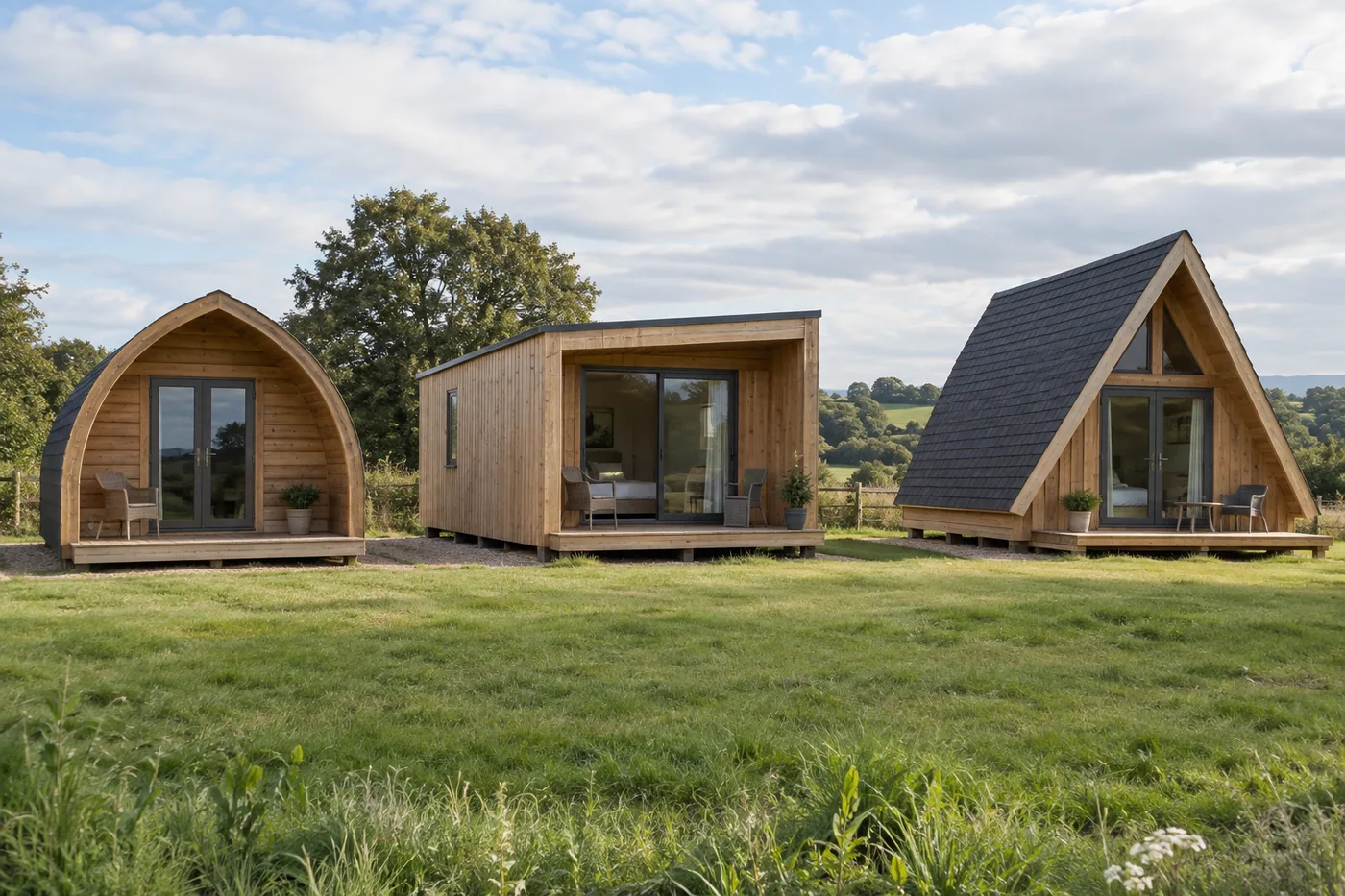
When selecting glamping cabin manufacturers, ask for information that can be traced from the standard model to the purchased configuration and then to the actual bookable room. Verify facilities, layouts and images before carrying supplier claims into UK guest listings. Site-dependent facts need site evidence. Keep AI illustrations, prototypes and actual accommodation photographs clearly distinguished; a disclosure does not make an inaccurate representation acceptable.
Introduction: the supplier's model is not yet your bookable room
An operator choosing among glamping cabin manufacturers needs more than a persuasive brochure. Once the cabins enter service, guests will make decisions from room descriptions, facility lists and photographs. The information used during procurement must therefore be checked before it becomes an offer for accommodation at a real site.
Three things need to remain distinct: the manufacturer's standard model, the configuration actually purchased and the room type the operator can legitimately offer. Optional equipment, a mirrored layout, site access and shared amenities can create differences between them. Copying the supplier's page without review can hide those differences from guests.
This article describes an information handover, not legal approval of advertising or a claim that CabinWild operates accommodation in the UK. The B2B supply contract and the operator's downstream consumer marketing are separate relationships. Operators should obtain appropriate UK advertising and legal advice for actual listings, alongside the professional review required for the accommodation itself.
Give the model, order and room type separate identities
Record the supplier's model reference and the options shown in its materials. Then identify the purchased configuration using the accepted order and current drawings. Finally, assign the operator's bookable room type to the installed units it actually represents. This mapping prevents a premium sample from becoming the description of every room by default.
Where several units differ, record the differences that matter to a guest decision. The bathroom, sleeping arrangement, kitchen equipment, access route or outdoor area may not be identical across a fleet. A single generic description should not silently promise features that only some units possess.
Keep naming consistent across operational systems. A procurement code may be unsuitable as a guest-facing name, but the internal mapping should remain available. If staff cannot connect a booking category to the installed configuration, they may be unable to answer a guest's practical question accurately even when the manufacturer supplied useful information.
Treat a prototype as a separate evidence category
A prototype can help explain a concept but may differ from the repeat-production order. Record what it represents and which features were changed. Do not use a prototype photograph as proof of the actual guest room merely because the roof shape and external cladding look similar.
Build a claim-to-evidence register before drafting the listing
List the factual statements the operator proposes to make and connect each to its evidence. A room description can include many separate claims: private facilities, equipment, dimensions, sleeping arrangements and access features, for example. Each should have a defined scope and a reviewer rather than relying on one broad supplier assurance.
Keep the wording proportionate to the evidence. A drawing may show a planned feature, an order may confirm what is contracted and a site record may confirm what was installed. Those are different stages. The final listing should not describe a planned or ordered feature as operational before the necessary checks have occurred.
| Proposed claim | Configuration and evidence | Site verification | Status and owner |
|---|---|---|---|
| Private bathroom | Purchased fit-out and unit mapping | Installed facility and operating arrangement | Assigned reviewer; draft or verified |
| Kitchen equipment | Actual equipment schedule | Presence and relevant readiness checks | Operator-approved wording |
| Sleeping arrangement | Furnished layout for the room type | Actual arrangement and relevant approvals | No occupancy inference from image alone |
| Room dimensions | Defined measurement basis | Match to the offered room type | Source and date retained |
| Access feature | Relevant design and facility information | Complete route assessment where required | Professionally reviewed claim |
| Photograph represents room | Image origin and configuration | Match to current offer and permissions | Approved, limited-use or withdrawn |
Ask suppliers for usable data rather than promotional adjectives
Request available drawings, equipment schedules and clear descriptions of included and optional items. Ask the supplier to identify the configuration and revision behind each document. A measured or specified fact is more useful to an operator than a vague adjective such as spacious or luxurious, although even a numerical statement needs a clear definition.
Where area is reported, ask what is measured. External footprint, internal floor area and another defined measure should not be mixed in guest information. Similarly, the number of illustrated beds does not establish an approved occupancy. Relevant local professionals and authorities must address the actual accommodation use.
For enquiries using phrases such as camping pod manufacturers UK, clarify whether the buyer needs a UK-based supplier, a package for a UK site or information suitable for UK review. Those are different needs. This article does not claim that CabinWild manufactures in the UK or provides unverified local services.
Further reading: Compare suppliers using a common request for quotation.
Keep site-owned facts out of the manufacturer's evidence column
A cabin manufacturer may be able to describe supplied walls, windows or fit-out. It cannot automatically verify the site's views, parking, distance to shared facilities, internet service or guest route. Assign those claims to the operator or other party with direct evidence of the actual site.
The same principle applies to relative descriptions. A supplier photograph showing generous spacing between demonstration units does not establish privacy at a different installation. A cabin's opening window does not prove a particular view will be available. Avoid carrying a setting from promotional imagery into the guest offer without site verification.
For accessibility-related information, obtain the appropriate professional assessment of the relevant room and complete route. A wide-looking door or an uncluttered AI image is not evidence. The operator should communicate verified features accurately and avoid broad claims that exceed the review's scope.
Further reading: Review bathroom accessibility through the actual layout.
Turn these questions into a project brief
Send the intended room types and facilities. Ask for available drawings, equipment information and image provenance for your own listing review.
Record image provenance and what each image represents
Classify each proposed image as an actual offered unit, a verified representative room type, a prototype, a rendering or an AI illustration. Record the creator or supplier, permission to use it and any relevant conditions. Having a copy of an image does not automatically establish publication rights or factual suitability for a booking page.
The ASA's travel-marketing guidance emphasizes accurate accommodation descriptions and representative imagery in its UK advertising context. It is a relevant source for the operator's review, not a building approval document. An image can be visually attractive yet unsuitable if it materially misrepresents the accommodation or amenities being offered.
Do not assume that labelling a picture illustrative makes every mismatch acceptable. The overall impression still matters and should receive appropriate review. Keep editorial AI concepts separate from evidence of real facilities. The AI images accompanying this article illustrate procurement issues only; they are not photographs of a factory, guest room or customer installation.
Further reading: ASA/CAP: travel marketing guidance.

Use evidence to limit claims, not to decorate them
The CMA's current unfair-commercial-practices guidance addresses UK consumer-facing conduct, including misleading presentation and the need for evidence behind factual claims. The relevant application here is the operator's marketing to guests. Do not assume that the same consumer framework automatically determines every term of an international B2B cabin supply contract.
A practical review asks whether a reasonable guest would understand the statement in the way the evidence supports. For example, a listing should not blur private in-room facilities with a separate shared building. The correct wording depends on the actual offer and appropriate advice; the register helps reviewers see the facts instead of relying on marketing shorthand.
Keep unsupported superlatives out of the draft. Claims about being the best, safest or most sustainable introduce evidence burdens that a standard model brochure is unlikely to resolve. Describe verified features and their limits. Where the operator wants a broader claim, identify the additional review needed rather than asking the writer to make it sound convincing.
Further reading: CMA: unfair commercial practices guidance.
Make information readiness part of operational handover
The supplier's information packet can be requested during procurement, but final guest-facing verification often depends on the completed site. Plan who checks the installed equipment, room mapping and actual photographs before publication. Keep listing readiness separate from manufacturing completion, shipment or arrival at the site.
Factory testing and shipment inspection can support specific claims within their genuine documented scope. They do not prove that site services work, that an operator has obtained necessary permissions or that every room matches a published photograph. Installation preparation should identify which checks and records must follow local completion.
Use a release list for the proposed claims. Each item should be verified, qualified appropriately, withheld or returned for investigation. Do not allow a deadline for accepting bookings to erase unresolved evidence. The operator's responsible decision makers should determine when the accommodation and its marketing are ready, using the required professional input.
- Map manufacturer model, purchased configuration and room type.
- List proposed factual claims and their evidence owners.
- Separate supplied features from site-dependent facts.
- Confirm image provenance, permissions and representation.
- Review the completed offer before publishing.
- Retain a change and withdrawal route for outdated claims.
Hypothetical example: the brochure kitchen is not the ordered kitchenette
Imagine a hypothetical operator comparing glamping cabins for sale UK and selecting a model shown with a full cooking arrangement. The accepted order instead includes a smaller kitchenette. The supplier's photograph remains useful for discussing the cabin shape, but it is not evidence that the purchased room contains all the pictured equipment.
The claim register identifies the actual equipment schedule and the operator's intended guest offer. The listing draft withholds unsupported cooking claims and requests suitable images of the installed room. If an illustration is used during development, its status and limitations receive appropriate review rather than being hidden in a footnote after the room is promoted.
No actual customer project is described here. The example demonstrates a procurement-to-operations handover problem: the correct order can still produce misleading marketing if the evidence mapping is absent. A supplier-information request early in the purchase makes later verification easier, but does not replace the operator's final responsibility for its offer.
Maintain the register after the first listing goes live
Facilities and layouts can change during operation. A replacement appliance, removed feature or altered room allocation may make old wording inaccurate. Assign an owner to review affected channels when the underlying facts change. The website, booking platform, downloadable brochure and staff reference information should not drift into contradictory descriptions.
Keep withdrawn images and wording out of the active publishing folder while preserving the history needed for records. Do not overwrite the only evidence of what a previous room type contained. A simple version history can connect the current claim to the current configuration and explain why an older image is no longer used.
Operators researching glamping huts for sale UK or glamping pod manufacturers should include this continuing information support in their supplier discussion. Ask how updated product documents and relevant changes are communicated, without assuming the manufacturer manages the operator's listings. The two responsibilities should remain explicit and proportionate to the contract.
Give staff an answer route for uncertain guest questions
When a guest asks about a feature not covered by approved information, staff should know whom to consult. Do not encourage them to infer dimensions, accessibility or equipment performance from an image. Add verified answers to the register so useful knowledge becomes controlled information rather than a repeated informal guess.
Create a compact review packet that people can actually use
For each room type, gather the approved description, included-facility list, current images and the evidence references behind them. Keep the packet short enough for the operator's reviewer to understand, while linking to the detailed documents when necessary. A large catalogue archive without a configuration map makes review slower without improving accuracy.
Ask the reviewer to identify the intended audience and channels. A technical drawing useful to the operator is not automatically a guest-facing illustration, and an internal planning image may be unsuitable for public advertising. Record the approved use so a later publisher does not assume that everything in the shared folder is ready for promotion.
Finally, keep a list of facts deliberately withheld because they remain unverified. That list is valuable: it prevents another writer from filling the same gap with an assumption. Once reliable evidence becomes available, the responsible reviewer can update the wording and release it through the same process rather than restarting the investigation.
Frequently asked questions
Can I use a manufacturer's cabin photographs on a booking page?
Confirm both permission and whether the image accurately represents the actual offer. Identify the pictured configuration and any differences from the bookable room. A right to use the image does not establish factual suitability. Obtain appropriate advertising review for the overall presentation.
Which details should glamping pod manufacturers provide?
Request available configuration-specific drawings, included equipment information, option distinctions and image provenance. Ask which documents match the actual order and what remains preliminary. The operator must separately verify site-owned facts and the completed room before making guest-facing claims.
Does an illustrated sleeping layout prove approved occupancy?
No. A layout or bed count is not a substitute for the appropriate local review of the actual accommodation. Obtain required professional and authority input, then communicate only the arrangement and occupancy supported by the relevant evidence.
Are AI images acceptable evidence of the offered cabin?
They are not evidence that a real unit or facility exists. Illustrations should be clearly identified and reviewed so the overall presentation is not misleading. A disclosure does not automatically make an inaccurate depiction suitable for selling accommodation.
Who updates the listing when equipment changes?
The operator should assign a responsible owner and a review process covering all active channels. The supplier can provide relevant product information within its scope, but should not be assumed to manage the operator's guest offer. Keep current claims linked to the current room configuration.
Conclusion: purchase information that can survive a guest-facing review
Good supplier information connects a standard model to the purchased configuration without pretending to verify the entire accommodation site. Build a claim-to-evidence register, separate image types and check the completed room before using its features in a guest offer. Maintain that record as the operation changes.
Send CabinWild your proposed room types and information requirements to request available configuration-specific material. Use it as one input to your own site verification and appropriate UK listing review, not as automatic authorization to repeat every brochure claim.
Request a configuration-specific information pack
Send the intended room types and facilities. Ask for available drawings, equipment information and image provenance for your own listing review.
Prepared with AI assistance for CabinWild Editorial using the linked public sources. Examples are illustrative, not customer results or verified CabinWild test data. Project-specific design and local requirements need review by the appropriate professionals.